
What this converter does
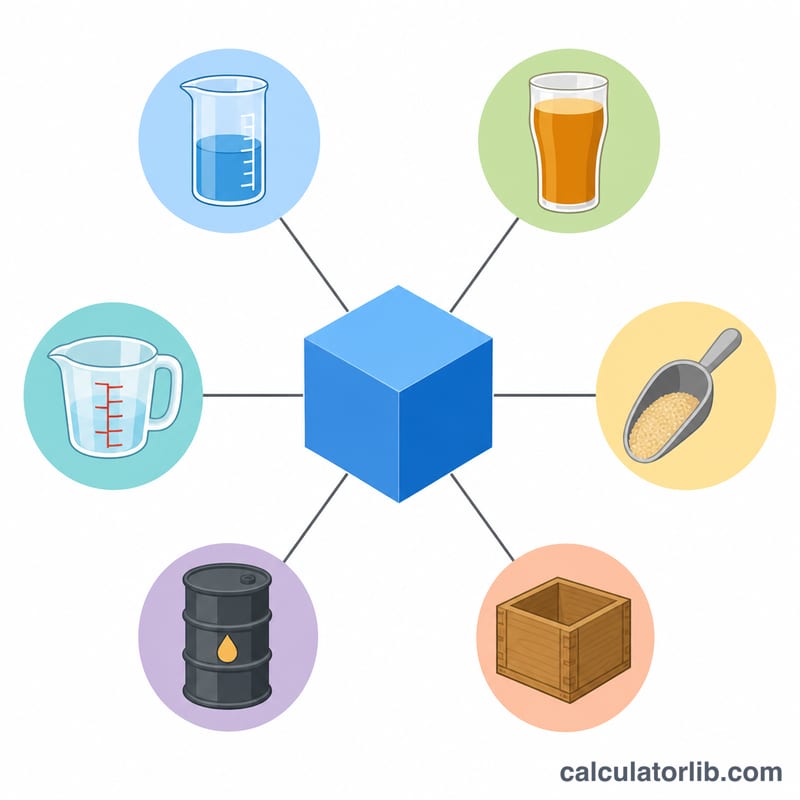
This calculator converts a single volume or capacity value into every supported volume unit at the same time. It covers the metric system (milliliter through cubic meter), the yard-pound system (cubic inch, cubic foot, acre-foot), imperial UK liquid measure, US liquid measure, US dry measure, the petroleum barrel, and traditional Japanese units (shaku, go, sho, to, koku). The conversion factors are exact physical definitions, so results stay accurate even at high significant-figure settings.
How to use it
Enter a numeric value, choose the unit it is expressed in, and pick how many significant figures you want displayed (default 14). The table then lists the equivalent value in every unit, grouped by measurement system. The hero box shows the value normalized to liters, the common base used internally.
The formula explained
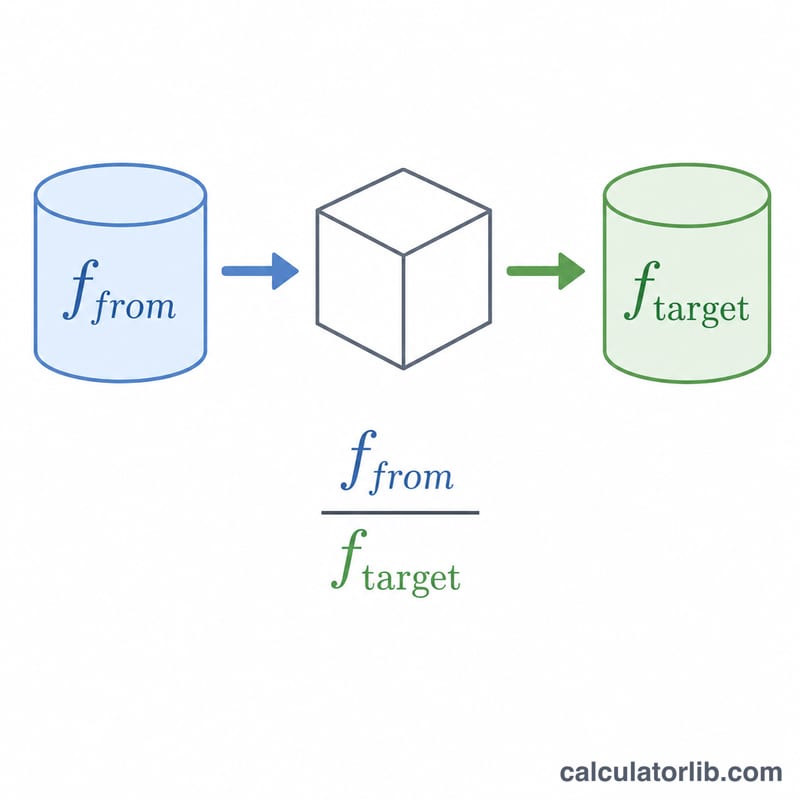
Every unit has a fixed factor equal to liters per one unit. First the input is normalized to liters by multiplying by the from-unit factor: $$\text{L} = \text{value} \times f_{\text{from}}$$ Then each target value is found by dividing those liters by the target factor: $$x = \text{L} / f_{\text{target}}$$ Combined, the conversion is simply \(\text{value} \times (f_{\text{from}} / f_{\text{target}})\), a single linear scaling.
Worked example
Convert 1 liter. Normalizing gives \(\text{L} = 1\). Dividing by each factor: $$\text{milliliter} = 1 / 0.001 = 1000 \text{ ml}$$ $$\text{cubic inch} = 1 / 0.016387064 = 61.0237 \text{ cu in}$$ $$\text{UK gallon} = 1 / 4.54609 = 0.219969 \text{ gal}$$ $$\text{US liquid gallon} = 1 / 3.785411784 = 0.264172 \text{ gal}$$ $$\text{oil barrel} = 1 / 158.987294928 = 0.00628981 \text{ bbl}$$ The two gallons differ because the UK and US gallons are defined by different exact factors.
FAQ
Why are there three different barrels? The UK barrel (36 imperial gallons), the US liquid barrel (31.5 US gallons), and the petroleum barrel (42 US gallons) are distinct definitions, so they are listed separately.
Are the Japanese units exact? Yes. They are exact rational multiples of the sho, defined as \(2401/1331\) liter, so shaku, go, to and koku all follow exactly.
Can I enter zero or negative values? Yes. Conversion is linear, so zero maps to all zeros and negatives scale through, though a negative volume is not physically meaningful.