
What this calculator does
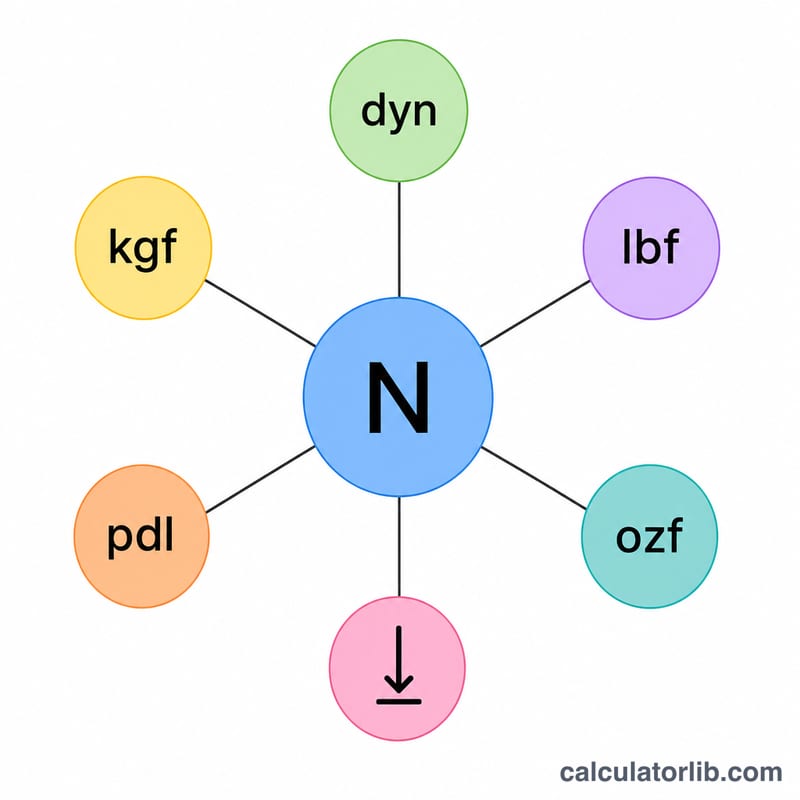
This is a universal physics tool that converts a single force value into all six common force units at once: dyne (dyn), newton (N), kilogram-force (kgf), pound-force (lbf), ton-force (tnf) and poundal (pdl). It works the same everywhere because it relies on fixed, internationally defined constants rather than any country-specific rule. Note that the "ton-force" here is the US/short ton-force equal to 2000 pound-force, not the metric tonne-force or the long ton.
How to use it
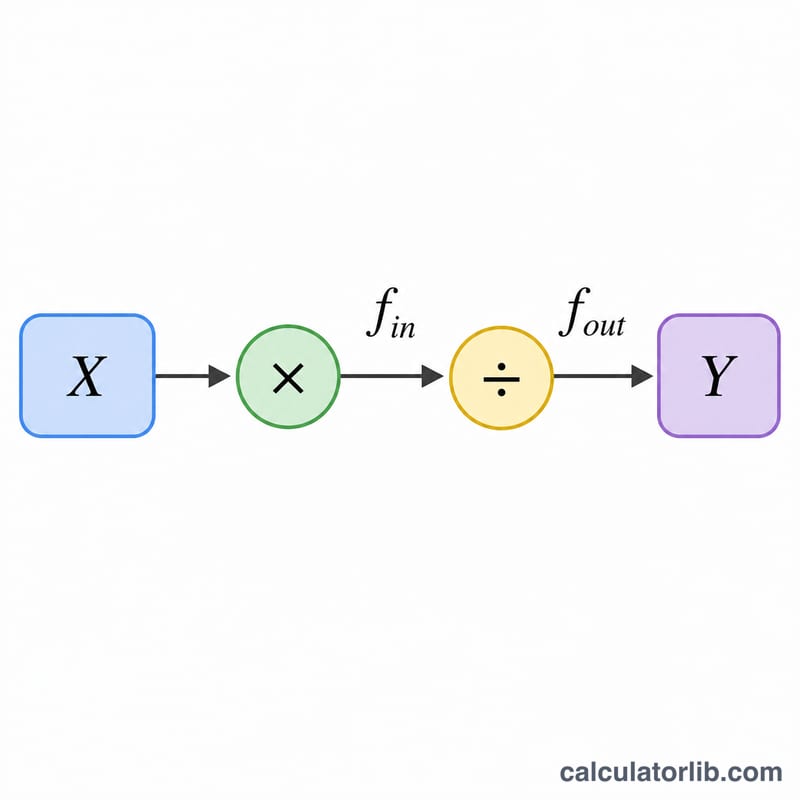
Enter your force in the Force field and pick the unit it is expressed in from the Input unit dropdown. The calculator first normalizes your value to newtons, then divides by each target unit's factor to fill in the full conversion table. Any real number works, including negatives (a force can be signed by direction) and zero.
The formula explained
Force conversion is purely linear. Each unit has an exact factor giving how many newtons one of that unit equals: \(1\,\text{dyn} = 10^{-5}\,\text{N}\), \(1\,\text{N} = 1\,\text{N}\), \(1\,\text{kgf} = 9.80665\,\text{N}\) (standard gravity), \(1\,\text{lbf} = 4.4482216152605\,\text{N}\), \(1\,\text{tnf} = 8896.4432305210\,\text{N}\) (2000 lbf), \(1\,\text{pdl} = 0.138254954376\,\text{N}\). We compute $$F_{\text{N}} = \text{value} \times \text{factor(input)}$$ then each $$\text{output} = \frac{F_{\text{N}}}{\text{factor(output)}}$$
Worked example
Enter 1 and select Newton. \(F_{\text{N}} = 1\,\text{N}\). Then $$\text{dyne} = \frac{1}{10^{-5}} = 100000\,\text{dyn}$$ $$\text{kilogram-force} = \frac{1}{9.80665} = 0.10197162129779\,\text{kgf}$$ $$\text{pound-force} = \frac{1}{4.4482216152605} = 0.22480894309971\,\text{lbf}$$ \(\text{ton-force} = 1.1240447 \times 10^{-4}\,\text{tnf}\), and $$\text{poundal} = \frac{1}{0.138254954376} = 7.2330138512099\,\text{pdl}$$
FAQ
Is kgf the same as kg? No. A kilogram (kg) is mass; a kilogram-force (kgf) is the weight of one kilogram under standard gravity (\(9.80665\,\text{m/s}^2\)), i.e. about \(9.80665\,\text{N}\).
Which ton does ton-force use? The US/short ton-force = 2000 lbf. It is not the metric tonne-force (1000 kgf) nor the long ton (2240 lbf).
Why might my result differ slightly? kgf and lbf depend on the assumed gravity. This tool always uses standard gravity \(9.80665\,\text{m/s}^2\); using local g would shift weight-based units slightly.