
What this calculator does
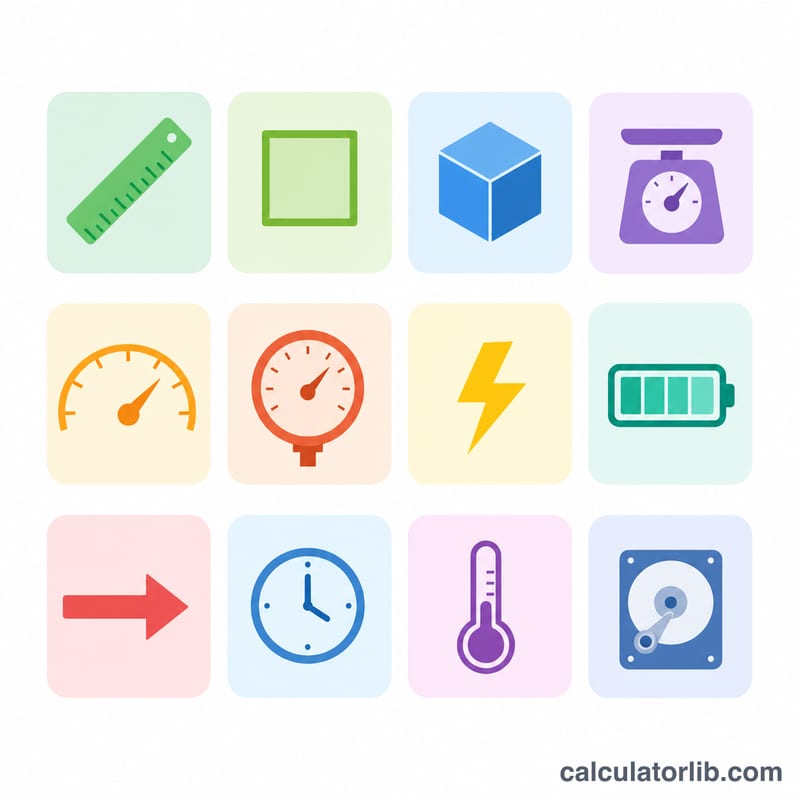
The Universal Unit Conversion Calculator converts a single numeric value from one unit to another within a chosen physical quantity category. It covers twelve categories: length, area, volume, weight/mass, speed, pressure, energy, power, force, time, temperature, and digital storage. Each category has its own family of units, and conversions are only valid within the same category — you cannot convert meters into kilograms.
How to use it
Enter the value you want to convert, choose the category, then type the unit code you are converting from and the code you are converting to. The codes are listed under the form (for example, mi for mile, km for kilometer, lb for pound, kg for kilogram). Press calculate and you get the converted value plus a readable echo line such as “5 mi = 8.04672 km”.
The formula explained
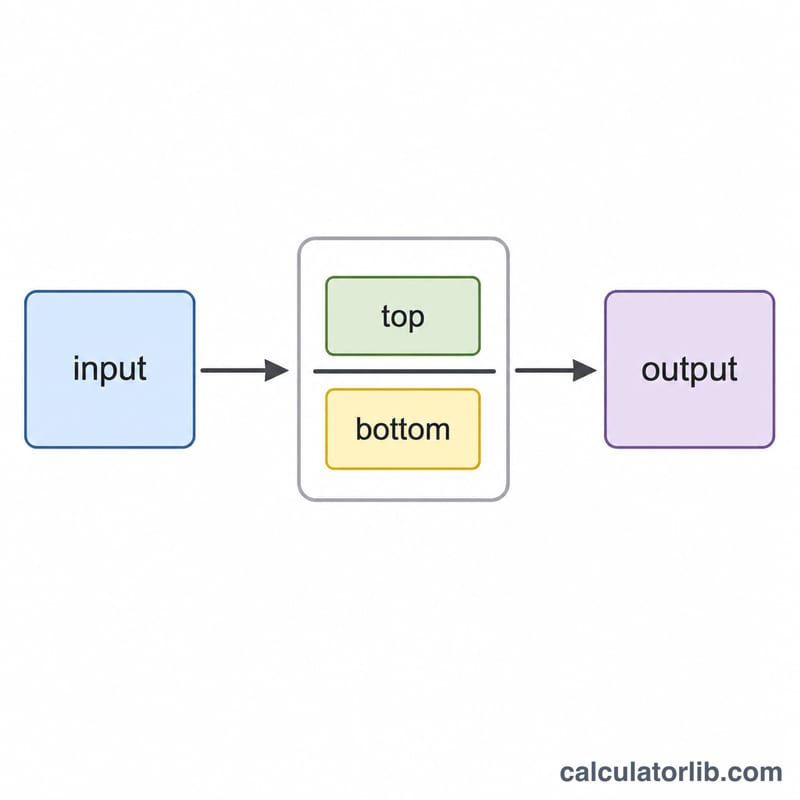
For every multiplicative (linear) quantity, each unit is defined by a single scale factor: how many SI base units make up one of that unit. Conversion is a two-step process — convert the input into the base unit, then convert the base value into the target unit:
\( \text{valueInBase} = \text{input} \times \text{fromFactor} \), then \( \text{output} = \text{valueInBase} \div \text{toFactor} \), which simplifies to $$\text{output} = \text{input} \times \dfrac{\text{fromFactor}}{\text{toFactor}}$$ Temperature is the one exception: because Celsius, Fahrenheit, Kelvin and Rankine have different zero points, the tool converts to Kelvin first and then to the target scale (an affine transformation, not a single multiplier).
Worked example
Convert 5 miles to kilometers. One mile is 1609.344 m, so \( \text{valueInBase} = 5 \times 1609.344 = 8046.72 \text{ m} \). One kilometer is 1000 m, so $$\text{output} = 8046.72 \div 1000 = \mathbf{8.04672 \text{ km}}$$ For temperature: 100 °C to °F gives $$100 \times \tfrac{9}{5} + 32 = \mathbf{212\ \degree\text{F}}$$
FAQ
Why are decimal and binary data units different? Decimal storage units (KB, MB, GB) use powers of 1000, while binary units (KiB, MiB, GiB) use powers of 1024. A "gigabyte" GB equals 1,000,000,000 bytes, whereas a gibibyte GiB equals 1,073,741,824 bytes.
Are the gallons US or imperial? The default volume units are US customary. Use impgal for the imperial gallon (4.54609 L), which is larger than the US gallon (3.785 L).
Why can a temperature result be flagged invalid? Kelvin and Rankine are absolute scales with a true zero. If a conversion produces a temperature below absolute zero, the tool warns you because that value is physically impossible.