
What is the 0-60 mph Calculator?
The 0-60 mph calculator estimates how long a vehicle takes to accelerate from a standstill to 60 miles per hour. Rather than requiring a test track, it uses a simple physics model based on the car's engine power, mass, and drivetrain efficiency. This makes it a great tool for comparing cars, planning modifications, or simply understanding the relationship between power and performance.
How to use it
Enter the engine power in horsepower, the vehicle weight in kilograms (including driver and fuel for best accuracy), and the drivetrain efficiency as a percentage. A typical front- or rear-wheel-drive car loses roughly 15-25% of crankshaft power through the transmission, so 75-85% is a reasonable efficiency value. Press calculate to see the estimated 0-60 time and the average acceleration.
The formula explained
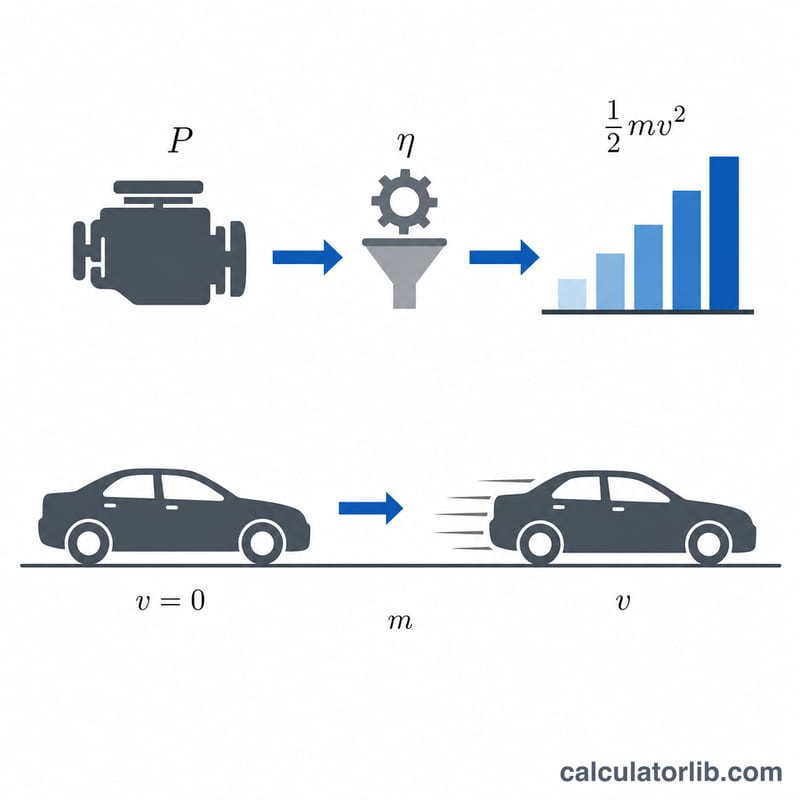
The calculator uses the work-energy principle. The kinetic energy needed to reach 60 mph is \(KE = \tfrac{1}{2} m v^2\), where \(v = 60\ \text{mph} = 26.8224\ \text{m/s}\). Engine power in horsepower is converted to watts (\(1\ \text{hp} = 745.7\ \text{W}\)) and multiplied by the efficiency factor to get usable power at the wheels. Since power is energy per unit time, the time to accumulate that energy is
$$t = \frac{KE}{P}$$Average acceleration is then simply
$$a = \frac{v}{t}$$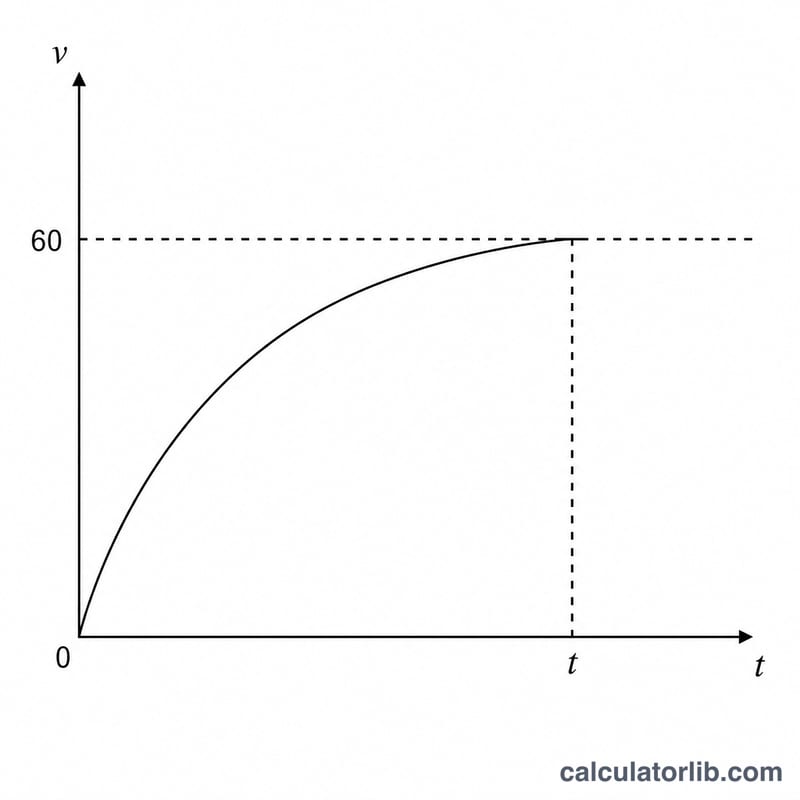
Worked example
A 200 hp car weighing 1500 kg with 75% efficiency: usable power = \(200 \times 745.7 \times 0.75 = 111{,}855\ \text{W}\). Kinetic energy = \(0.5 \times 1500 \times 26.8224^2 \approx 539{,}581\ \text{J}\). Time = \(539{,}581 / 111{,}855 \approx 4.82\) seconds. Average acceleration \(\approx 26.8224 / 4.82 \approx 5.56\ \text{m/s}^2\).
Constants & Reference Values
The 0-60 mph calculator works in SI units internally, so several fixed conversion constants are applied to your inputs before the energy-based time estimate is computed. The model equates the engine's usable power output to the rate at which kinetic energy is delivered to the car.
| Constant | Value | Role in the formula |
|---|---|---|
| Target speed (60 mph) | 26.8224 m/s | The final velocity \(v\) used in the kinetic energy term \(\tfrac{1}{2}mv^2\). |
| Speed conversion | 1 mph = 0.44704 m/s | Converts the 60 mph target to m/s: \(60 \times 0.44704 = 26.8224\) m/s. |
| Horsepower to watts | 1 hp = 745.7 W | Converts the power input to watts so \(P\) is in SI units. |
| Kilowatt to horsepower | 1 kW = 1.341 hp | Reference for converting metric power ratings into the hp input. |
| Weight basis | 1 kg | The weight input is the vehicle mass \(m\) in kilograms used directly in \(\tfrac{1}{2}mv^2\). |
The efficiency input (a percentage) scales crankshaft power down to the power actually reaching the wheels: \(P = \text{hp} \times 745.7 \times \tfrac{\text{efficiency}}{100}\).
Key Terms Explained
- Engine (crankshaft) power
- The power produced at the engine's output shaft before transmission losses, normally quoted in horsepower (hp). This is the power input to the calculator.
- Drivetrain efficiency
- The fraction of crankshaft power that actually reaches the driven wheels after losses in the transmission, differential and driveline. Typical values are about 85% for front-wheel drive, 80-88% for rear-wheel drive, and slightly lower for all-wheel drive. Entered as the efficiency percentage.
- Wheel power
- The usable power at the wheels, equal to crankshaft power multiplied by drivetrain efficiency. This is the \(P\) used in the time formula.
- Kinetic energy
- The energy of motion, \(KE = \tfrac{1}{2}mv^2\). Reaching 60 mph requires the drivetrain to deliver this much energy to the vehicle's mass.
- Average acceleration
- The mean rate of velocity change over the run, \(a = v/t\). For a 0-60 time \(t\) it equals \(26.8224/t\) in m/s². It does not capture the higher peak acceleration at launch.
- 0-60 mph time
- The elapsed time to accelerate from a standstill to 60 mph (26.8224 m/s), a common benchmark of straight-line performance. This model estimates it from the energy needed and the power available.
FAQ
Why is the real-world time different? This model assumes constant average power and ignores tire grip, aerodynamic drag, and gear shifts, so it tends to be optimistic for low-traction or high-drag conditions.
What efficiency should I use? Around 80% for manual rear-wheel drive, 75% for automatics, and lower for AWD systems.
Can I use metric power (kW)? Convert kW to hp first by multiplying by 1.341, then enter that value.