
What is centripetal acceleration?
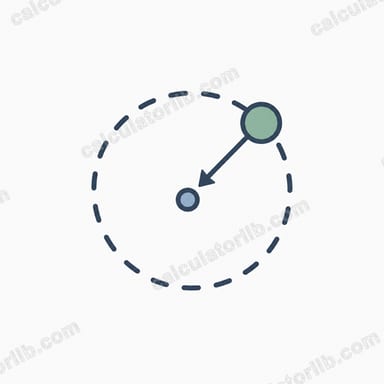
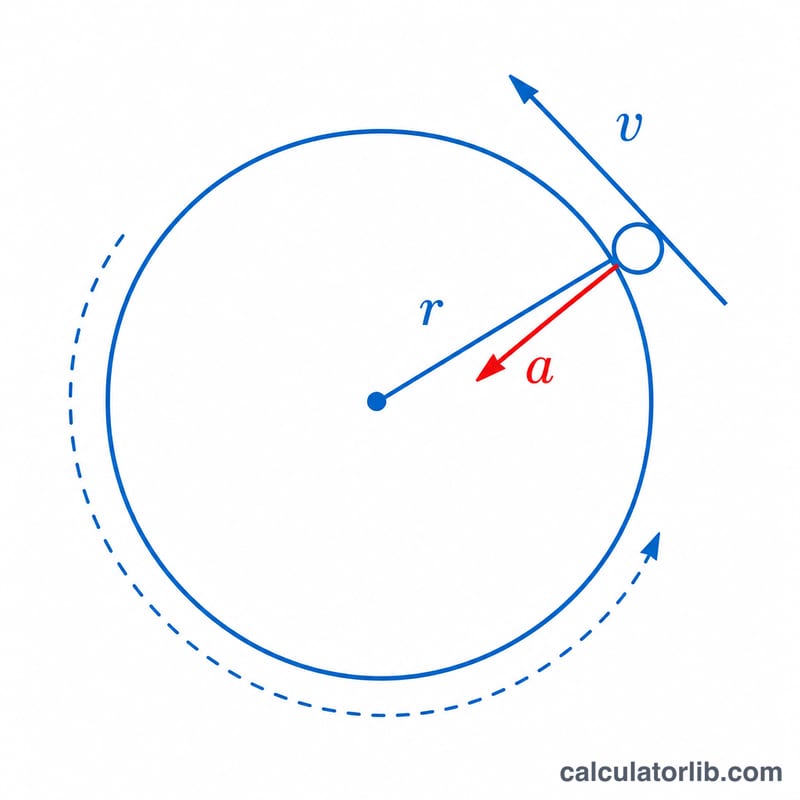
Any object moving along a circular path is constantly changing direction, which means it is accelerating even at constant speed. This acceleration always points toward the center of the circle and is called centripetal acceleration. Its magnitude depends on how fast the object travels (tangential velocity \(v\)) and how tight the curve is (radius \(r\)).
How to use this calculator
Enter the tangential velocity in metres per second and the radius of the circular path in metres. The calculator instantly returns the centripetal acceleration in m/s² and the angular velocity \(\omega\) in rad/s. This works for any uniform circular motion problem — satellites, car turns, spinning wheels or particles on a circle.
The formula explained
The two key relationships are:
$$a = \frac{v^{2}}{r}$$ — centripetal acceleration equals the square of the speed divided by the radius. Equivalently, \(a = \omega^{2} \cdot r\).
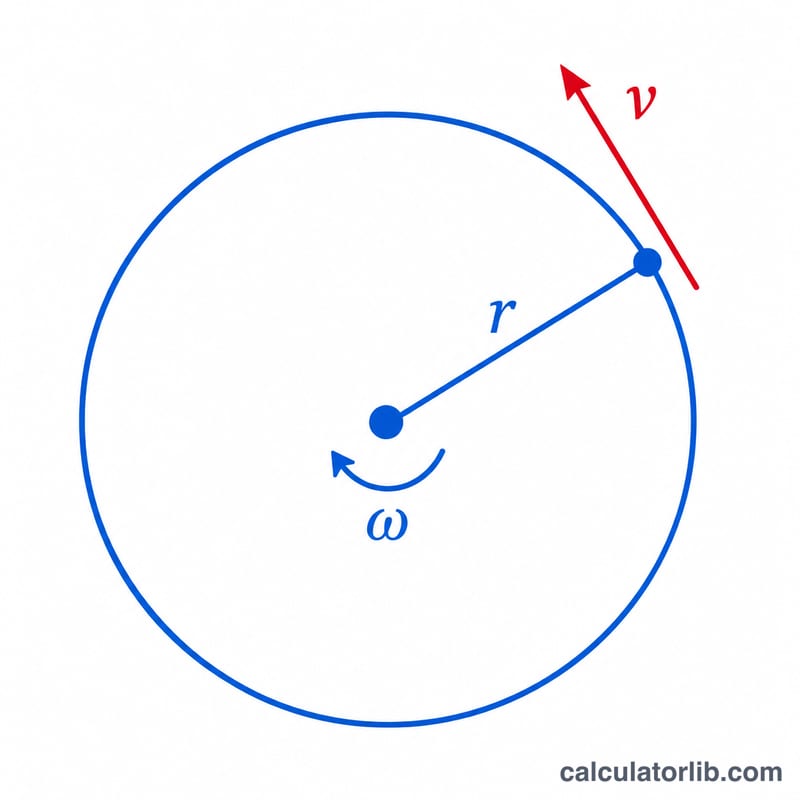
$$\omega = \frac{v}{r}$$ — angular velocity equals the tangential speed divided by the radius.
A larger speed or a smaller radius both increase the inward acceleration the object experiences.
Worked example
Suppose an object moves at \(v = 10\ \text{m/s}\) on a circle of radius \(r = 5\ \text{m}\). Then $$a = \frac{10^{2}}{5} = \frac{100}{5} = 20\ \text{m/s}^2,$$ and $$\omega = \frac{10}{5} = 2\ \text{rad/s}.$$ The object accelerates 20 m/s² toward the center while rotating at 2 radians per second.
FAQ
Does centripetal acceleration mean the object speeds up? No. In uniform circular motion the speed is constant; the acceleration only changes the direction of motion.
What provides centripetal force? A real force such as tension, gravity, friction or a normal force supplies the inward force \(F = m \cdot a\) needed to keep the object on its circular path.
Can I use any units? The formula is unit-consistent. Using m/s and m gives acceleration in m/s² and \(\omega\) in rad/s.