
What this calculator does (United States)
This tool applies the US Social Security retirement earnings test. If you claim Social Security before your full retirement age (FRA) and keep working, the Social Security Administration may temporarily withhold part of your benefit when your earnings exceed an annual limit. This calculator estimates how much is withheld for the year. Choose a tax year (2025, 2026, or 2027) and the tool uses the official SSA exempt amount for that year: under full retirement age all year, $23,400 (2025), $24,480 (2026), or $25,560 (2027); in the year you reach full retirement age, $62,160 (2025), $65,160 (2026), or $67,920 (2027). Leave the limit blank to use that amount, or type another limit to override it.
How to use it
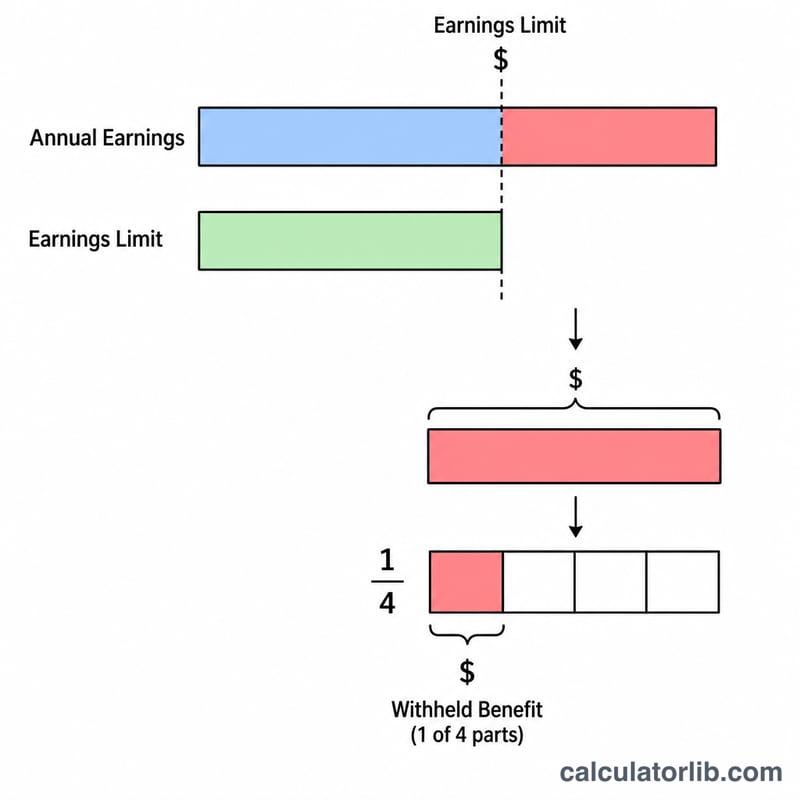
Choose which rule applies. If you are under full retirement age for the entire year, $1 is withheld for every $2 you earn above the lower limit (divisor = 2). In the year you reach full retirement age, a higher limit applies and only $1 is withheld for every $3 above it (divisor = 3), counting earnings only in the months before the month you reach FRA. Enter your expected annual earnings and the applicable limit, then read the estimated amount withheld.
The formula explained
The calculation is simple: take the amount your earnings exceed the limit, never less than zero, and divide by the divisor.
$$\text{Reduction} = \frac{\max\left(0,\ \text{Earnings} - \text{Limit}\right)}{d}$$
Only earned income (wages and net self-employment) counts — pensions, investment income, and IRA distributions do not.
Worked example
Suppose you are under FRA all year, expect to earn $30,000, and the limit is $24,480 (the 2026 lower limit). Excess = \(\$30{,}000 - \$24{,}480 = \$5{,}520\). Withheld = \(\$5{,}520 \div 2 = \mathbf{\$2{,}760}\) for the year.
FAQ
Is the withheld money lost forever? No. Once you reach full retirement age, Social Security recalculates and increases your benefit to credit back months that were withheld.
Does this count my spouse's income? No — the earnings test is based only on your own earned income.
What income counts? Wages and net self-employment earnings count. Pensions, annuities, investment income, and Social Security benefits do not.