What Is the Social Security COLA?
This calculator applies to United States Social Security and SSI benefits. Each year the Social Security Administration (SSA) announces a Cost-of-Living Adjustment (COLA) tied to inflation (the CPI-W). The COLA raises monthly benefit checks so retirees, survivors, and disability recipients keep pace with rising prices. This tool estimates your new monthly and annual benefit once a COLA takes effect (typically the January payment).
How to Use It
Enter your current monthly benefit in dollars and the announced COLA percentage. The calculator returns your new monthly benefit, the dollar increase per month, and the new annual total. For reference, recent COLAs include 8.7% (2023), 3.2% (2024), 2.5% (2025), 2.8% (2026), and 3.6% (2027, announced in October 2026).
The Formula
The math is simple percentage growth:
$$\text{New Benefit} = \text{Current Benefit} \times \left(1 + \frac{\text{COLA \%}}{100}\right)$$
The monthly increase is just \(\text{Current Benefit} \times \text{COLA \%} \div 100\), and the annual figures multiply the monthly values by \(12\).
Worked Example
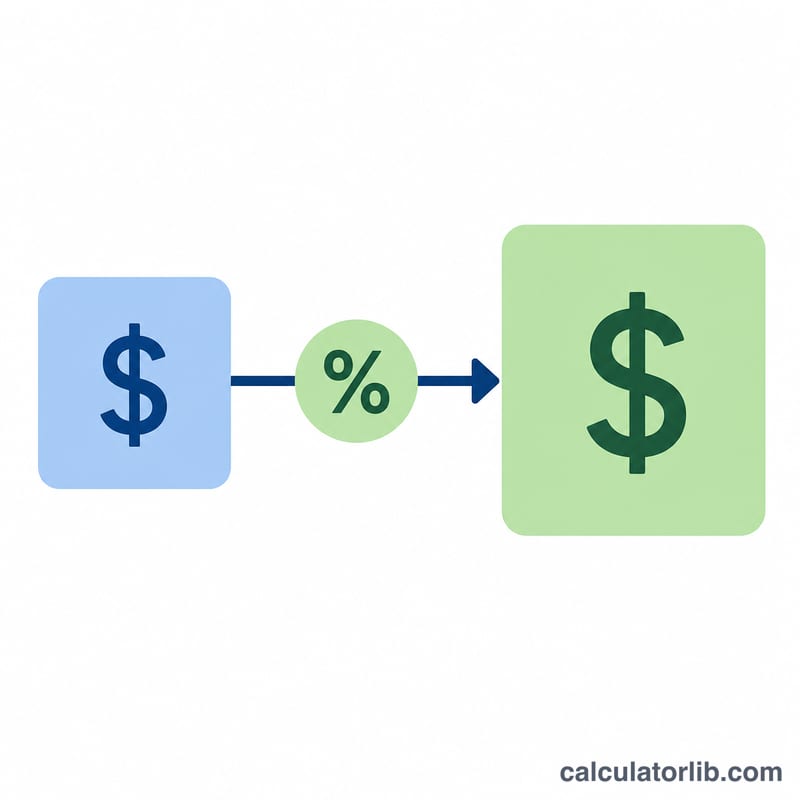
Suppose your current monthly benefit is $2,000 and the announced COLA is the 3.6% set for 2027. Your new benefit is $$2000 \times (1 + 0.036) = \$2{,}072$$ That is a $72 monthly increase, $24,864 per year, or $864 more annually than before.
Inflation in United States: the official figures
Official consumer-price data for United States, updated automatically. Use these figures as inputs in the calculator above.
- 12-month change, September 2026
- +3.7%
- Inflation 2024
- 2.9%
- Cumulative 2015–2024
- 32.3%
- Average per year
- 3.2%
Latest change Up +0.3 pp September 2026: +3.7%, against +3.4% in August 2026.
Latest month (September 2026): consumer prices in United States changed by +3.7% over 12 months (Consumer Price Index for All Urban Consumers, CPI-U). The yearly figures below are annual averages. CalculatorLib calculates this change from the published index: index of the month ÷ index of the same month a year earlier − 1.
Prices in United States changed by 32.3% between 2015 and 2024, an average of 3.2% a year: what cost 100 USD in 2015 cost about 132 USD in 2024.
| Year | CPI (2010 = 100) | Inflation | World |
|---|---|---|---|
| 2024 | 143.9 | 2.9% | 3.0% |
| 2023 | 139.7 | 4.1% | 5.7% |
| 2022 | 134.2 | 8.0% | 8.0% |
| 2021 | 124.3 | 4.7% | 3.5% |
| 2020 | 118.7 | 1.2% | 1.9% |
| 2019 | 117.2 | 1.8% | 2.2% |
| 2018 | 115.2 | 2.4% | 2.5% |
| 2017 | 112.4 | 2.1% | 2.3% |
| 2016 | 110.1 | 1.3% | 1.6% |
| 2015 | 108.7 | 0.1% | 1.4% |
United States and other countries
Inflation, consumer prices (annual %) — each country’s latest published year.
- Türkiye 34.9% (2025)
- Russia 8.7% (2025)
- Mexico 3.8% (2025)
- Vietnam 3.3% (2025)
- Japan 3.2% (2025)
- World 3.0% (2025)
- United States 2.9% (2024)
- India 2.4% (2025)
- South Korea 2.1% (2025)
- Saudi Arabia 2.0% (2025)
- France 0.9% (2025)
- China 0.1% (2025)
No published figure yet for Taiwan.
Years can differ between rows: each figure is shown with its own year. The same World Bank indicator for every country.
Latest figure: 2026-09 Data last updated 2026-11-14 · current
Source: The World Bank Group CC BY 4.0; U.S. Bureau of Labor Statistics (BLS.gov), Consumer Price Index Public domain (U.S. government work)
The cumulative change, the average yearly rate and the price comparison are computed by CalculatorLib from these data.
Source details and methodology
- The World Bank Group — World Development Indicators (FP.CPI.TOTL.ZG, FP.CPI.TOTL)
- U.S. Bureau of Labor Statistics (BLS.gov), Consumer Price Index (CUUR0000SA0)
FAQ
Is the COLA applied before or after Medicare premiums? The COLA is applied to your gross benefit. Medicare Part B premiums are then deducted separately, so your net deposit may rise less than the gross COLA.
Does everyone get the same COLA percentage? Yes — the percentage is uniform, but the dollar increase varies because it is a percentage of each person's own benefit.
When does the COLA take effect? COLAs generally apply to benefits payable for December, which most recipients receive in their January payment.