
What Is the Degrees to Radians Calculator?
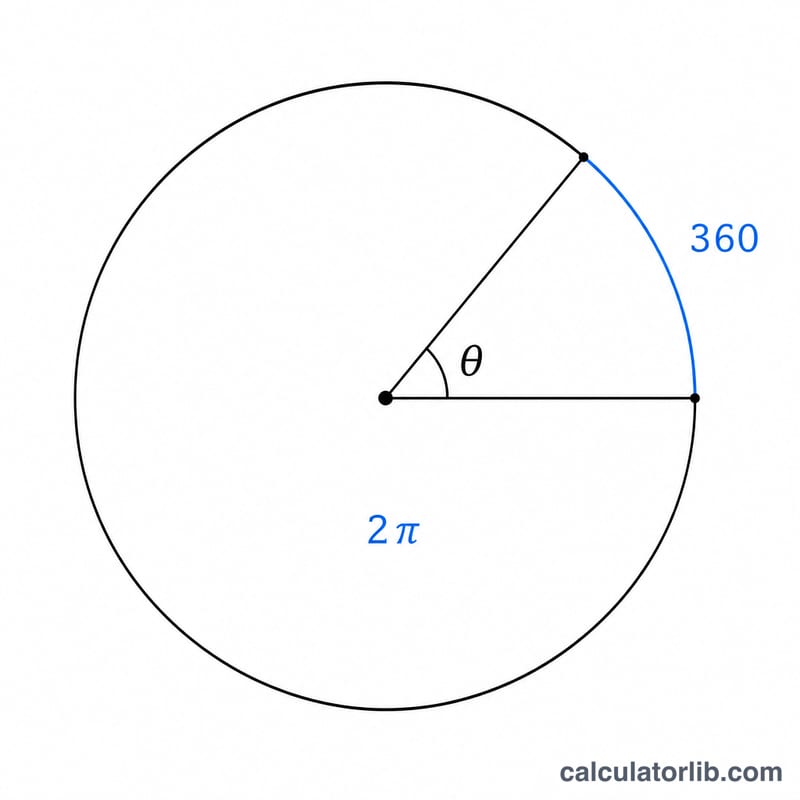
This tool converts an angle measured in degrees into radians, the standard unit of angular measure used throughout trigonometry, calculus, and physics. A full circle is 360 degrees or 2π radians, so the two systems describe the same rotation in different units. Radians are "natural" because they relate an arc length directly to the radius of a circle.
How to Use It
Enter any angle in degrees — positive, negative, or with decimals — and the calculator returns the equivalent value in radians along with the angle expressed as a multiple of π. This is handy when you need a clean answer such as \(\pi/2\) or \(3\pi/4\) rather than a long decimal.
The Formula Explained
The conversion is $$\text{Radians} = \text{Degrees} \times \frac{\pi}{180}$$ Because 180° equals π radians, every degree is worth \(\pi/180 \approx 0.0174533\) radians. Multiplying your degree value by this factor scales it into radians. To go the other way, multiply radians by \(180/\pi\).
Worked Example
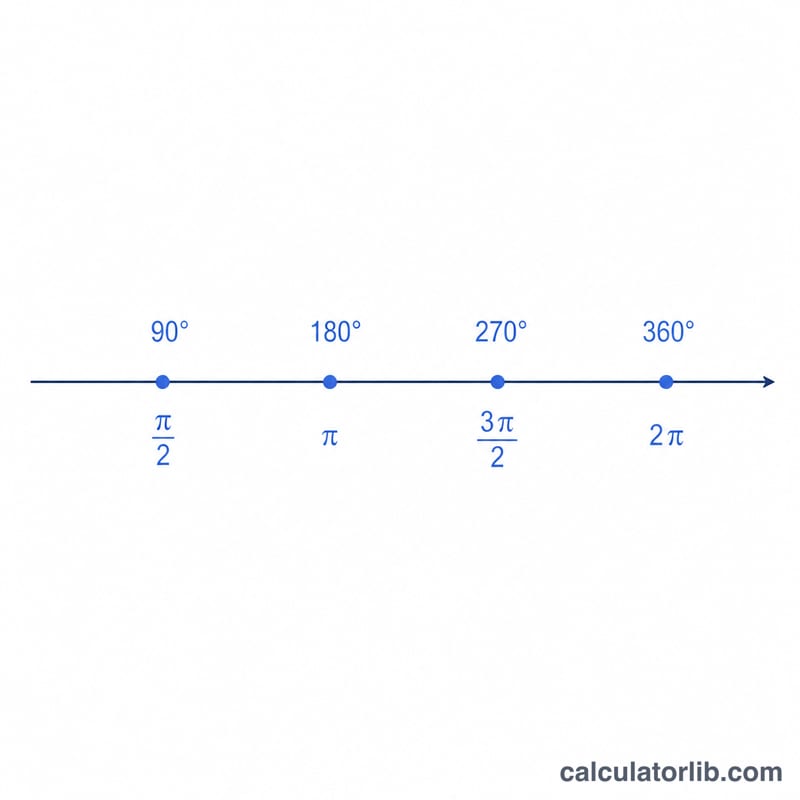
Convert 90°: $$\text{radians} = 90 \times \frac{\pi}{180} = \frac{\pi}{2} \approx 1.570796$$ Expressed as a multiple of π, that is \(90 / 180 = 0.5\pi\). Convert 45°: $$45 \times \frac{\pi}{180} = \frac{\pi}{4} \approx 0.785398$$ or \(0.25\pi\).
FAQ
How many radians are in 180 degrees? Exactly π radians, approximately 3.141593.
How many radians are in one degree? One degree equals \(\pi/180 \approx 0.0174533\) radians.
Can I enter negative angles? Yes. A negative degree value simply yields a negative radian value of the same magnitude, representing rotation in the opposite direction.