
What Is the Angle Conversion Calculator?
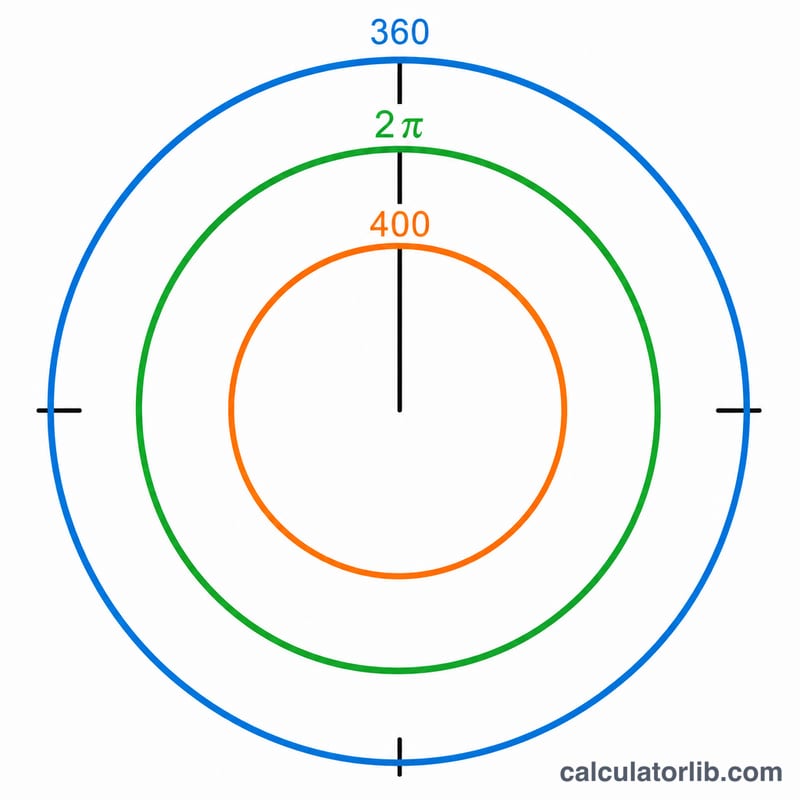
This calculator converts an angle between the three most common units: degrees, radians, and gradians (also called gon). A full circle equals 360 degrees, 2π radians, or 400 gradians. Whether you are working on trigonometry homework, programming, surveying, or engineering, this tool gives you all three equivalents at once.
How to Use It
Enter your angle value, choose which unit it is currently in (degrees, radians, or gradians), and the calculator instantly displays the same angle expressed in all three units. The result panel highlights the degree value, with radians and gradians shown in the table below.
The Formula Explained
The calculator first converts your input to degrees, then applies the standard conversions:
$$\text{radians} = \text{degrees} \times \frac{\pi}{180}$$because 180° equals \(\pi\) radians.
$$\text{gradians} = \text{degrees} \times \frac{10}{9}$$because 90° equals 100 gradians, so the ratio is \(100/90 = 10/9\).
When the input is radians, \(\text{degrees} = \text{radians} \times \frac{180}{\pi}\). When the input is gradians, \(\text{degrees} = \text{gradians} \times \frac{9}{10}\).
Worked Example
Convert 90 degrees.
$$\text{Radians} = 90 \times \frac{\pi}{180} = \frac{\pi}{2} \approx 1.570796$$$$\text{Gradians} = 90 \times \frac{10}{9} = 100$$So a right angle is 90°, about 1.5708 rad, or exactly 100 gon.
FAQ
Why use radians instead of degrees? Radians are the natural unit in calculus and physics because formulas like the derivative of sine are simplest in radians.
What is a gradian? A gradian divides a right angle into 100 parts, making a full circle 400 gradians. It is used in some surveying and civil engineering contexts.
How many radians are in a full circle? Exactly \(2\pi\) radians, approximately 6.283185.