
What Is the Degrees to Radians Calculator?
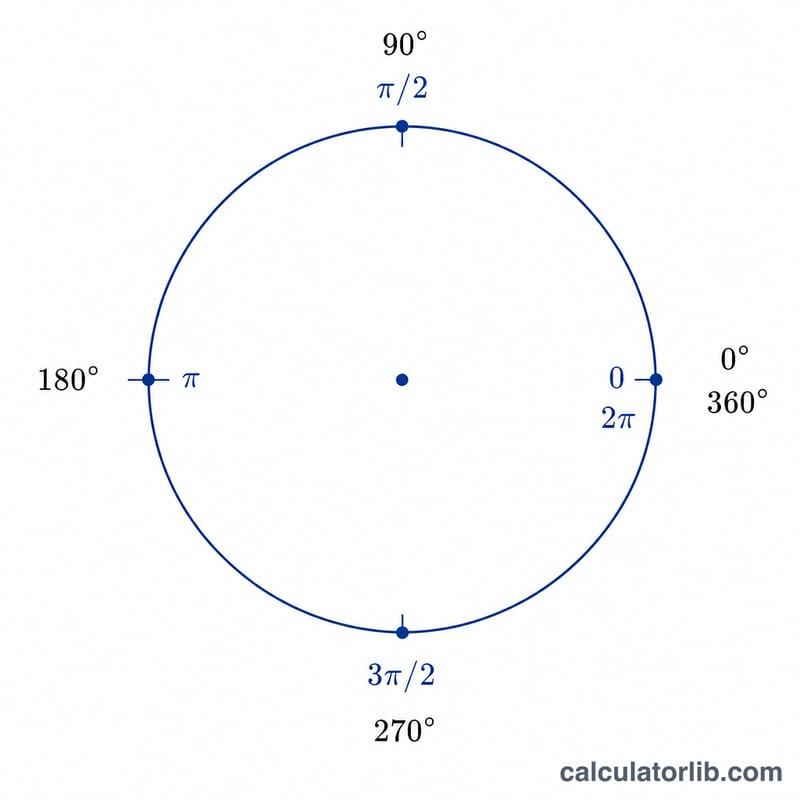
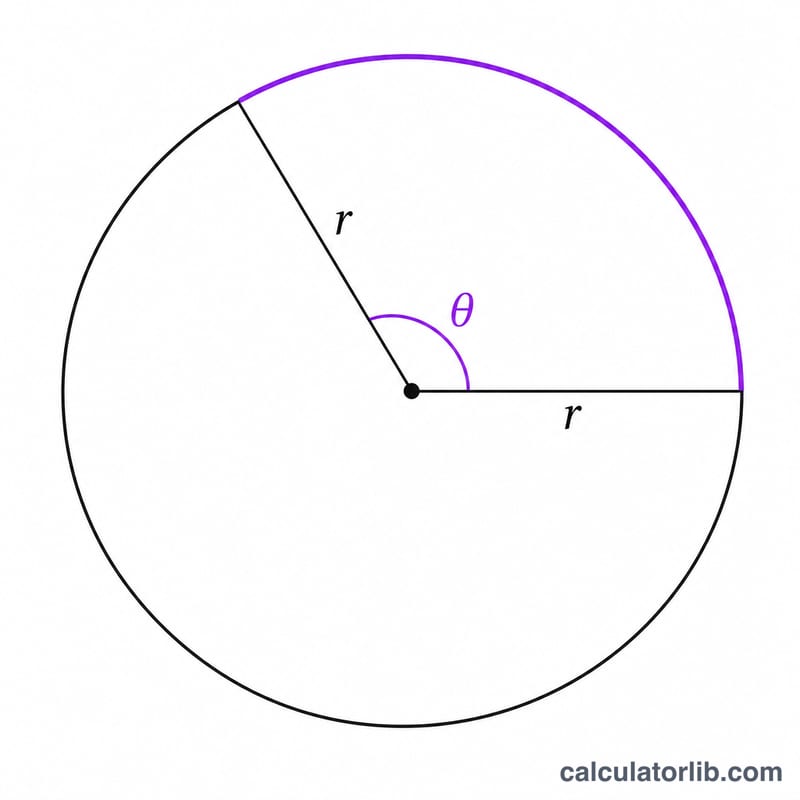
This calculator converts an angle measured in degrees into radians, the standard unit of angular measure used in higher mathematics, physics, and engineering. While degrees divide a full circle into 360 equal parts, radians measure an angle by the length of the arc it sweeps on a unit circle. A full circle equals \(2\pi\) radians, which is why many formulas in calculus and trigonometry are simpler in radians.
How to Use It
Enter the angle in degrees in the input field and the calculator instantly returns the equivalent value in radians. It also shows the result expressed as a multiple of π, which is often the cleaner form for common angles like 30°, 45°, 90°, and 180°.
The Formula Explained
The conversion uses the relationship that 180° equals π radians. So to convert any degree value you multiply by π/180:
$$\text{radians} = \text{degrees} \times \frac{\pi}{180}$$
Because \(\pi/180 \approx 0.0174533\), each degree is just over one-hundredth of a radian.
Worked Example
Convert 90 degrees to radians. Multiply 90 by π/180:
$$90 \times \frac{3.14159265}{180} = 90 \times 0.01745329 = 1.5708 \text{ radians}$$Expressed as a multiple of π, that is \(90/180 = 0.5\pi\) radians, or \(\pi/2\).
FAQ
How many radians are in a full circle? A full circle is 360°, which equals \(2\pi\) radians (about 6.2832 radians).
Why use radians instead of degrees? Radians make calculus and many physics formulas cleaner — for example, the derivative of \(\sin(x)\) is \(\cos(x)\) only when \(x\) is in radians.
What is 1 degree in radians? One degree equals \(\pi/180 \approx 0.0174533\) radians.