
What Are Vertical Angles?
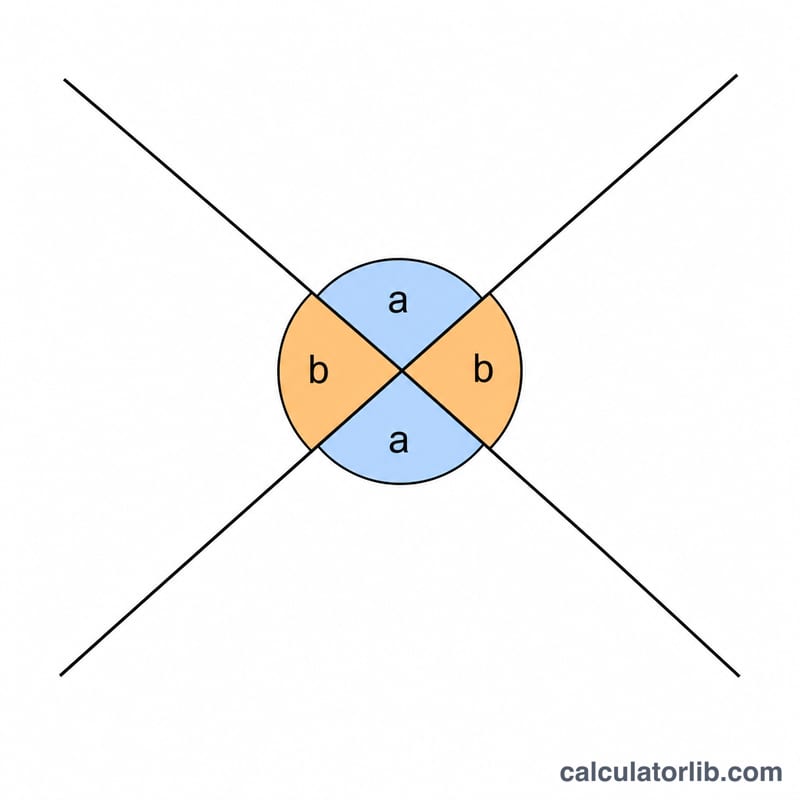
When two straight lines cross, they form four angles at the point of intersection. The two angles that sit directly opposite each other are called vertical angles (or vertically opposite angles), and they are always equal. The two angles that sit next to each other along a straight line are adjacent angles, and they are supplementary — they add up to 180°.
How to Use This Calculator
Enter any one of the four angles formed by the intersecting lines (in degrees, from 0 to 180). The calculator instantly returns the angle directly opposite it (the vertical angle, which is identical) and the angle beside it (the adjacent angle, found by subtracting from 180°).
The Formula Explained
Two key relationships govern intersecting lines:
Vertical angle = your angle. Because vertical angles are congruent, the opposite angle has the same measure. Adjacent angle = 180° − your angle. Because a straight line measures 180°, the neighboring angle is its supplement.
$$\begin{gathered} \theta_{\text{vertical}} = \text{Angle} \\[1em] \theta_{\text{adjacent}} = 180^{\circ} - \text{Angle} \end{gathered}$$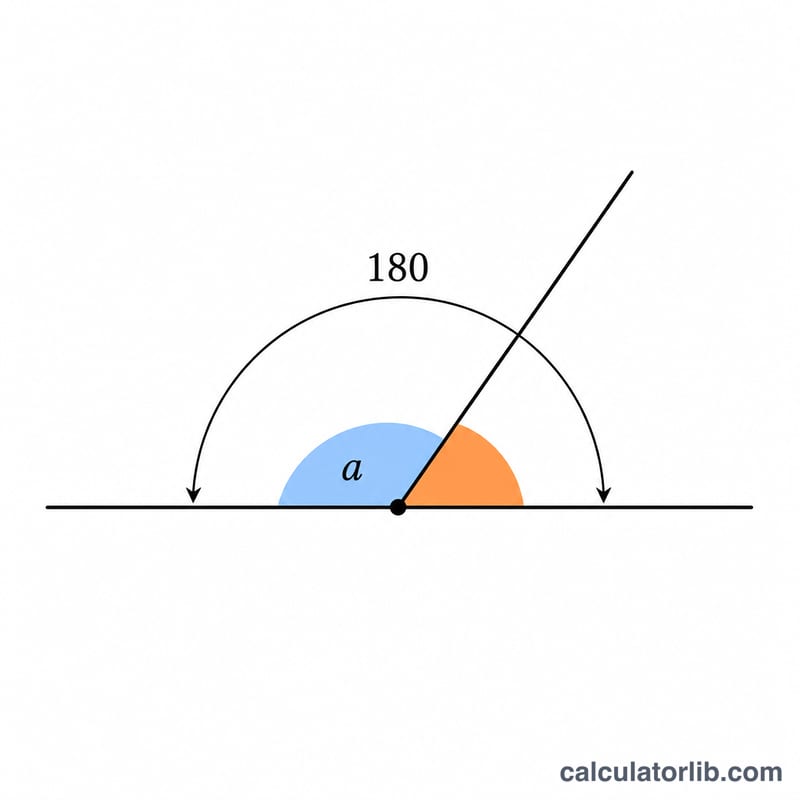
Worked Example
Suppose two lines intersect and one of the angles measures 40°. The angle directly opposite is also 40° (vertical angles are equal). The two angles beside it each measure $$180^{\circ} - 40^{\circ} = 140^{\circ}.$$ So the four angles around the point are 40°, 140°, 40°, and 140° — and they all sum to 360°.
FAQ
Are vertical angles always equal? Yes. Whenever two straight lines intersect, vertically opposite angles are always congruent.
What is the difference between vertical and adjacent angles? Vertical angles are opposite and equal; adjacent angles share a side, lie on a straight line, and are supplementary (sum to 180°).
Can a vertical angle be a right angle? Yes. If one angle is 90°, all four angles are 90°, meaning the lines are perpendicular.