
What is an isosceles triangle?
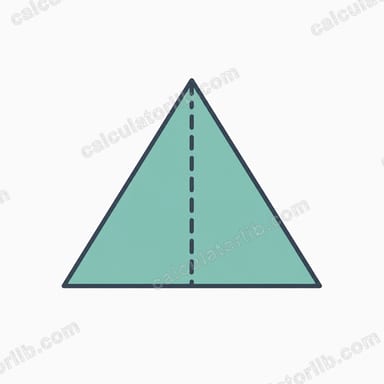
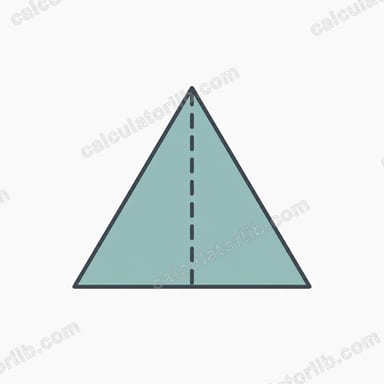
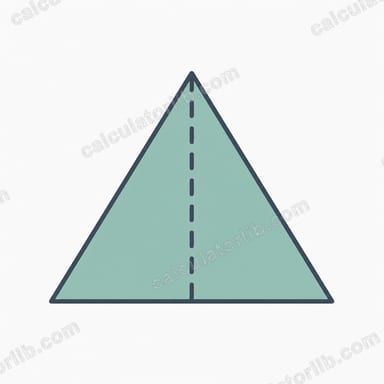
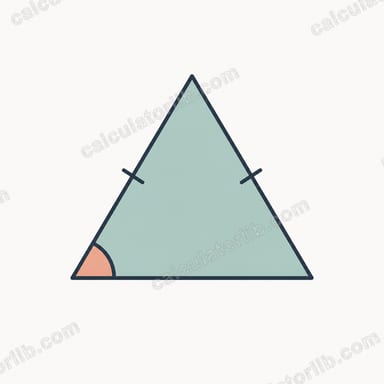
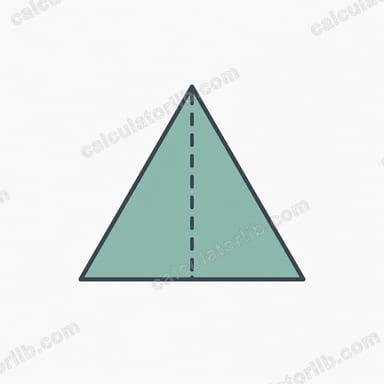
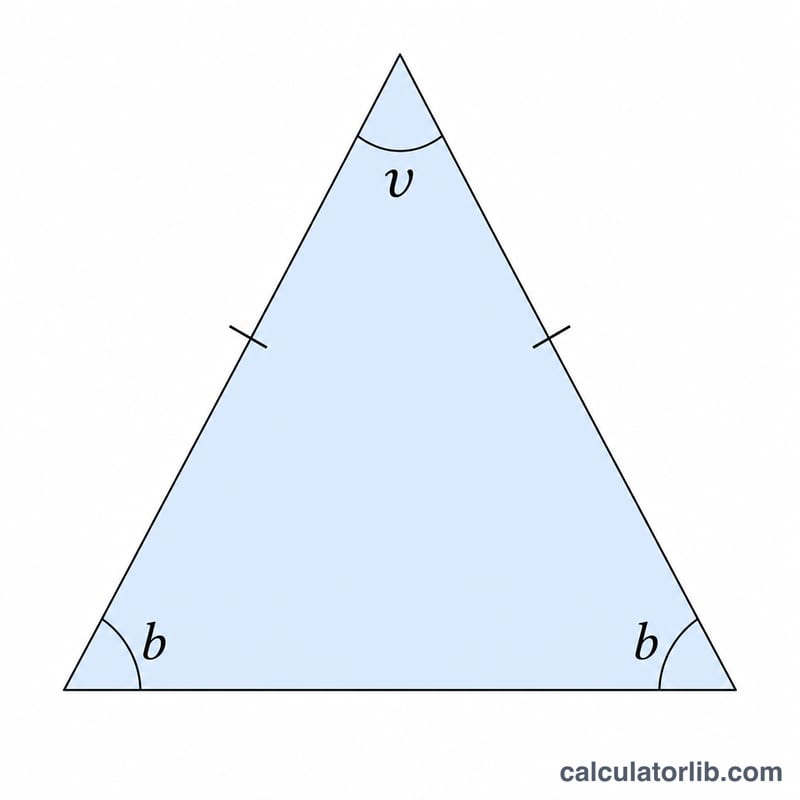
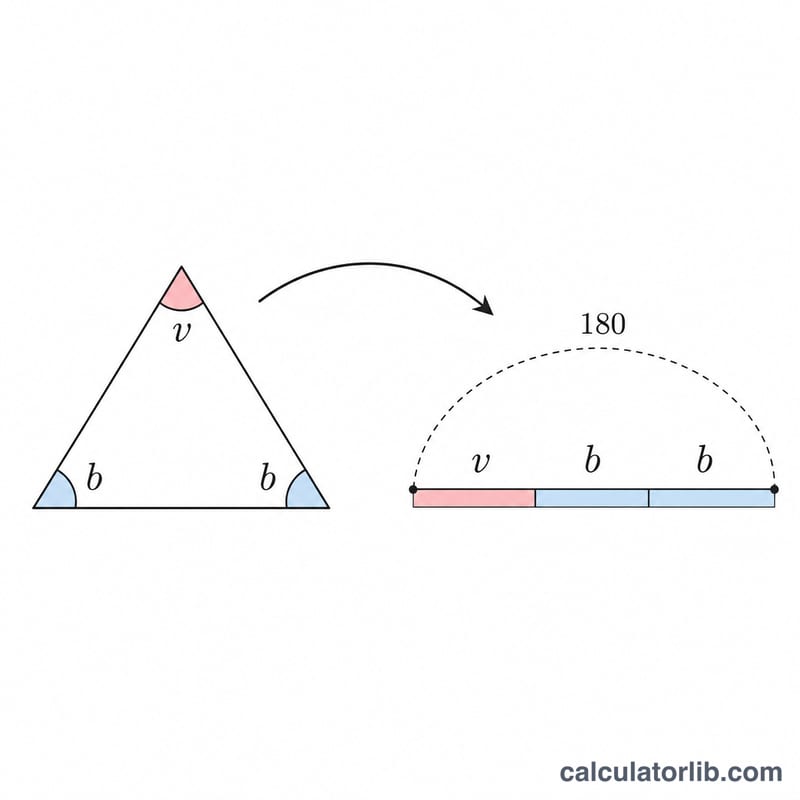
An isosceles triangle is a triangle with two sides of equal length. Because of this symmetry, the two angles opposite those equal sides — called the base angles — are also equal. The third angle, formed between the two equal sides, is called the vertex or apex angle. This calculator finds whichever angles you do not already know.
How to use it
Choose whether the angle you already know is a base angle or the vertex angle, type it in degrees, and the calculator returns the remaining angles along with a check that they sum to 180°.
The formula explained
The angles of any triangle add to 180°. In an isosceles triangle there are two equal base angles plus one vertex angle, so:
$$\text{base} + \text{base} + \text{vertex} = 180^\circ$$
Rearranging gives the two relationships used here: $$\text{vertex} = 180^\circ - 2 \times \text{base}$$ and $$\text{base} = \frac{180^\circ - \text{vertex}}{2}$$
Worked example
Suppose each base angle is 70°. Then the vertex angle is $$180 - 2 \times 70 = 40^\circ$$ Checking: \(70 + 70 + 40 = 180^\circ\). ✓ Conversely, if the vertex angle is 40°, each base angle is \(\frac{180 - 40}{2} = 70^\circ\).
FAQ
Can a base angle be 90° or more? No. Two base angles of 90° would already total 180°, leaving nothing for the vertex. A base angle must be less than 90°.
What if the vertex angle is 60°? Each base angle is \(\frac{180 - 60}{2} = 60^\circ\), making the triangle equilateral — a special case of isosceles.
Does this work for any triangle? The equal-base-angle assumption only holds for isosceles (and equilateral) triangles. For a scalene triangle all three angles can differ.