
What is the lateral area of a cone?
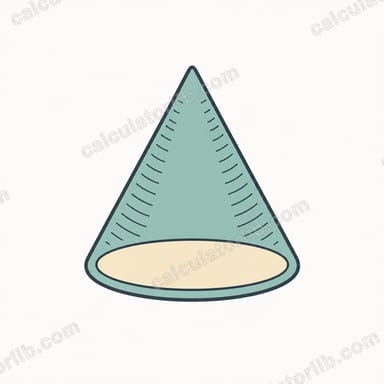
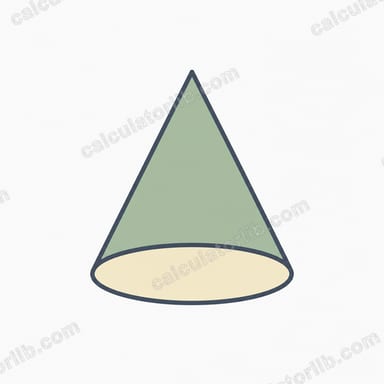
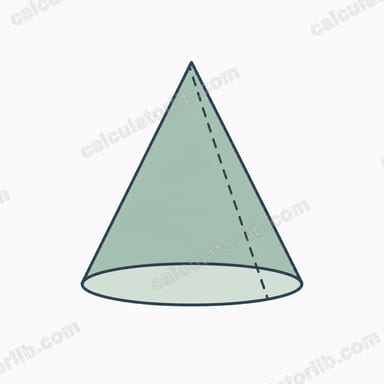
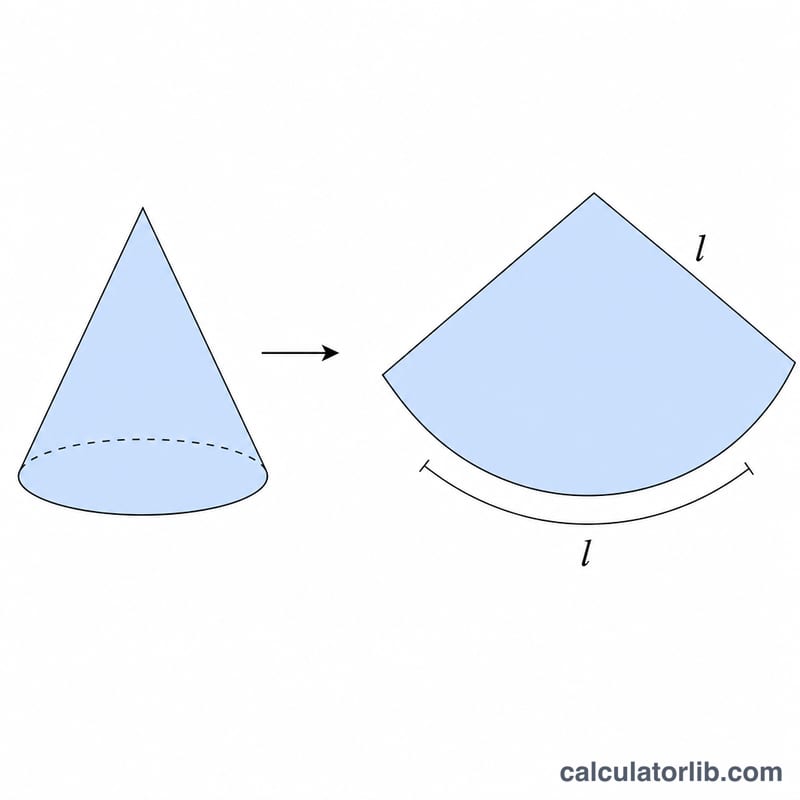
The lateral surface area (LSA) of a cone is the area of its curved side — everything except the flat circular base. It is the surface you would get if you unrolled the cone's slanted wall into a flat sector. This calculator computes the lateral area from two simple measurements: the base radius and the vertical height.
How to use this calculator
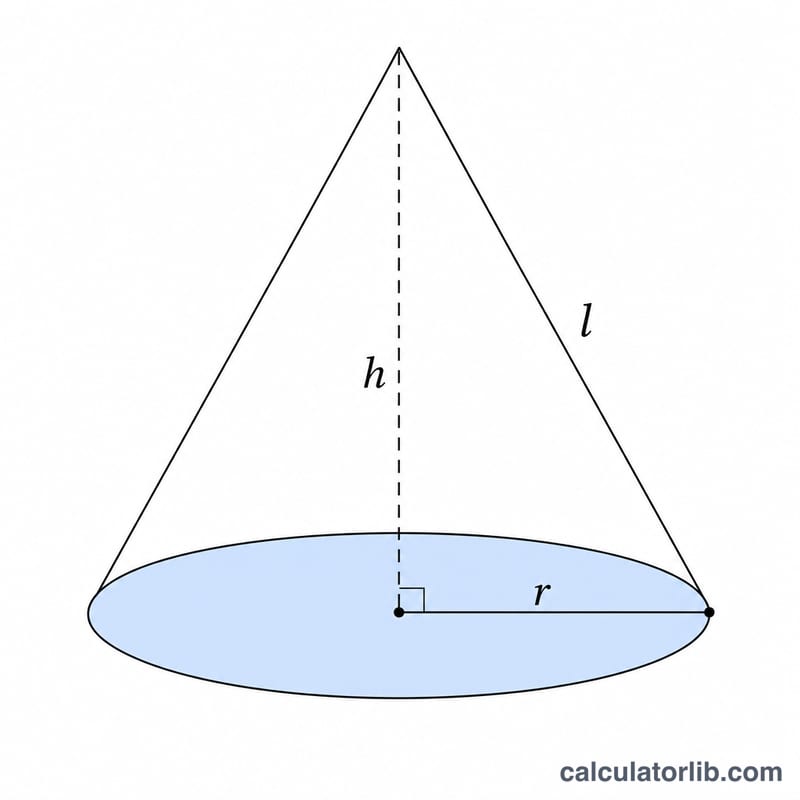
Enter the base radius (r) and the perpendicular height (h) of the cone in the same units. The calculator first finds the slant height, then the lateral area, and shows all three values so you can check your work. The result is in square units matching whatever length unit you used.
The formula explained
The lateral area is \(\text{LSA} = \pi \cdot r \cdot l\), where \(l\) is the slant height. Because the radius and height form a right triangle with the slant as the hypotenuse, the slant height is \(l = \sqrt{r^{2} + h^{2}}\). Substituting gives $$\text{LSA} = \pi \cdot r \cdot \sqrt{r^{2} + h^{2}}.$$ Note this excludes the base area (\(\pi r^{2}\)); add that separately if you need the total surface area.
Worked example
For a cone with radius \(r = 3\) and height \(h = 4\): the slant height is $$l = \sqrt{3^{2} + 4^{2}} = \sqrt{25} = 5.$$ The lateral area is $$\text{LSA} = \pi \times 3 \times 5 = 15\pi \approx 47.12 \text{ square units}.$$
FAQ
Does this include the base? No. Lateral area is only the curved side. Total surface area = lateral area + base area (\(\pi r^{2}\)).
What if I know the slant height instead of the height? If you already have \(l\), just compute \(\pi r l\). This tool derives \(l\) from \(h\), so enter the height it corresponds to, or set \(h\) so that \(\sqrt{r^{2}+h^{2}}\) equals your known slant.
What units does the answer use? Square units of whatever length unit you input — cm gives cm², inches give in², and so on.