
What is a frustum of a cone?
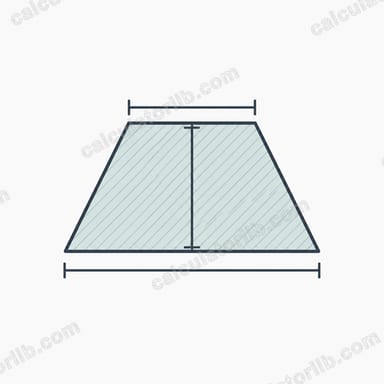
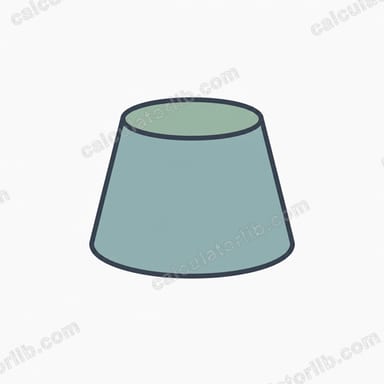
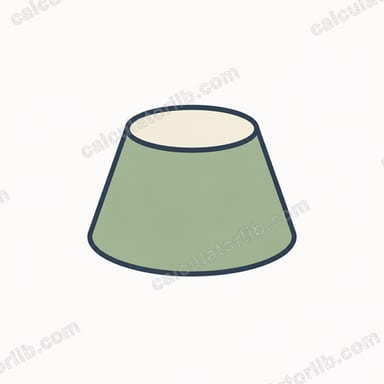
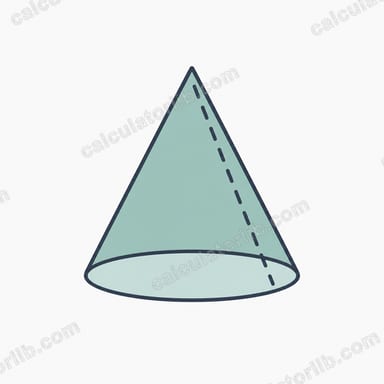
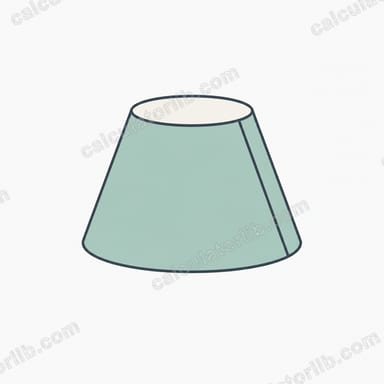
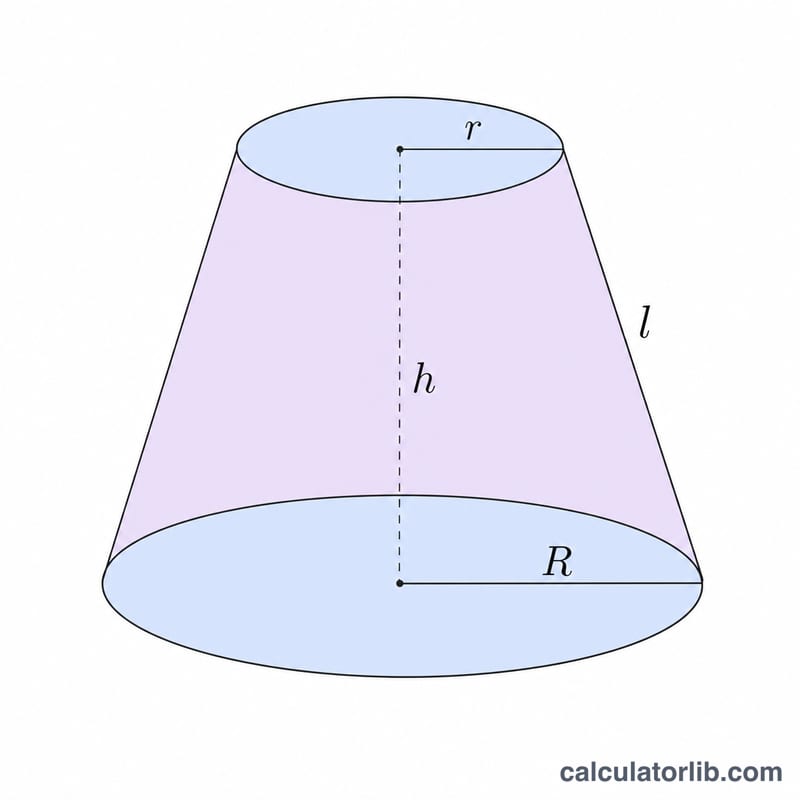
A frustum of a cone is the solid that remains when the top of a cone is sliced off parallel to its base, leaving two circular faces: a larger bottom of radius R and a smaller top of radius r, separated by a vertical height h. This calculator finds its slant height, lateral (side) area, and total surface area.
How to use it
Enter the bottom radius \(R\), the top radius \(r\), and the perpendicular height \(h\) in any consistent unit. The calculator returns the total surface area in square units, along with the slant height and the individual area components so you can verify each step.
The formula explained
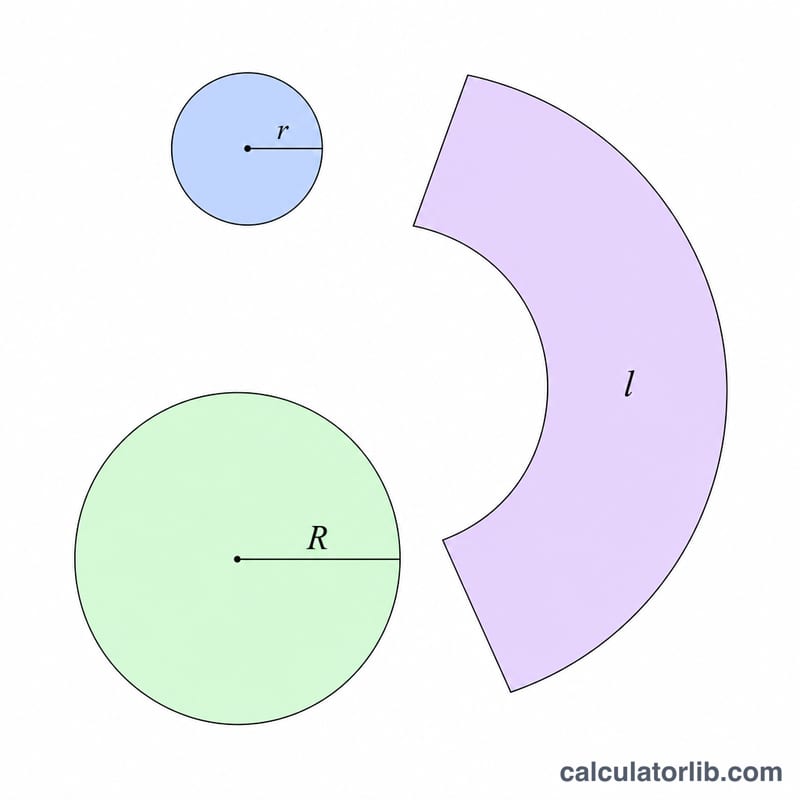
The sloped side of the frustum has a slant height \(l = \sqrt{h^{2} + (R - r)^{2}}\), found from the right triangle whose legs are the height and the difference of the radii. The lateral surface area is \(\pi(R + r)l\). Adding the two circular bases, \(\pi R^{2}\) and \(\pi r^{2}\), gives the total surface area $$A = \pi(R + r)\,l + \pi R^{2} + \pi r^{2}.$$
Worked example
For \(R = 5\), \(r = 3\), \(h = 6\): $$l = \sqrt{6^{2} + (5-3)^{2}} = \sqrt{36 + 4} = \sqrt{40} \approx 6.3246.$$ Lateral \(= \pi(5+3)(6.3246) \approx 158.97\). Bases \(= \pi \cdot 25 + \pi \cdot 9 = 78.54 + 28.27 = 106.81\). Total \(\approx 265.78\) square units.
FAQ
What if R = r? The frustum becomes a cylinder; the formula still holds, giving lateral \(= 2\pi R h\) plus two equal circular caps.
Does it include the top base? Yes — total surface area includes both the bottom (\(\pi R^{2}\)) and top (\(\pi r^{2}\)) circles. The lateral figure is shown separately if you need an open frustum.
What units does it use? Any consistent unit; if lengths are in cm the area is in cm².