
What is the Cylindrical to Cartesian Converter?
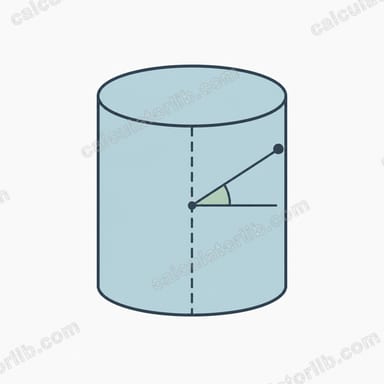
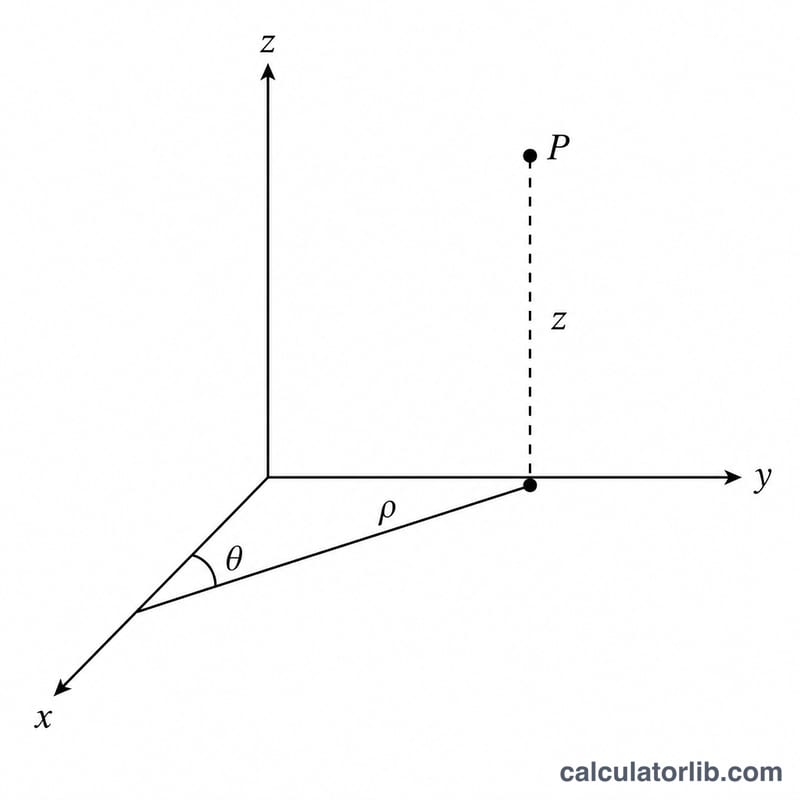
This tool converts a point in 3D space given in cylindrical coordinates — the radial distance rho, the azimuthal angle theta, and the height z — into standard Cartesian (rectangular) coordinates (x, y, z). Cylindrical coordinates are widely used in physics and engineering for problems with rotational symmetry, such as pipes, wires, and electromagnetic fields, while Cartesian coordinates are the everyday x-y-z system.
How to use it
Enter the radial distance rho (the distance from the z-axis to your point), the azimuthal angle theta (measured in the xy-plane from the positive x-axis), and the height z. Choose whether theta is given in degrees or radians, then read off the converted (x, y, z) values. All inputs accept any real number, including negatives and zero.
The formula explained
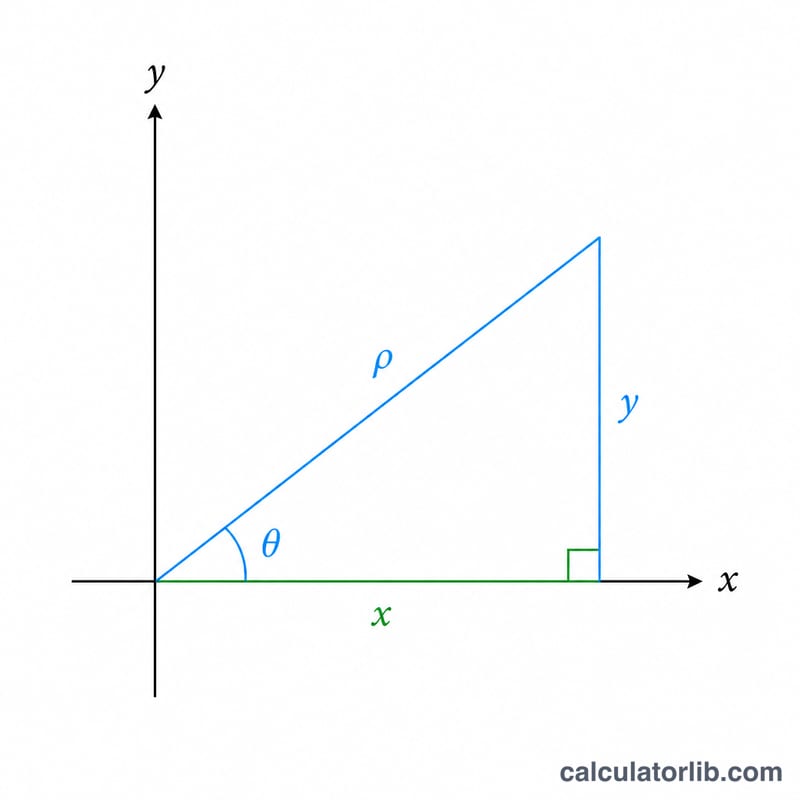
The conversion is pure trigonometry. The angle is first converted to radians: if degrees are selected, multiply theta by pi/180. Then \(x = \rho\cos\theta\) and \(y = \rho\sin\theta\), which break the radial distance into its horizontal components. The height z is unchanged: \(z = z\). Because the formulas only multiply, there is never a division-by-zero issue; when \(\rho = 0\) the point lies on the z-axis and \(x = y = 0\).
$$x = \rho\cos\theta, \quad y = \rho\sin\theta, \quad z = \text{z}$$
$$\text{where}\quad \left\{ \begin{aligned} \rho &= \text{Radius } \rho \\ \theta &= \text{Azimuth } \theta \text{ (deg)} \times \frac{\pi}{180} \end{aligned} \right.$$
Worked example
Take \(\rho = 3\), \(\theta = 60\) degrees, \(z = 4\). Converting the angle: $$60 \cdot \frac{\pi}{180} = 1.0472 \text{ rad}$$ Then \(\cos(60\degree) = 0.5\) and \(\sin(60\degree) = 0.8660254\). So $$x = 3 \cdot 0.5 = 1.5, \quad y = 3 \cdot 0.8660254 = 2.5980762$$ and z stays 4. The Cartesian point is \((1.5, 2.5980762, 4)\).
FAQ
What units does rho and z use? Any consistent length unit you like — the converter is dimensionless, so x, y, and z come out in the same units you put in.
Can the angle be negative or over 360 degrees? Yes. Trigonometric functions handle any angle, so values like -45° or 720° work correctly.
How do I go the other way? The inverse (Cartesian to cylindrical) uses \(\rho = \sqrt{x^2 + y^2}\), \(\theta = \operatorname{atan2}(y, x)\), and \(z = z\).