
What this converter does
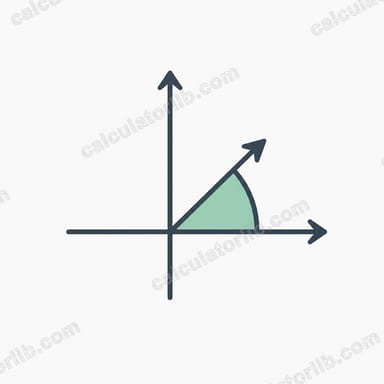
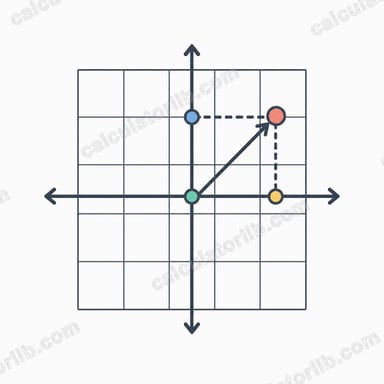
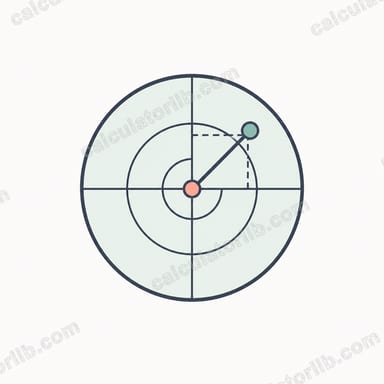
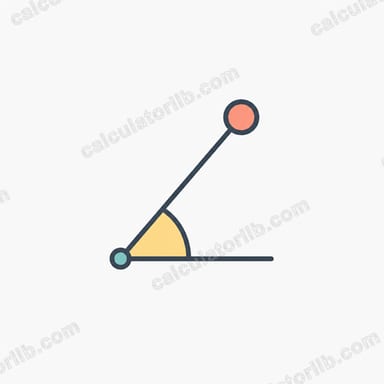
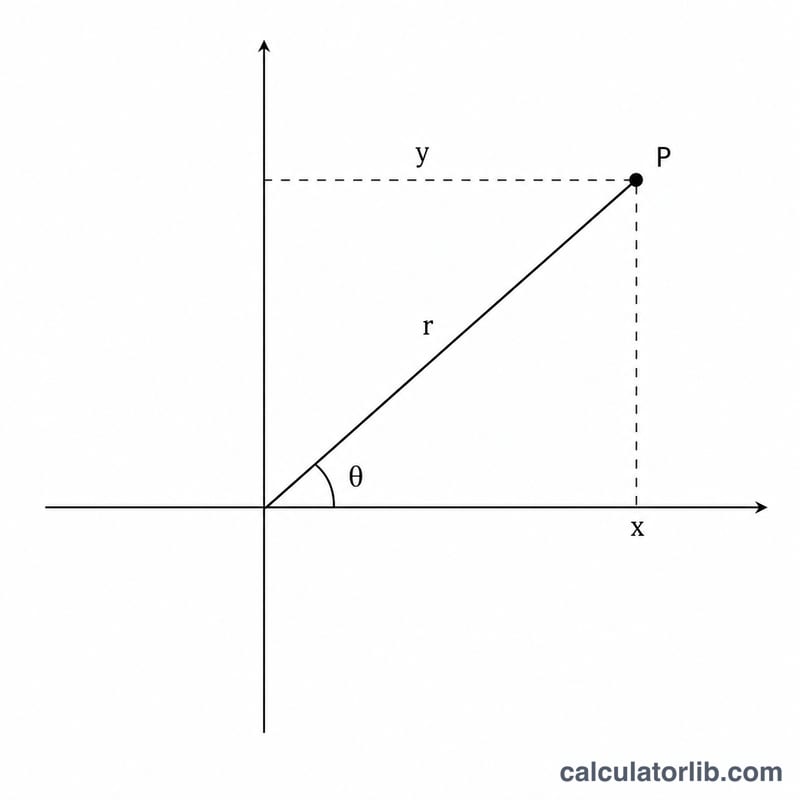
This tool converts a point given in 2D Cartesian (rectangular) coordinates (x, y) into polar coordinates (r, theta). The radius r is the straight-line distance from the origin to the point, and the angle theta is measured counterclockwise from the positive x-axis. You can choose to read theta in degrees or radians.
How to use it
Enter the X coordinate and Y coordinate, pick whether you want the output angle in degrees or radians, and the calculator returns r and theta instantly. The coordinates are unitless plane values, so r is expressed in the same length units you used for x and y.
The formula explained
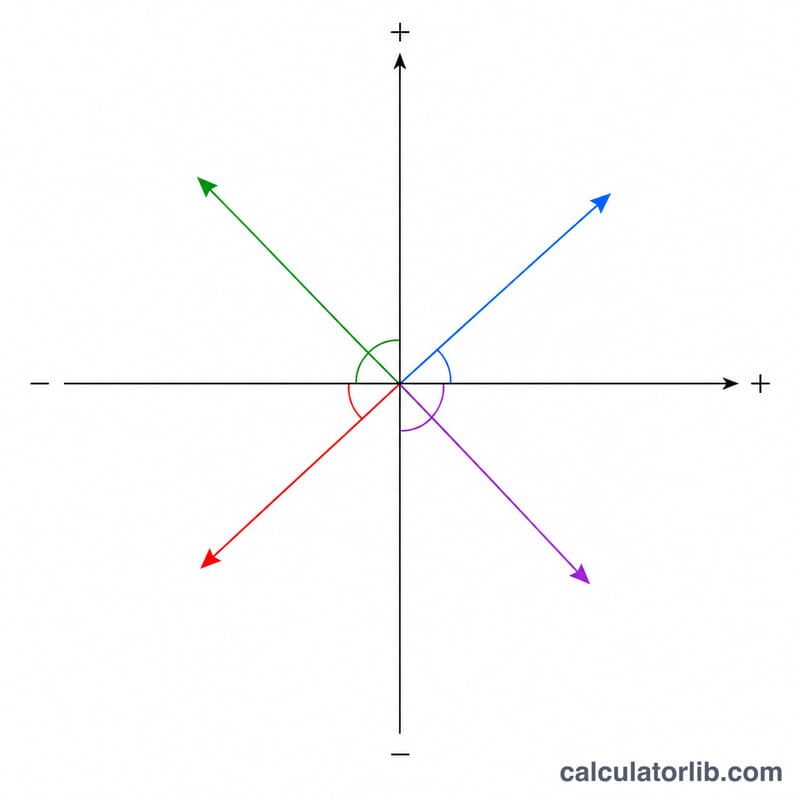
The radius comes from the Pythagorean theorem: $$r = \sqrt{x^{2} + y^{2}}$$ The angle is computed with the two-argument arctangent, $$\theta = \operatorname{atan2}(y,\ x)$$ Although many textbooks write \(\theta = \arctan(y/x)\), plain arctan only returns angles between -90 and 90 degrees and is undefined when \(x = 0\). The atan2 function fixes both problems: it inspects the signs of \(x\) and \(y\) to place the angle in the correct quadrant, returning a value in (-180, 180] degrees (equivalently \((-\pi, \pi]\) radians).
Worked example
For \(x = 3\), \(y = 4\): $$r = \sqrt{9 + 16} = \sqrt{25} = 5$$ The angle is \(\operatorname{atan2}(4, 3) = 0.927295\) rad, which is 53.130102 degrees. So (3, 4) becomes (r = 5, theta = 53.130102 degrees).
For \(x = -1\), \(y = 1\) (second quadrant): \(r = \sqrt{2} = 1.414214\), and \(\operatorname{atan2}(1, -1) = 135\) degrees. Naive \(\arctan(1 / -1)\) would wrongly give -45 degrees, showing why atan2 is essential.
FAQ
What angle range does it use? This tool follows the atan2 convention, giving theta in (-180, 180] degrees or \((-\pi, \pi]\) radians. If you prefer a 0 to 360 range, add 360 degrees (or \(2\pi\)) to any negative result.
What happens at the origin? If \(x = 0\) and \(y = 0\), then \(r = 0\) and the angle is mathematically undefined; by convention \(\operatorname{atan2}(0, 0)\) returns 0, so theta is reported as 0.
Why is the angle not arctan(y/x)? Plain arctan loses quadrant information and divides by zero when \(x = 0\). Using atan2 handles every quadrant and the vertical axis correctly.