
What is the Julian Day?
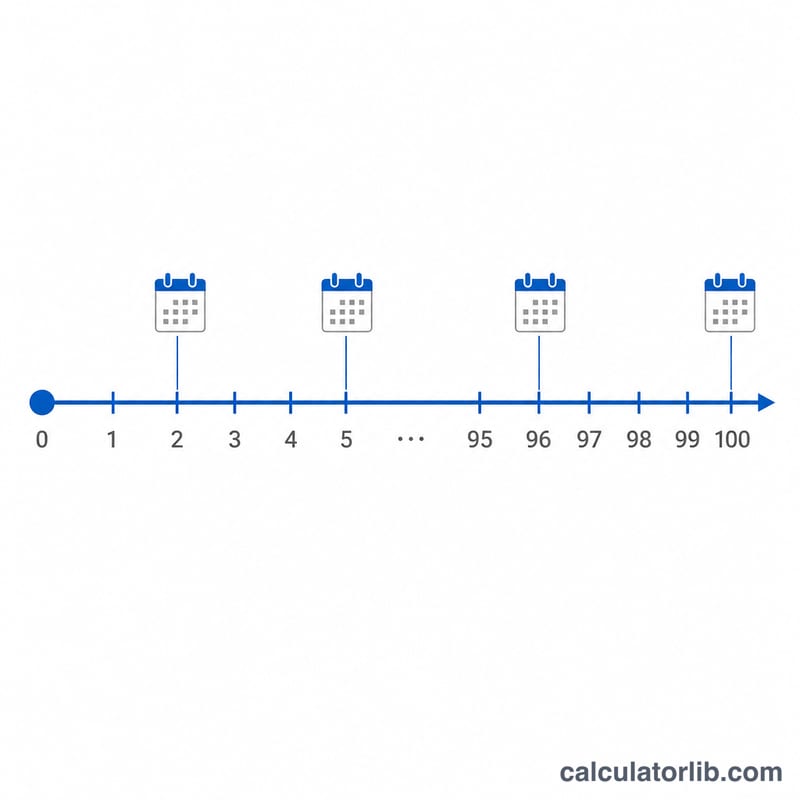
The Julian Day (JD) is a continuous count of days used by astronomers and chronologists worldwide. It starts at JD 0.0 at noon on 1 January 4713 BC in the proleptic Julian calendar, so any date can be expressed as a single number regardless of calendar reforms. The Modified Julian Day (MJD) is simply JD minus 2400000.5, placing its zero point at midnight on 17 November 1858 to give smaller, more manageable numbers for modern dates. This is a universal tool with no national rules.
How to use it
Pick the calendar your date is expressed in (Julian or Gregorian), choose the era (AD or BC), then enter the year, month and day. The tool computes JD and MJD for 00:00 (the start of the civil day), so every result ends in .5 because JD epochs begin at noon. The Gregorian calendar was historically adopted from 15 October 1582; for earlier dates the Julian calendar is normally appropriate, but you may select either.
The formula explained
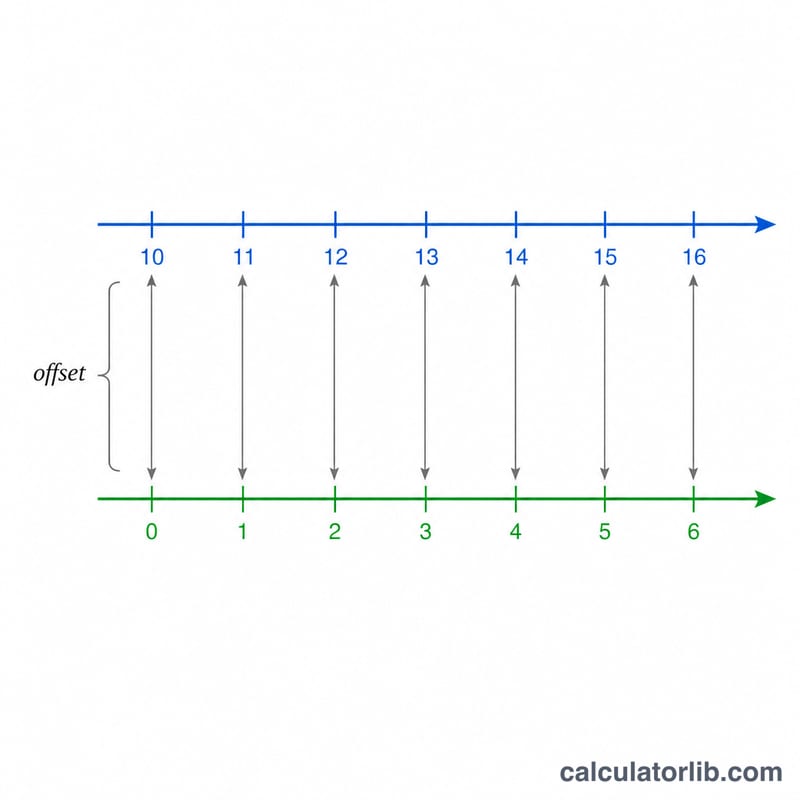
First the year is mapped to an astronomical year \(Y\): for AD, \(Y = \text{year}\); for BC, \(Y = 1 - \text{year}\) (because there is no historical year 0, the year after BC 1 is AD 1). If the month is January or February it is treated as the 13th or 14th month of the previous year: \(y = Y - 1\), \(mo = \text{month} + 12\). For the Gregorian calendar a century correction \(B = 2 - A + \lfloor A/4 \rfloor\) with \(A = \lfloor y/100 \rfloor\) is applied; for the Julian calendar \(B = 0\). Then $$JD = \lfloor 365.25\,(y+4716) \rfloor + \lfloor 30.6001\,(mo+1) \rfloor + d + B - 1524.5.$$
Worked example
For Gregorian AD 2000-01-01: \(Y = 2000\), and since month \(\le 2\), \(y = 1999\), \(mo = 13\). \(A = 19\), \(B = 2 - 19 + 4 = -13\). $$JD = \lfloor 365.25 \times 6715 \rfloor + \lfloor 30.6001 \times 14 \rfloor + 1 - 13 - 1524.5 = 2452653 + 428 + 1 - 13 - 1524.5 = 2451544.5.$$ \(MJD = 2451544.5 - 2400000.5 = 51544\). This matches the standard JD for 2000-01-01 00:00 UT.
FAQ
Why does the answer end in .5? JD is counted from noon, while this tool reports the start of the civil day at 00:00, which is half a day before noon.
What is the difference between Julian Day and the Julian calendar? They are unrelated despite the shared name: the Julian Day is a day count, while the Julian calendar is a leap-year scheme. The calendar radio only chooses how your input date is interpreted.
How is BC handled? Historical numbering is used, so BC 1 maps to astronomical year \(Y = 0\) via \(Y = 1 - \text{year}\), reproducing JD 1721057.5 for BC 1-01-01.