What is the quartic equation solver?
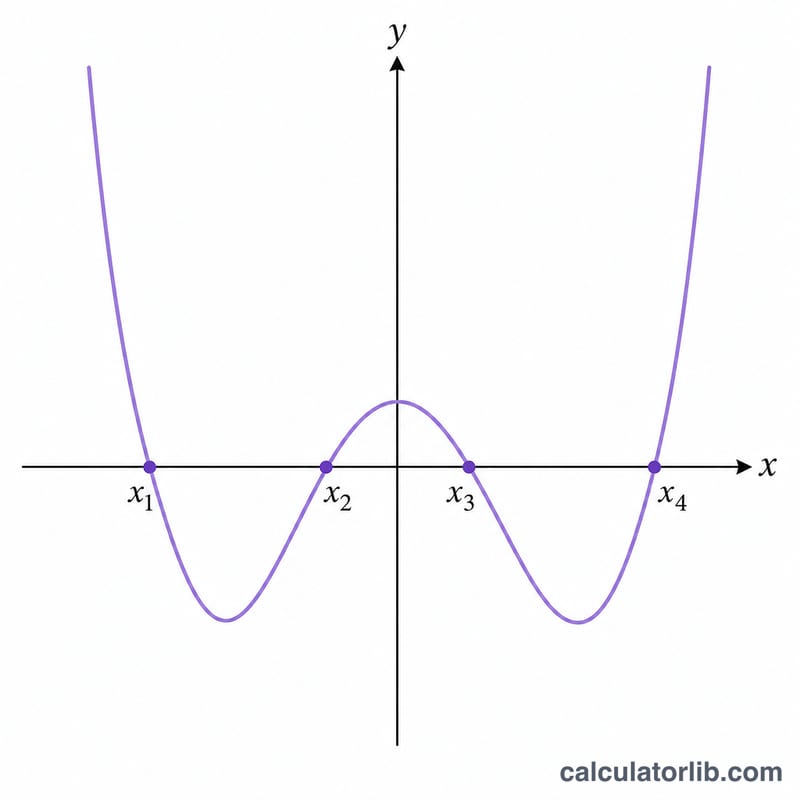
This calculator finds all four roots of a quartic (fourth-degree) polynomial equation of the form \(ax^4 + bx^3 + cx^2 + dx + e = 0\). It uses Ferrari's method, an exact algebraic technique, so it returns real and complex roots precisely rather than by numerical iteration. Every quartic with real coefficients has exactly four roots in the complex plane, and any complex roots appear in conjugate pairs.
How to use it
Enter the five coefficients \(a\), \(b\), \(c\), \(d\) and \(e\). The leading coefficient \(a\) must be non-zero, otherwise the equation is not quartic. Leave the others at zero if your polynomial has missing terms. Press calculate to see \(x_1\) through \(x_4\). Real roots show no imaginary part; complex roots show the form \(p + qi\).
The formula explained
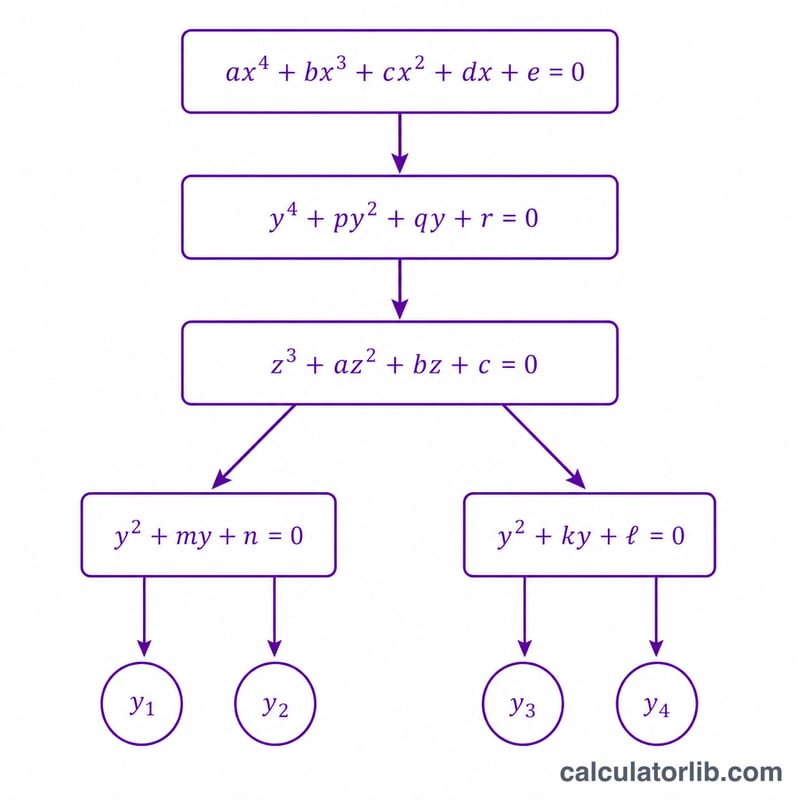
First the equation is made monic by dividing by \(a\). The substitution \(x = y - \tfrac{b}{4a}\) produces a depressed quartic $$y^4 + p\,y^2 + q\,y + r = 0$$ with no cubic term. Ferrari's method then finds a real root \(m\) of a resolvent cubic, which lets the depressed quartic be written as a product of two quadratic factors. Solving each quadratic with the complex quadratic formula yields four \(y\)-values; converting back with \(x = y - \tfrac{b}{4a}\) gives the roots.
Worked example
For $$x^4 - 7x^3 + 5x^2 + 31x - 30 = 0$$ (\(a=1\), \(b=-7\), \(c=5\), \(d=31\), \(e=-30\)) the polynomial factors as $$(x-1)(x+2)(x-3)(x-5).$$ The solver returns \(x_1 = -2\), \(x_2 = 1\), \(x_3 = 3\), \(x_4 = 5\), all real.
FAQ
Can it handle complex roots? Yes. For example \(x^4 + 1 = 0\) returns the four complex fourth roots of \(-1\), approximately \(\pm 0.7071 \pm 0.7071i\).
What if a equals zero? The equation is no longer quartic and the calculator reports an error; use a cubic or quadratic solver instead.
Does it handle repeated roots? Yes. An equation like \((x-2)^4 = 0\) returns \(x = 2\) four times.