
What this calculator does
This tool measures the elapsed time between a start date and an end date and shows it five ways at once: total days; weeks plus leftover days; whole calendar months plus leftover days; whole years plus leftover days; and the conventional years-months-days breakdown. A typical use is finding exactly how many days you have lived since your birthday.
Jurisdiction note (Japan)
The calculation itself is universal date arithmetic and works for any country. Only the optional era dropdown is Japan-specific: choosing Meiji, Taisho, Showa, Heisei or Reiwa converts an era year into a Gregorian (CE) year by adding a fixed base offset (for example Reiwa 1 = \(2018 + 1 = 2019\)). The default and primary mode is the Western year (CE), where the value you type is the full CE year. Japanese-era input is only meaningful from Meiji 6 (1873), when Japan adopted the Gregorian calendar.
How to use it
Pick the calendar/era for each date (leave it on "CE (Western)" for ordinary use), enter the year, month and day for both the start and end date, and choose whether to count the first day. "Exclude" gives the plain difference; "Include" adds one day so both endpoints are counted.
The formula
Each date is converted to a Julian Day Number (JDN), a continuous count of days that is independent of month and year boundaries and handles leap years automatically. The total is JDN(end) minus JDN(start), optionally plus one. Weeks come from integer division by 7. Months and years use the anniversary method: a calendar month is only counted once the same day-of-month is reached, so the breakdown matches how people normally state ages and durations.
$$\begin{gathered} \Delta = \text{JDN}(Y_e,M_e,D_e) - \text{JDN}(Y_s,M_s,D_s) + \text{First Day} \\[1.5em] \text{where}\quad \left\{ \begin{aligned} Y_s &= \text{Start Era} + \text{Start Year},\; M_s = \text{Start Month},\; D_s = \text{Start Day} \\ Y_e &= \text{End Era} + \text{End Year},\; M_e = \text{End Month},\; D_e = \text{End Day} \end{aligned} \right. \end{gathered}$$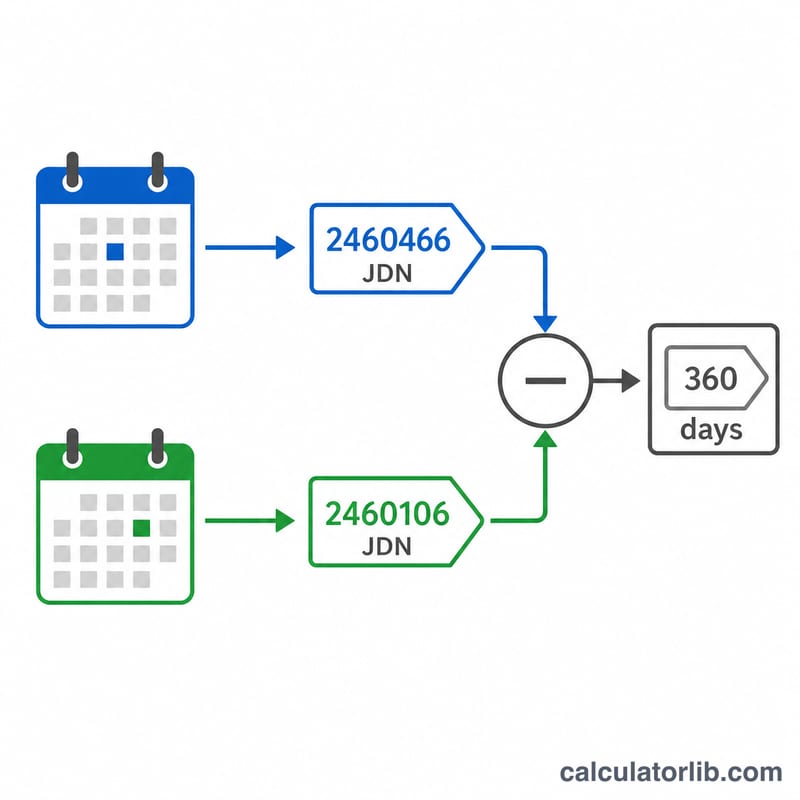
Worked example
Start 2000-06-15, end 2010-06-20, first day excluded. \(\text{JDN(start)}=2451711\), \(\text{JDN(end)}=2455368\), so days:
$$\text{days} = 2455368 - 2451711 = 3657$$Weeks = 522 with 3 remaining days. Months = 120 with 5 remaining days. Years = 10 with 5 remaining days. Years-months-days = 10 years, 0 months, 5 days.
FAQ
What if the end date is before the start date? The total-day figure becomes negative to show the direction, while the week/month/year breakdown is shown as an absolute duration.
Are leap years handled? Yes. Julian Day Numbers account for leap years and February 29 automatically.
Why are months and years not just days divided by 30 or 365? Because real months and years vary in length. This tool counts true calendar anniversaries, which is more accurate than a fixed average.