
What This Calculator Does
The Years Between Two Dates Calculator tells you how many years separate any two calendar dates. Enter a start date and an end date, and it returns the elapsed time as a decimal number of years, along with the total number of days. This is handy for working out ages, anniversaries, service lengths, project durations, or any span where a precise year count matters.
How to Use It
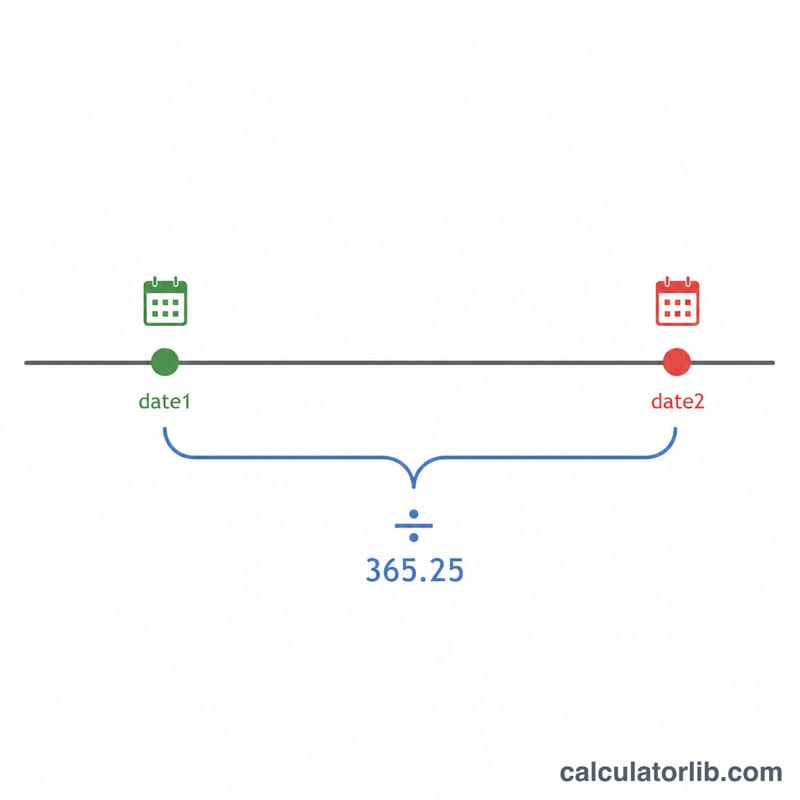
Pick your earlier date in the "Start date" field and your later date in the "End date" field. The tool computes the difference and divides by 365.25 — the average length of a year that accounts for leap years occurring roughly every four years. If the end date is earlier than the start date, the result will be negative.
The Formula Explained
The calculation is straightforward: $$\text{years} = \frac{\text{date2} - \text{date1}}{365.25}$$ First the two dates are converted to a number of days apart, then those days are divided by 365.25. Using 365.25 rather than 365 keeps long spans accurate because it averages in the extra leap day, so a 4-year gap returns very close to 4.00 instead of drifting.
Worked Example
Suppose the start date is January 1, 2000 and the end date is January 1, 2020. That span includes 7,305 days (20 years with 5 leap days). Dividing 7,305 by 365.25 gives 19.9986 years — essentially 20 years, as expected.
$$\text{years} = \frac{7305}{365.25} = 19.9986$$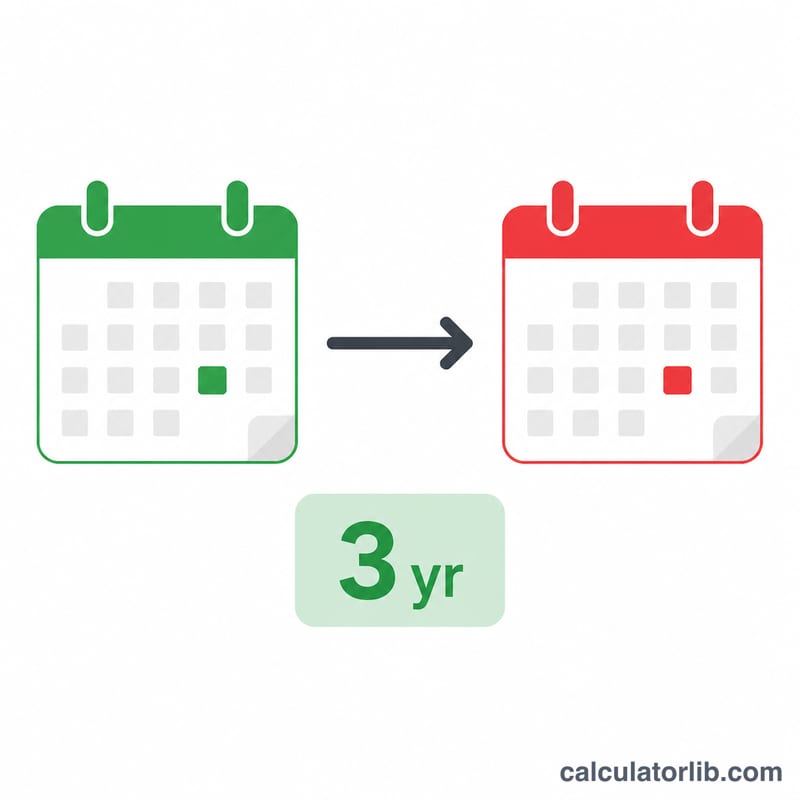
FAQ
Why divide by 365.25 instead of 365? Because leap years add an extra day about once every four years. 365.25 is the average year length and gives more accurate results over multi-year spans.
Can I get a negative answer? Yes. If the end date comes before the start date, the result is negative, indicating the dates are reversed.
Is this exact calendar-year counting? It is an average-based estimate. For legal age calculations that count exact calendar years, results may differ by a fraction of a year, but for most purposes this is precise enough.