
What Is Average Fixed Cost?
Average fixed cost (AFC) measures how much of a company's fixed costs are attributed to each unit produced. Fixed costs — such as rent, insurance, salaries, and equipment leases — do not change with the level of production. As output rises, those same fixed costs are spread across more units, so AFC always declines as quantity increases. This downward-sloping behavior is a key concept in microeconomics and cost accounting.
How to Use This Calculator
Enter your total fixed costs (the sum of all expenses that stay constant regardless of output) and the quantity of output (the number of units produced). The calculator divides the two and returns the average fixed cost per unit instantly.
The Formula Explained
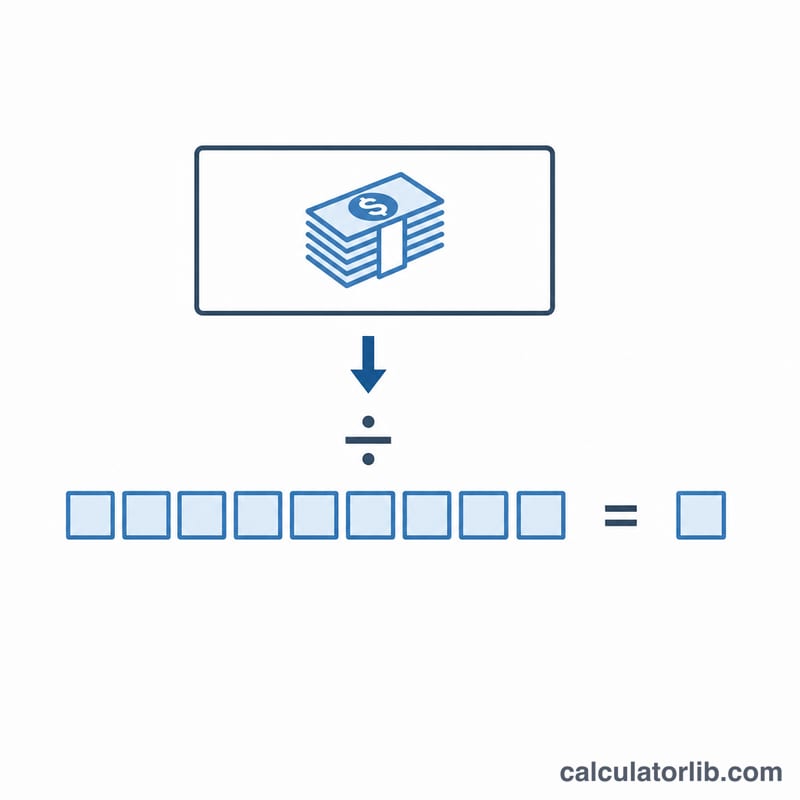
The formula is simple: $$\text{AFC} = \frac{\text{Total Fixed Costs}}{\text{Quantity of Output}}$$ Because the numerator stays the same while the denominator grows, AFC behaves like a hyperbola — falling sharply at first and then flattening as volume increases. This is why high-volume producers enjoy a lower fixed cost burden per item.
Worked Example
Suppose a bakery has $10,000 in monthly fixed costs and produces 500 loaves of bread. The average fixed cost is $$\$10{,}000 \div 500 = \$20 \text{ per loaf}$$ If production doubles to 1,000 loaves, AFC falls to \(\$10\) per loaf — the same fixed costs now spread over twice the output.
AFC Across Different Output Levels
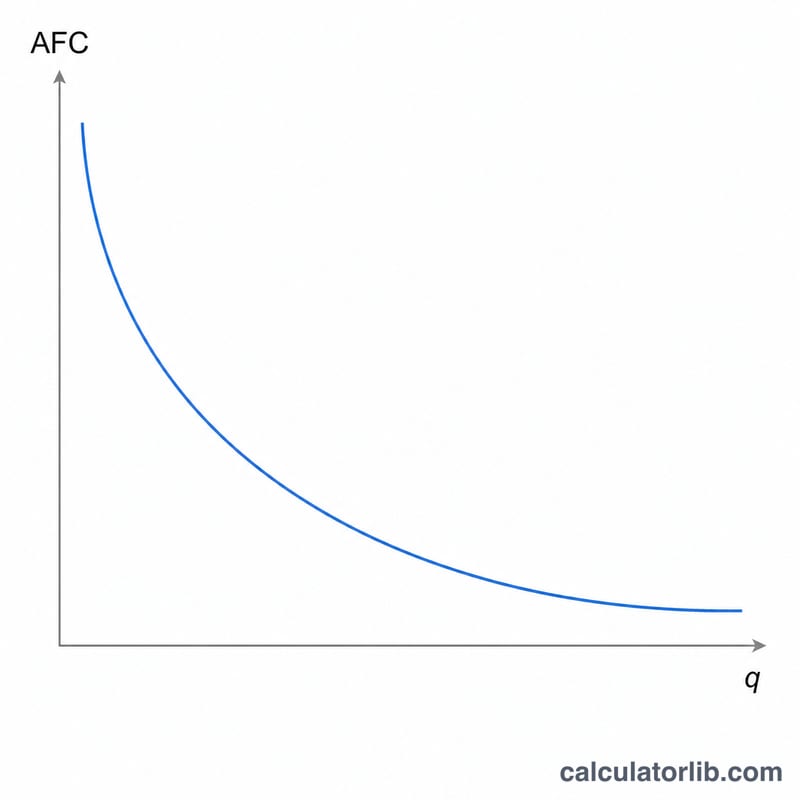
Average fixed cost (AFC) is total fixed costs divided by the quantity of output: \(\text{AFC} = \frac{\text{Total Fixed Costs}}{\text{Quantity}}\). Because total fixed costs stay the same no matter how much you produce, AFC falls continuously as output rises — a phenomenon often called "spreading the overhead." The decline is steep at first and then flattens, approaching (but never reaching) zero. This is why the AFC curve is a downward-sloping rectangular hyperbola.
The table below holds total fixed costs constant at $10,000 and varies output. Notice how doubling output always halves AFC.
| Total Fixed Costs | Quantity (units) | AFC per Unit |
|---|---|---|
| $10,000 | 100 | $100.00 |
| $10,000 | 250 | $40.00 |
| $10,000 | 500 | $20.00 |
| $10,000 | 1,000 | $10.00 |
| $10,000 | 2,000 | $5.00 |
| $10,000 | 5,000 | $2.00 |
Worked example for the 250-unit row: \(\text{AFC} = \frac{10{,}000}{250} = 40\), so each unit carries $40 of fixed cost. At 5,000 units that same $10,000 is spread to just \(\frac{10{,}000}{5{,}000} = \$2.00\) per unit. The curve keeps falling but the gap between successive points shrinks, which is the visual "flattening" of AFC at high volumes.
Key Terms Defined
- Average Fixed Cost (AFC)
- Total fixed costs divided by quantity of output, expressed as a cost per unit: \(\text{AFC} = \frac{\text{TFC}}{Q}\). AFC always declines as output increases because the fixed cost is shared over more units.
- Total Fixed Costs (TFC)
- Costs that do not change with the level of production within the relevant range — for example rent, salaried staff, insurance, equipment depreciation, and loan payments. They must be paid even if output is zero.
- Quantity of Output (Q)
- The number of units produced (or sold) over the period being measured. It is the denominator in the AFC formula; as Q grows, AFC shrinks.
- Average Variable Cost (AVC)
- Total variable costs divided by quantity, \(\text{AVC} = \frac{\text{TVC}}{Q}\). Unlike AFC, AVC typically follows a U-shape, falling then rising as output increases.
- Average Total Cost (ATC)
- Total cost per unit, equal to the sum of average fixed and average variable cost: \(\text{ATC} = \text{AFC} + \text{AVC} = \frac{\text{TC}}{Q}\). Because AFC falls continuously, the vertical gap between ATC and AVC narrows as output rises.
- Fixed vs. Variable Cost
- A fixed cost stays constant in total regardless of how many units are produced, so its per-unit amount falls with volume. A variable cost changes in total in proportion to output (e.g. raw materials, hourly labor, packaging), so its per-unit amount tends to stay roughly stable. Together they make up total cost.
FAQ
Does AFC include variable costs? No. AFC only considers fixed costs. To find the total average cost, add average variable cost (AVC) to AFC.
Why does AFC always decrease with output? Because fixed costs are constant, dividing them by a larger quantity always yields a smaller per-unit figure.
What units should I use? Use any currency for costs and any consistent unit (loaves, gadgets, hours) for output; the result is expressed per that unit.