

What Is the A/R Days Calculator?
The A/R Days Calculator measures Accounts Receivable Days, also known as Days Sales Outstanding (DSO). It tells you, on average, how many days it takes your business to collect payment after a credit sale. A lower number means you collect cash faster and have healthier working capital; a higher number can signal slow-paying customers or loose credit policies.
How to Use It
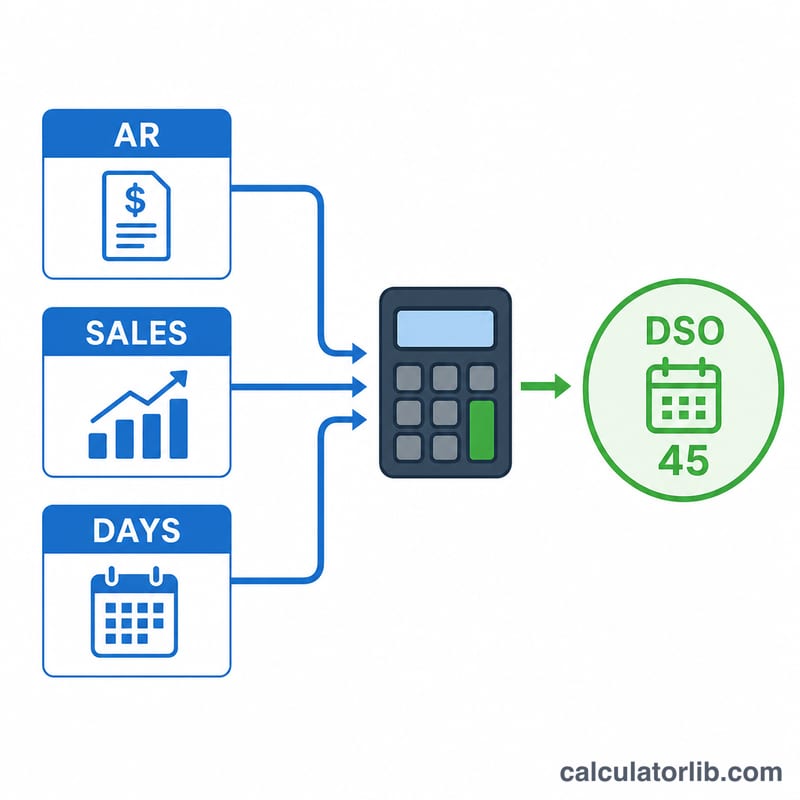
Enter three values: your accounts receivable balance (the money customers currently owe you), your total credit sales for the period, and the number of days in that period (typically 365 for a year, 90 for a quarter, or 30 for a month). The calculator instantly returns your A/R Days and your receivables turnover ratio.
The Formula Explained
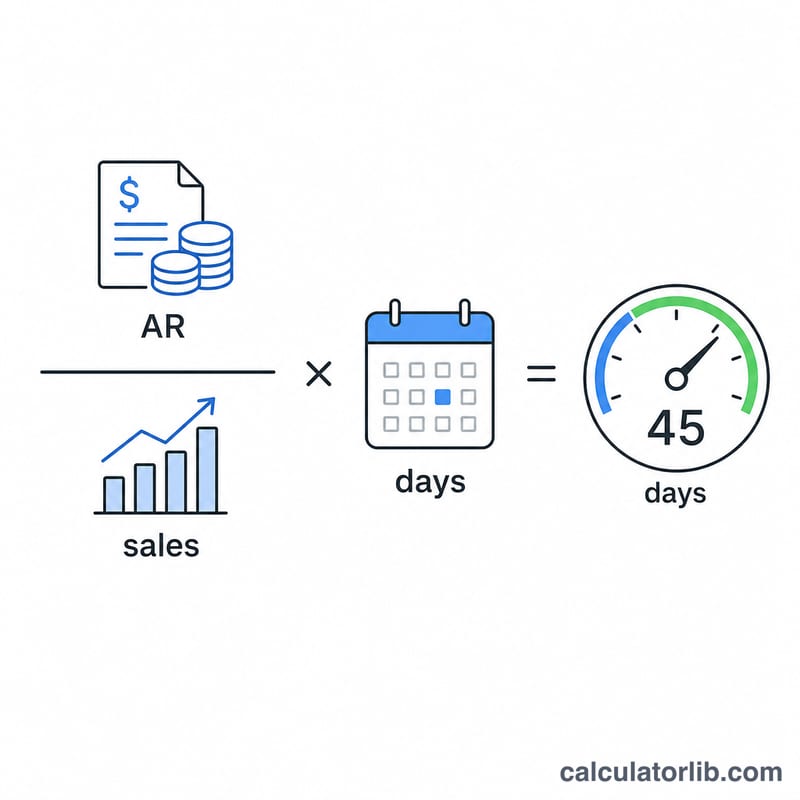
The core equation is:
$$\text{A/R Days} = \frac{\text{Accounts Receivable}}{\text{Total Credit Sales}} \times \text{Number of Days}$$
Accounts receivable divided by total credit sales gives the fraction of a period's sales still uncollected. Multiplying by the number of days converts that fraction into a day count. The related receivables turnover (Credit Sales ÷ A/R) shows how many times you cycle through your receivables in the period.
Worked Example
Suppose your accounts receivable is $50,000, total credit sales are $365,000, and the period is 365 days. Then $$\text{A/R Days} = \left(\frac{50{,}000}{365{,}000}\right) \times 365 = 0.13699 \times 365 = 50 \text{ days}$$ 50 days. Receivables turnover = \(365{,}000 \div 50{,}000 = 7.3\) 7.3 times per year.
Interpreting Your A/R Days Result
A/R Days — also called Days Sales Outstanding (DSO) — measures the average number of days it takes to collect payment after a credit sale. The number is most meaningful when compared against your stated payment terms.
- DSO near your terms (healthy): If you sell on net-30 and your A/R Days is roughly 30–35, customers are paying close to schedule and collections are running smoothly.
- DSO well above your terms (collection lag): A net-30 business with A/R Days of 55–70 is collecting far slower than agreed. This signals lenient credit policies, slow-paying customers, billing disputes, or weak follow-up.
- Very low DSO: A DSO well below terms can reflect efficient collections or a large share of cash/upfront sales — though an unusually low figure may also mean overly strict credit that limits sales.
The receivables turnover ratio is the inverse view: it equals total credit sales divided by accounts receivable, showing how many times you collect your average receivables balance during the period. A higher turnover means receivables convert to cash more frequently. The two metrics are linked: \(\text{A/R Days} = \frac{\text{Days in Period}}{\text{Receivables Turnover}}\).
Because uncollected receivables are cash tied up outside the business, DSO directly affects working capital and cash flow. A rising DSO means more capital is locked in customer balances, which can force a company to draw on credit lines or delay its own payments. DSO is also one of three components of the cash conversion cycle (alongside days inventory outstanding and days payable outstanding). This is general educational information, not financial advice.
A/R Days Across Common Scenarios
Each row applies \(\text{A/R Days} = \frac{\text{Accounts Receivable}}{\text{Total Credit Sales}} \times \text{Days in Period}\). The turnover ratio is total credit sales divided by accounts receivable.
| Scenario | Accounts Receivable | Total Credit Sales | Days in Period | A/R Days (DSO) | Turnover |
|---|---|---|---|---|---|
| Annual review | $120,000 | $1,460,000 | 365 | 30.0 | 12.2 |
| Quarterly check | $85,000 | $300,000 | 91 | 25.8 | 3.5 |
| Monthly snapshot | $48,000 | $50,000 | 30 | 28.8 | 1.04 |
| Slow collections (net-30) | $220,000 | $1,200,000 | 365 | 66.9 | 5.5 |
| Fast collections | $40,000 | $1,000,000 | 365 | 14.6 | 25.0 |
DSO is one leg of the cash conversion cycle, where it combines with days inventory outstanding and days payable outstanding to show how long cash is tied up overall.
Key Terms & Definitions
- Accounts Receivable (A/R)
- The total amount customers owe the business for goods or services delivered on credit but not yet paid for. Often the period-ending balance or an average of beginning and ending balances.
- Total Credit Sales
- Revenue from sales made on credit during the period (cash sales excluded). When credit-only figures aren't available, total revenue is sometimes used as an approximation.
- Days in Period
- The number of calendar days in the measurement window — typically 365 for a year, 90–92 for a quarter, or 28–31 for a month. This scales the ratio into a day count.
- Days Sales Outstanding (DSO)
- Another name for A/R Days: the average number of days between making a credit sale and receiving payment. Lower generally indicates faster collection.
- Receivables Turnover Ratio
- Total credit sales divided by accounts receivable — how many times the average receivables balance is collected during the period. It is the inverse driver of DSO.
- Net Terms
- The payment deadline a seller grants on a credit invoice, such as net-30 or net-60, meaning the full amount is due within that many days of the invoice date. DSO is judged against these terms.
FAQ
What is a good A/R Days figure? It depends on your industry and payment terms. If your terms are net-30, a DSO near 30–45 days is reasonable; much higher suggests collection issues.
Should I use total sales or only credit sales? Use credit sales for accuracy. Cash sales are collected immediately and dilute the metric if included.
Can I calculate it for a quarter? Yes — just use the credit sales for that quarter and set the number of days to 90 (or the actual days in the quarter).