What is the Days Lived Calculator?
This tool counts the exact number of days between your date of birth and any end date you choose (today by default). It also converts that span into weeks, hours, and approximate years. Because the calculation is based on actual calendar dates, it automatically accounts for leap years — so the count is precise rather than a simple multiplication.
How to use it
Enter your birth year, month, and day in the first row. In the second row, enter the end date you want to count up to (it defaults to the current date). Click calculate and you will see the total days lived along with weeks, hours, and a rough number of years.
The formula explained
The calculator converts both dates to a millisecond timestamp at midnight, subtracts the birth timestamp from the end timestamp, and divides by the number of milliseconds in a day (86,400,000). The result is rounded to the nearest whole day. Years are estimated by dividing days by 365.25, the average year length once leap years are taken into account.
$$\text{Days Lived} = \frac{\text{End Date} - \text{Birth Date}}{86400\ \text{s}} \\[1.5em] \text{where}\quad \left\{ \begin{aligned} \text{End Date} &= (\text{End Year},\ \text{End Month},\ \text{End Day}) \\ \text{Birth Date} &= (\text{Birth Year},\ \text{Birth Month},\ \text{Birth Day}) \end{aligned} \right.$$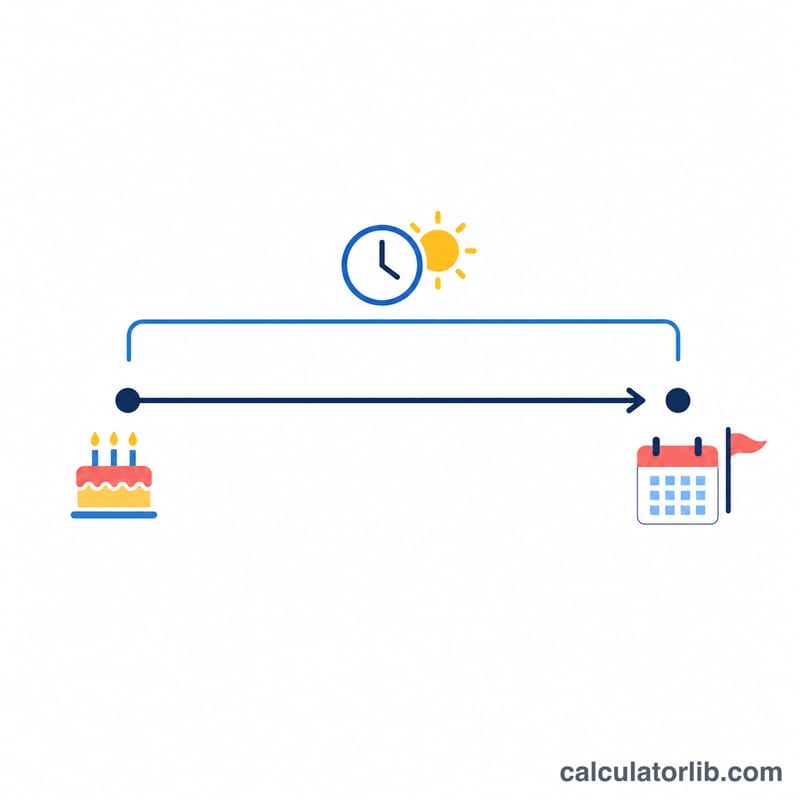
Worked example
From January 1, 2000 to January 1, 2020 there are 20 years. Five of those years are leap years (2000, 2004, 2008, 2012, 2016), so the span is
$$15 \times 365 + 5 \times 366 = 5{,}475 + 1{,}830 = 7{,}305 \text{ days}.$$That equals about 1,043.6 weeks, 175,320 hours, and roughly 20 years.
Common Day-Count Milestones
Round day counts are popular personal milestones precisely because they never line up with birthdays. The table lists the counts people most often watch for, with their equivalent in average years of 365.25 days.
| Milestone (days) | ≈ Average years | Notes |
|---|---|---|
| 1,000 | ≈ 2.74 | Common for babies and for tracking a streak or sobriety date |
| 5,000 | ≈ 13.7 | Falls in early adolescence |
| 6,570 | ≈ 18.0 | \(18 \times 365\) — reached shortly before the 18th birthday, since leap days are not counted in the product |
| 7,305 | ≈ 20.0 | \(20 \times 365.25\) — lands on or within a day of the 20th birthday |
| 10,000 | ≈ 27.4 | The best-known "round" day milestone |
| 11,574 | ≈ 31.7 | One billion seconds lived (\(10^9 \div 86{,}400 = 11{,}574.07\) days) |
| 13,149 | ≈ 36.0 | \(36 \times 365.25\) |
| 15,000 | ≈ 41.1 | Mid-life marker |
| 20,000 | ≈ 54.8 | |
| 25,000 | ≈ 68.4 | |
| 30,000 | ≈ 82.1 | Reached by a minority of people worldwide |
| ≈ 694.4 | ≈ 1.9 | One million minutes lived (\(10^6 \div 1{,}440\)) — day 694 is the last full day before it |
Worked example — the 10,000th day. For a birth date of 15 June 1990, counting forward 10,000 days gives 31 October 2017. Checking it the other way round, the span from 15 June 1990 to 31 October 2017 contains 27 full years (27 × 365 = 9,855 days) plus the seven 29 February dates of 1992, 1996, 2000, 2004, 2008, 2012 and 2016, plus 138 further days:
$$9{,}855 + 7 + 138 = 10{,}000\ \text{days}$$Entering those two dates returns exactly 10,000 days.
Finding your own milestone date
- Enter your date of birth in the birth fields and today's date as the end date to see your current day count.
- Subtract that count from your target milestone to see how many days remain.
- Move the end date forward — by years first, then months, then single days — until the counter reads the target number. The end date showing at that moment is your milestone date.
Expect the year equivalents in the table to shift by about ±1 day for any individual. Dividing by 365.25 assumes leap days arrive exactly one in four, but a specific person's span may contain one more or one fewer 29 February than average — someone born on 1 March 1996 and someone born on 1 March 1997 pass day 10,000 at slightly different ages. Only the day, week and hour figures are exact; treat the year column as a label, and use the calculator itself for the date.
FAQ
Does it count the end date itself? No — it counts the elapsed days between the two dates, so a date compared with itself gives 0 days.
Why use 365.25 for years? A calendar year averages 365.25 days once a leap day is added every four years, giving a more accurate "approximate years" figure than 365.
Can I count to a future date? Yes. Set the end date later than today to count days until a milestone, or earlier to look back.