
What Is the Days Since Date Calculator?
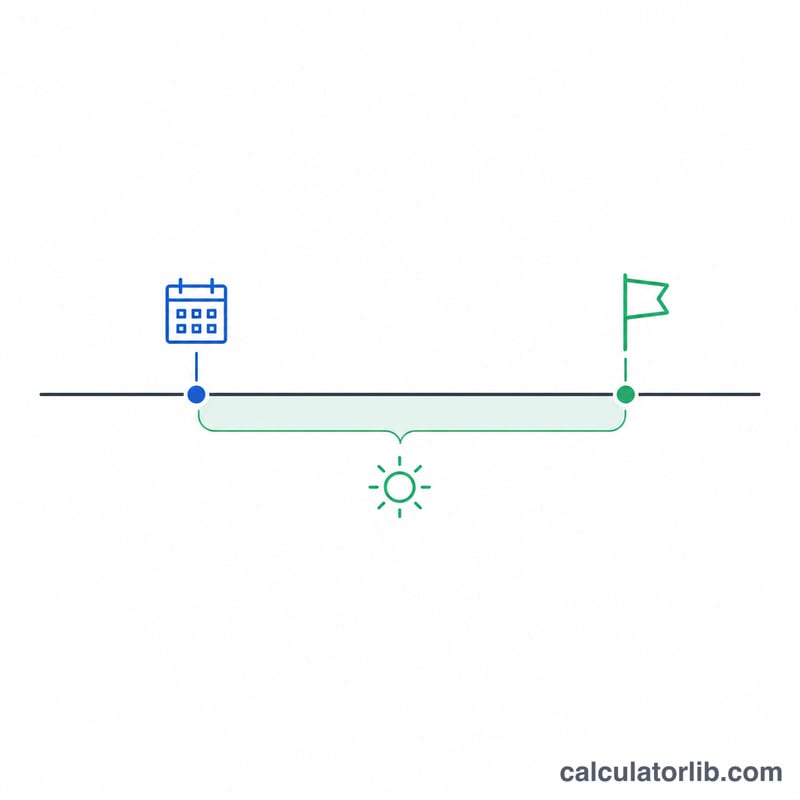
This tool counts how many days have elapsed between a past date and a reference date (today by default). It's handy for tracking how long ago an event happened — a birthday, an anniversary, a project start, a sobriety milestone, or the last time you did something.
How to Use It
Pick the past date. Optionally set a reference date; if you leave it blank the calculator uses today. The result shows the total number of days that have passed, plus equivalent weeks, approximate months, and approximate years.
The Formula
The core calculation subtracts the two calendar dates and divides by the number of milliseconds in a day:
$$\text{Days} = \frac{\text{Reference Date} - \text{Past Date}}{86400000 \text{ ms/day}}$$Both dates are normalized to midnight so partial days don't skew the count. Secondary figures use \(\text{weeks} = \text{days} \div 7\), \(\text{months} \approx \text{days} \div 30.4375\), and \(\text{years} \approx \text{days} \div 365.25\) (the average accounting for leap years).
Worked Example
From 1 January 2024 to a reference date of 1 January 2025: 2024 is a leap year, so that span is 366 days. In weeks that's \(366 \div 7 \approx 52.29\) weeks, and in years \(366 \div 365.25 \approx 1.002\) years.
FAQ
Does it count today? The result is the difference between the two midnights, so the reference day itself is not added as an extra day.
Why are months and years approximate? Calendar months vary from 28 to 31 days, so we use the average month length of 30.4375 days and average year of 365.25 days for a consistent estimate.
Can I count days into the future? This calculator is designed for past dates. If the past date is later than the reference date the day count will be negative.