

What Is the Days Ago Calculator?
The Days Ago Calculator tells you the exact calendar date that fell a given number of days before today. Whether you are counting back a billing cycle, a return window, an incubation period, or just satisfying curiosity, this tool removes the guesswork of subtracting days across month and year boundaries — including leap years.
How to Use It
Enter the number of days you want to count backward and submit. The calculator subtracts that many days from the current date and returns the resulting date in a friendly long form, the day of the week, and the ISO 8601 format (YYYY-MM-DD) that is handy for spreadsheets and software.
The Formula
The math is simply
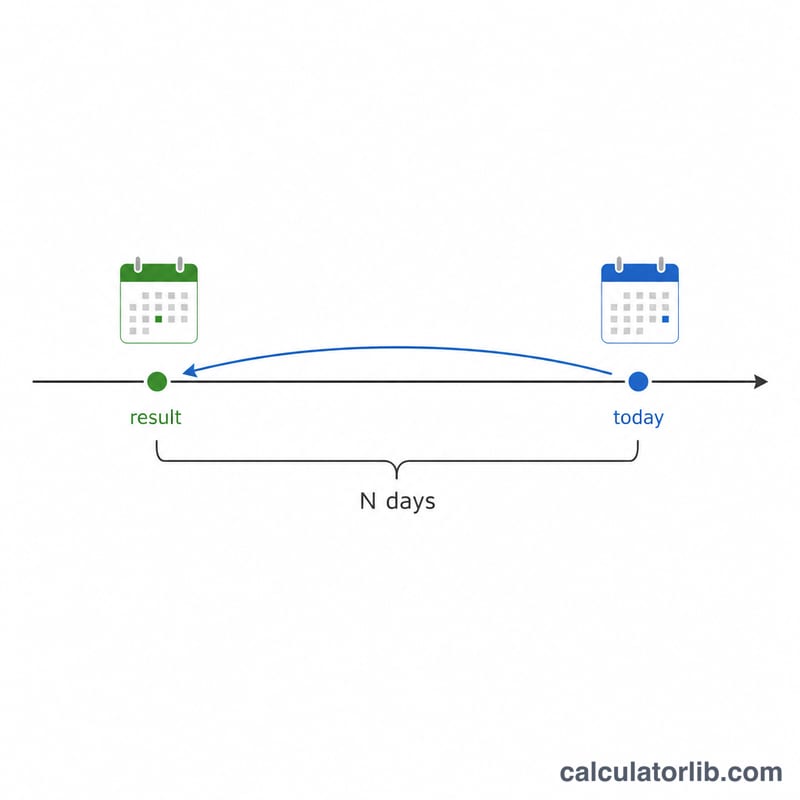
$$\text{Result Date} = \text{Today} - \text{Number of days ago}$$The calculator anchors to midnight of the current day, then steps backward \(N\) calendar days. Because it uses real calendar arithmetic, it automatically handles months of different lengths and February in leap years.
Worked Example
Suppose today is March 10, 2024 and you want to know what date was 30 days ago. Counting back:
$$\text{March 10, 2024} - 30\ \text{days} = \text{February 9, 2024}$$9 days reaches March 1, then 1 more reaches February 29 (2024 is a leap year), and 20 more reaches February 9, 2024. So 30 days ago was Friday, February 9, 2024 — written as 2024-02-09.
FAQ
Does it count today as day zero? Yes. "1 day ago" is yesterday, and "0 days ago" returns today's date.
Does it account for leap years? Yes. The calculation uses calendar logic, so February 29 is included in leap years and skipped otherwise.
Is it weekdays only? No. It counts every calendar day, including weekends and holidays. For a business-days tool, use a working-days calculator instead.