

What is the Time Ago Calculator?
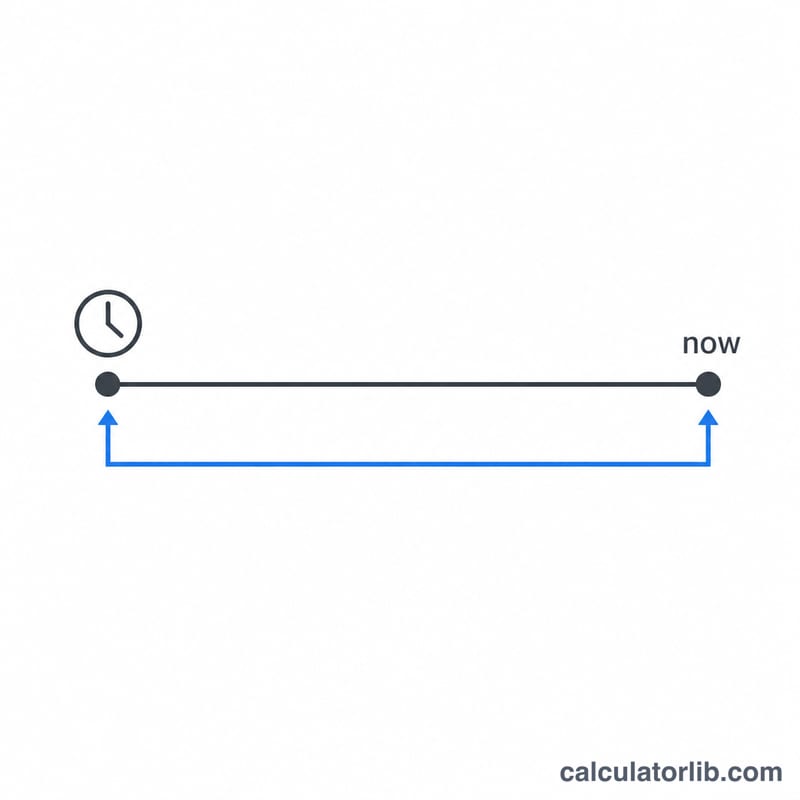
The Time Ago Calculator measures the span between a past date/time and a reference moment (by default, right now). It expresses the gap both as a friendly breakdown — years, months, days, hours and minutes — and as cumulative totals (weeks, days, hours, minutes). It also works in reverse: if the date you enter is in the future, it counts the time remaining until that moment.
How to use it
Enter the past date and (optionally) the time of day. Choose whether to compare against "Now" or a specific reference date/time. The result shows the direction (Past or Future), the calendar breakdown, and the total elapsed units. This is handy for tracking anniversaries, account age, project durations, or how long since an event.
The formula explained
The core calculation is simply the difference in milliseconds between the two instants:
$$\Delta t = t_{ref} - t_{past}$$Dividing by the number of milliseconds in a day, hour or minute yields the cumulative totals:
$$\text{days} = \frac{\Delta t_{ms}}{1000 \times 60 \times 60 \times 24}$$For the calendar breakdown, the calculator subtracts each field (year, month, day, hour, minute) and "borrows" from the next larger unit when a field goes negative — borrowing the actual number of days in the relevant month so February and 31-day months are handled correctly.
Worked example
Past: 2021-01-01 00:00. Reference: 2024-03-10 06:30. The gap is 3 years, 2 months, 9 days, 6 hours and 30 minutes. That equals roughly \(1{,}164.27\) total days and \(167.75\) total weeks.

FAQ
Does it handle leap years? Yes — millisecond arithmetic and calendar day counts naturally account for leap years.
What if my date is in the future? The "Direction" row will read "Future" and the totals count time until that moment.
Why are months variable length? Calendar months have 28–31 days, so the calculator borrows the exact length of the preceding month when normalizing the breakdown.