What This Calculator Does
This tool tells you exactly what the clock read a chosen number of hours before a reference time. Enter the current hour and minute, type how many hours to go back, and it returns the past time in both 24-hour and 12-hour (AM/PM) formats — plus how many days earlier the result falls if the subtraction crosses midnight.
How to Use It
1. Enter the current hour (0–23) and minute (0–59). 2. Enter the number of hours ago — decimals like 1.5 or 2.25 are allowed (a quarter hour = 0.25). 3. Read the result: the headline shows HH:MM, and the detail rows give the 24-hour hour, minute, and number of days rolled back.
The Formula Explained
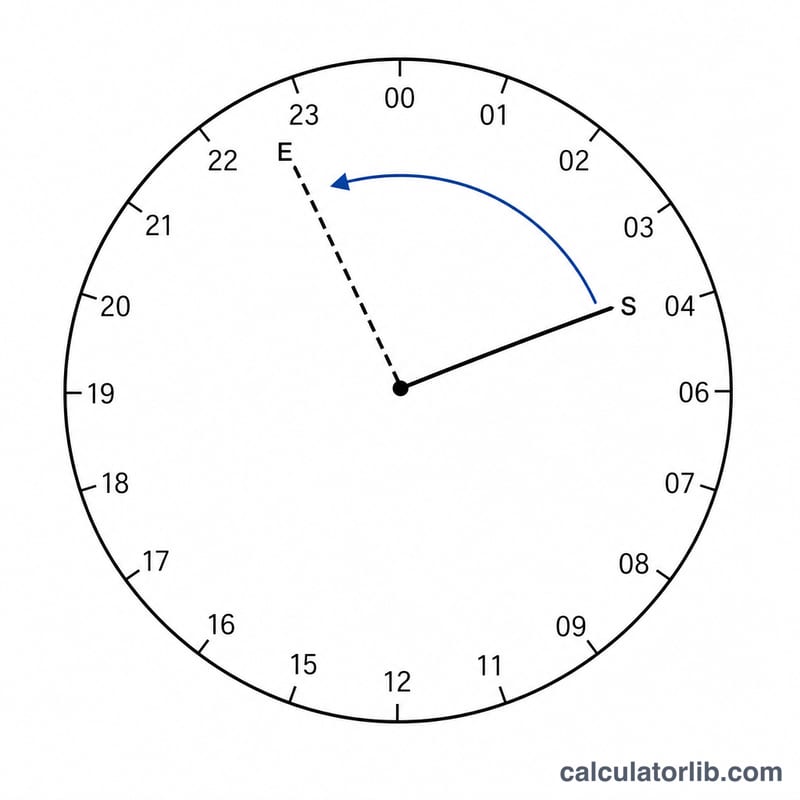
The current time is converted to seconds since midnight: \(\text{nowSeconds} = \text{hour} \times 3600 + \text{minute} \times 60\). We subtract the elapsed seconds (\(\text{hoursAgo} \times 3600\)) and take the result modulo 86400 (the number of seconds in a day). Because the raw subtraction can be negative, we add 86400 and take the modulo again so the answer is always a valid time between 00:00 and 23:59. Dividing the raw difference by 86400 and taking the floor tells us how many whole days back the time lands.
$$\text{Past Time} = \left[\left(\text{Hour} \times 3600 + \text{Minute} \times 60\right) - \text{Hours Ago} \times 3600 \right] \bmod 86400$$$$\begin{gathered} t = \Big[\,S - \text{Hours Ago} \times 3600\,\Big] \bmod 86400 \\[1.5em] \text{where}\quad \left\{ \begin{aligned} S &= \text{Hour} \times 3600 + \text{Minute} \times 60 \\ \text{Past Hour} &= \left\lfloor t / 3600 \right\rfloor \\ \text{Past Minute} &= \left\lfloor (t \bmod 3600) / 60 \right\rfloor \end{aligned} \right. \end{gathered}$$Worked Example
It is 2:00 (02:00) and you want to know the time 5 hours ago.
$$\text{nowSeconds} = 2 \times 3600 = 7200$$$$\text{agoSeconds} = 5 \times 3600 = 18000$$$$\text{Raw} = 7200 - 18000 = -10800$$$$\text{Wrapped: } (-10800 \bmod 86400 + 86400) \bmod 86400 = 75600 \text{ seconds} = 21{:}00 \text{ (9:00 PM), one day earlier.}$$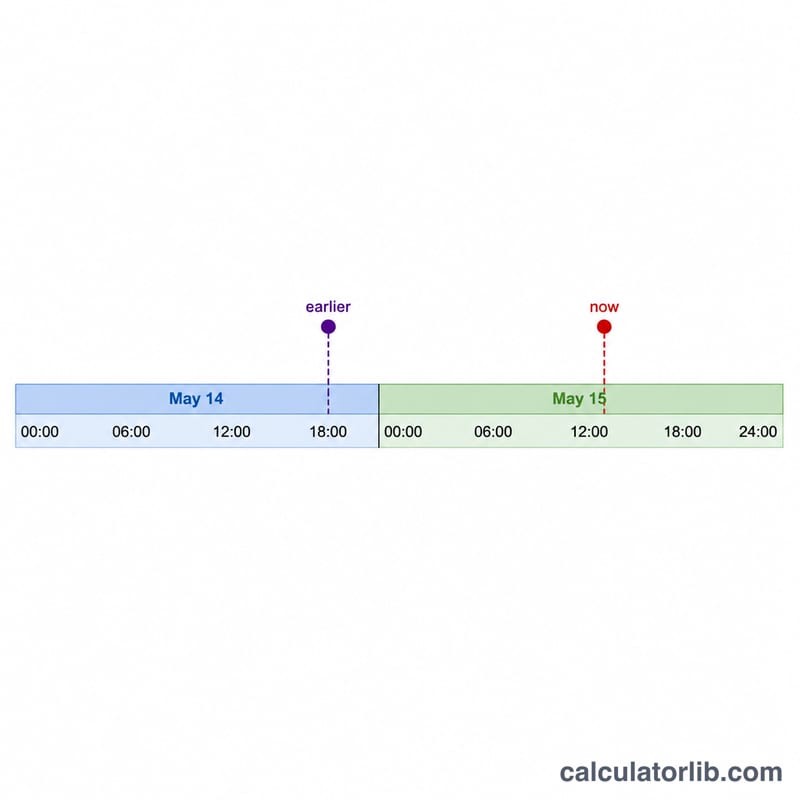
More Worked Examples
Each example uses the formula \(\text{Past Time} = (\text{Hour}\times 3600 + \text{Minute}\times 60 - \text{Hours Ago}\times 3600) \bmod 86400\), where 86,400 is the number of seconds in a day.
1. Same day, no rollover: 15:30 minus 2 hours
- Convert to seconds: \(15\times 3600 + 30\times 60 = 54000 + 1800 = 55800\).
- Subtract: \(55800 - 2\times 3600 = 55800 - 7200 = 48600\).
- Wrap: \(48600 \bmod 86400 = 48600\), because the value is already between 0 and 86,399.
- Convert back: \(48600 \div 3600 = 13.5\) h, which is 13:30.
Result: 13:30, 0 days back.
2. Decimal hours: 09:15 minus 1.75 hours
- Convert to seconds: \(9\times 3600 + 15\times 60 = 32400 + 900 = 33300\).
- Subtract: \(33300 - 1.75\times 3600 = 33300 - 6300 = 27000\).
- Wrap: \(27000 \bmod 86400 = 27000\).
- Convert back: \(27000 \div 3600 = 7.5\) h, which is 07:30.
Result: 07:30, 0 days back.
3. Multiple days: 10:00 minus 50 hours
- Convert to seconds: \(10\times 3600 + 0\times 60 = 36000\).
- Subtract: \(36000 - 50\times 3600 = 36000 - 180000 = -144000\).
- Wrap: \(-144000 + 2\times 86400 = -144000 + 172800 = 28800\), so \(-144000 \bmod 86400 = 28800\).
- Convert back: \(28800 \div 3600 = 8\) h, which is 08:00.
- Days back: \(-144000 \div 86400 \approx -1.67\), and rounding down gives \(-2\), so the time falls 2 days earlier.
Result: 08:00, 2 days earlier. Check: 50 h = 48 h + 2 h, so going back two full days and then 2 more hours from 10:00 gives 08:00.
Decimal Hours to Minutes Conversion
The calculator accepts decimal hours. To convert a decimal to minutes, multiply by 60. To go the other way, divide minutes by 60.
| Decimal hours | Minutes | Hours and minutes |
|---|---|---|
| 0.1 | 6 | 6 min |
| 0.25 | 15 | 15 min |
| 0.5 | 30 | 30 min |
| 0.75 | 45 | 45 min |
| 1.25 | 75 | 1 h 15 min |
| 1.5 | 90 | 1 h 30 min |
| 2.75 | 165 | 2 h 45 min |
Minutes to decimal hours (rounded): 10 min ≈ 0.167 h, 20 min ≈ 0.333 h. Because these repeat, 1 h 10 min is about 1.167 h, not 1.10 h.
Quick Scenarios: Time Hours Ago
| Current time | Hours ago | Resulting time (24-hour) | Resulting time (12-hour) | Days earlier |
|---|---|---|---|---|
| 12:00 | 6 | 06:00 | 6:00 AM | 0 |
| 00:30 | 1 | 23:30 | 11:30 PM | 1 |
| 03:00 | 8 | 19:00 | 7:00 PM | 1 |
| 14:45 | 24 | 14:45 | 2:45 PM | 1 |
| 08:00 | 72 | 08:00 | 8:00 AM | 3 |
| 18:20 | 0.5 | 17:50 | 5:50 PM | 0 |
Whenever the hours subtracted are an exact multiple of 24, the clock time stays the same and only the date changes. This calculation uses plain clock arithmetic and does not account for daylight saving time changes, which can shift the real result by an hour on transition days.
FAQ
Can I subtract more than 24 hours? Yes. The "days earlier" row shows how many full days the result rolls back.
Does it use my real current time? No — you type the reference time, so the result is reproducible and not affected by time zones.
Can I use fractions of an hour? Yes, use decimals such as 0.5 for 30 minutes or 0.25 for 15 minutes.