
What Is the Sober Up Time Calculator?
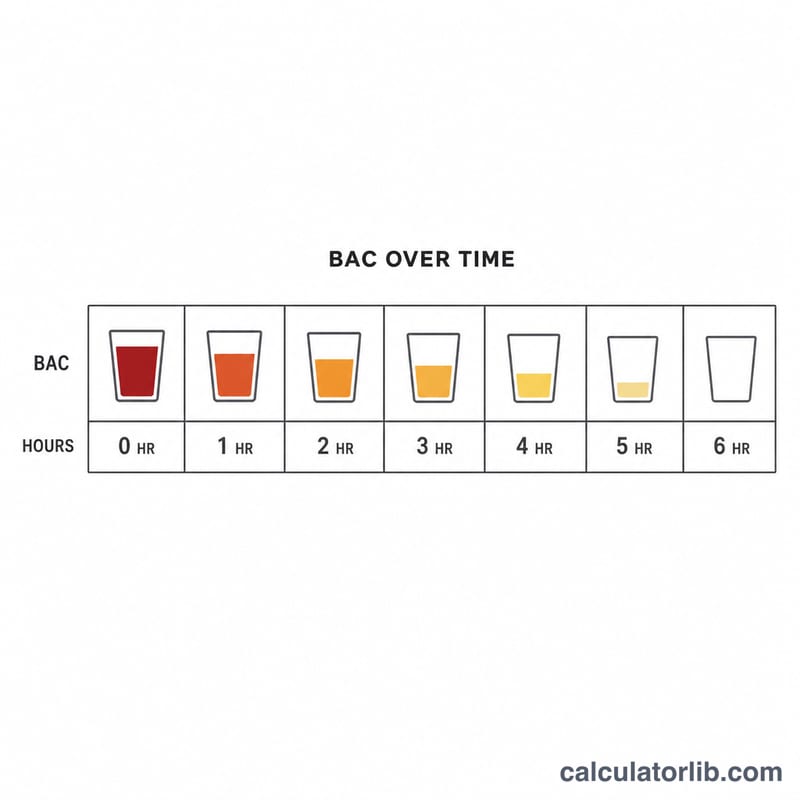
This tool estimates how long it will take for your blood alcohol concentration (BAC) to fall back to zero. The human body eliminates alcohol at a roughly constant rate, commonly cited as about 0.015% BAC per hour, regardless of coffee, cold showers, or sleep. By dividing your current BAC by that elimination rate, you get an approximate number of hours until you are fully sober.
How to Use It
Enter your current BAC as a percentage (for example, the common legal driving limit of 0.08). Then enter the metabolism rate — the default of 0.015 reflects the average adult. The calculator returns the total hours, broken down into whole hours and minutes.
The Formula Explained
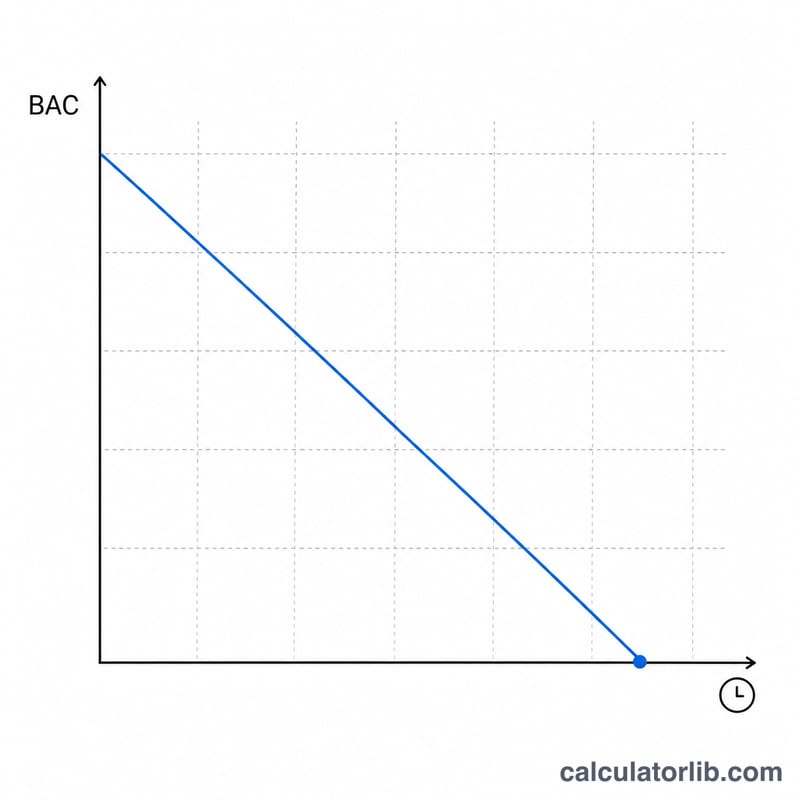
The equation is simply $$\text{Hours} = \frac{\text{BAC (\%)}}{\text{Rate (\%/hr)}}$$ Because alcohol elimination follows roughly zero-order kinetics (a fixed amount removed per unit time rather than a percentage), the relationship is linear. A higher starting BAC means a proportionally longer wait.
Worked Example
Suppose your BAC is 0.08% and your body clears 0.015% per hour. Then $$0.08 \div 0.015 = 5.33 \text{ hours},$$ which is 5 hours and 20 minutes until your BAC reaches zero.
FAQ
Can I speed up the process? No. Only time reliably lowers BAC; the liver metabolizes alcohol at a fairly fixed pace.
Is the 0.015 rate exact for everyone? No. Actual rates vary roughly between 0.010 and 0.020 per hour depending on body composition, sex, food intake, and liver health.
Is this safe to use for deciding to drive? No. This is an educational estimate only. Never rely on it to determine fitness to drive — when in doubt, do not drive.