
What Is the Standard Error of the Mean?
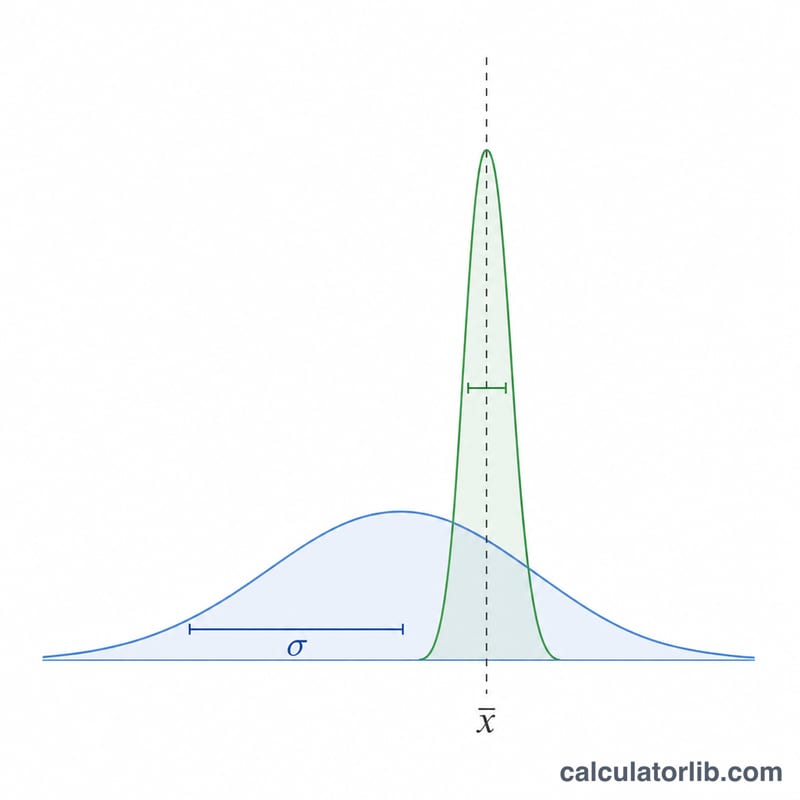
The standard error of the mean (SEM, or SE) measures how far the sample mean is likely to be from the true population mean. While the standard deviation describes how spread out individual data points are, the standard error describes how precise your estimate of the mean is. Larger samples produce smaller standard errors, meaning your mean estimate is more reliable.
How to Use This Calculator
Enter two values: your sample standard deviation (s) and your sample size (n). The calculator divides the standard deviation by the square root of the sample size to return the standard error of the mean. This is a universal statistical formula that applies to any field — biology, finance, psychology, engineering, and more.
The Formula Explained
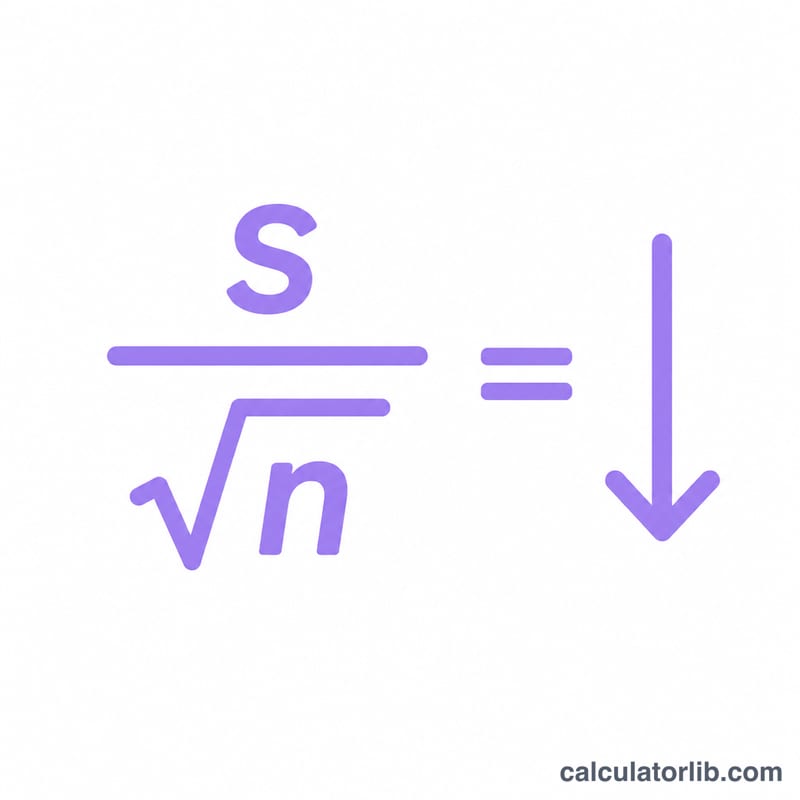
The equation is $$\text{SE} = \frac{\text{Standard Deviation }(s)}{\sqrt{\text{Sample Size }(n)}}$$ Here, s is the sample standard deviation and \(n\) is the number of observations. Because \(n\) is under a square root, you must quadruple your sample size to halve the standard error — a useful insight when planning studies.
Worked Example
Suppose a sample has a standard deviation of 15 and contains 25 observations. The standard error is $$15 \div \sqrt{25} = 15 \div 5 = 3$$ So the sample mean is estimated to within about 3 units of the true population mean (one standard error).
FAQ
What is the difference between standard deviation and standard error? Standard deviation measures variability among data points; standard error measures the precision of the sample mean estimate.
Does a bigger sample reduce the standard error? Yes. As \(n\) increases, \(\sqrt{n}\) increases and the standard error shrinks, giving a more precise estimate of the mean.
Can I use the population standard deviation instead? If you know the true population standard deviation (\(\sigma\)), you can use \(\text{SE} = \sigma / \sqrt{n}\). Most often you only have the sample standard deviation \(s\).