
What this calculator does
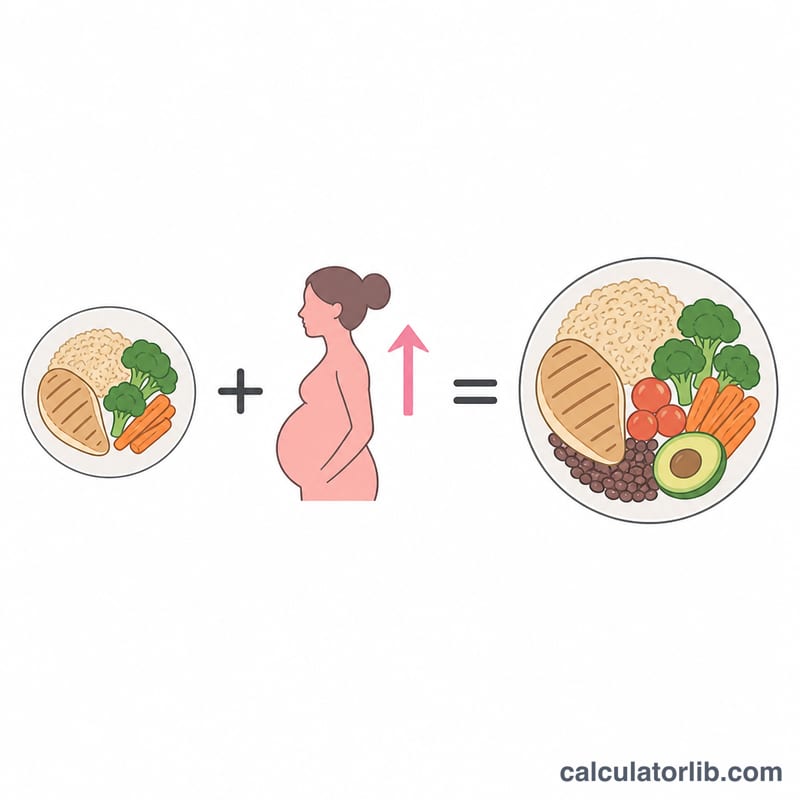
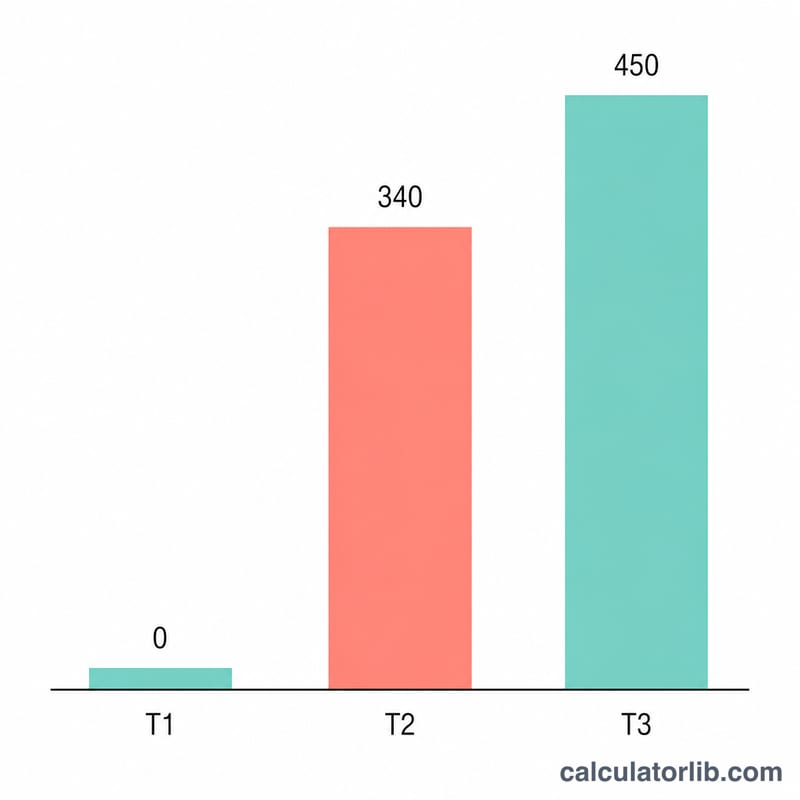
This tool estimates how many calories you need each day during pregnancy. It first computes your maintenance energy (TDEE) from your body stats and activity level, then adds the additional calories generally recommended for your trimester. The guidance figures used here (+0 kcal in the first trimester, +340 kcal in the second, +450 kcal in the third) follow widely cited recommendations from the U.S. Institute of Medicine / Dietary Guidelines. This is an educational estimate only — always follow the advice of your own healthcare provider, especially with multiples, underweight/overweight starting points, or medical conditions.
How to use it
Enter your pre-pregnancy or current weight in kilograms, your height in centimetres, your age, your typical activity level, and select your current trimester. The calculator returns your basal metabolic rate (BMR), your maintenance calories (TDEE), the trimester add-on, and the recommended daily total.
The formula explained
BMR uses the Mifflin-St Jeor equation for women: BMR = 10·weight(kg) + 6.25·height(cm) − 5·age − 161. Multiplying BMR by an activity factor (1.2 sedentary to 1.9 extra active) gives TDEE, the calories needed to maintain weight. Pregnancy increases energy demand, so we add 0 kcal (1st trimester), 340 kcal (2nd), or 450 kcal (3rd).
$$\text{TDEE} = \big(10w + 6.25h - 5a - 161\big) \times \text{activity}$$
$$\text{kcal} = \text{TDEE} + \begin{cases} 0 & T1 \\ 340 & T2 \\ 450 & T3 \end{cases}$$
Worked example
A 30-year-old woman weighing 65 kg at 165 cm, moderately active (×1.55), in her second trimester: $$\text{BMR} = 10\times65 + 6.25\times165 - 5\times30 - 161 = 650 + 1031.25 - 150 - 161 = \mathbf{1370.25}\ \text{kcal}$$ $$\text{TDEE} = 1370.25 \times 1.55 = \mathbf{2123.9}\ \text{kcal}$$ Add +340 for the second trimester → about 2464 kcal/day.
Activity Level Multipliers
The Mifflin-St Jeor equation estimates your Basal Metabolic Rate (BMR), which is then multiplied by a Physical Activity Level (PAL) factor to approximate your full maintenance energy expenditure (TDEE). Choose the category that best matches a typical week.
| Activity Category | PAL Multiplier | Typical Weekly Exercise |
|---|---|---|
| Sedentary | 1.2 | Desk job, little or no deliberate exercise |
| Lightly active | 1.375 | Light exercise or sport 1–3 days per week |
| Moderately active | 1.55 | Moderate exercise or sport 3–5 days per week |
| Very active | 1.725 | Hard exercise or sport 6–7 days per week |
| Extra active | 1.9 | Very hard daily exercise plus a physically demanding job |
During pregnancy, choose your activity level based on what you are realistically doing now, and discuss any changes to exercise intensity with your prenatal care provider.
Extra Calories by Trimester
On top of your maintenance calories, pregnancy increases energy needs as the trimesters progress. This tool uses the standard added amounts below for a singleton pregnancy.
| Trimester | Extra kcal/day | Approximate Food Equivalent |
|---|---|---|
| First (weeks 1–13) | +0 | No routine increase needed |
| Second (weeks 14–27) | +340 | A peanut-butter sandwich plus a glass of milk |
| Third (weeks 28–birth) | +450 | A small sandwich, fruit, and a serving of yogurt |
These figures derive from the Institute of Medicine (IOM, now the National Academy of Medicine) Dietary Reference Intakes (DRI) for energy during a singleton pregnancy. The food equivalents are rough illustrations only. Needs for twins or higher-order multiples are greater and should be set with a clinician.
Key Terms Explained
- BMR (Basal Metabolic Rate): The calories your body burns at complete rest to maintain vital functions such as breathing, circulation, and cell repair.
- TDEE (Total Daily Energy Expenditure): Your total calories burned in a day, equal to BMR multiplied by an activity factor — also called maintenance calories.
- Activity factor / PAL: A multiplier (1.2 to 1.9) that scales BMR up to account for movement, exercise, and daily activity.
- Trimester: One of the three roughly 13-week stages of pregnancy; energy needs rise in the second and third trimesters.
- Mifflin-St Jeor equation: A widely used BMR formula. For females: \(\text{BMR} = 10\,W + 6.25\,H - 5\,A - 161\), where \(W\) is weight in kg, \(H\) is height in cm, and \(A\) is age in years.
- Maintenance calories: The number of calories that keeps body weight stable for your current activity level — the baseline before adding trimester energy.
FAQ
Do I really "eat for two"? No. Extra needs are modest — roughly a small snack's worth in the later trimesters, not a doubling of intake.
Why is the first trimester +0? Energy needs change very little early on; quality of nutrition matters more than quantity at that stage.
Is this safe for weight management? Pregnancy is not a time for calorie restriction. Use this as a guide and consult your doctor or dietitian for a plan tailored to you.