
What Is the Number of Diagonals of a Polygon?
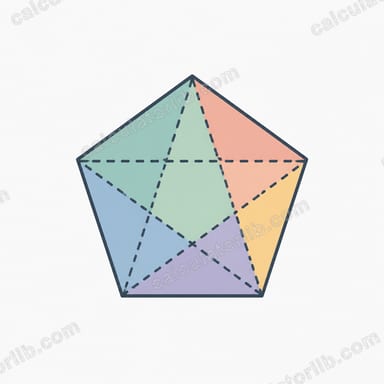
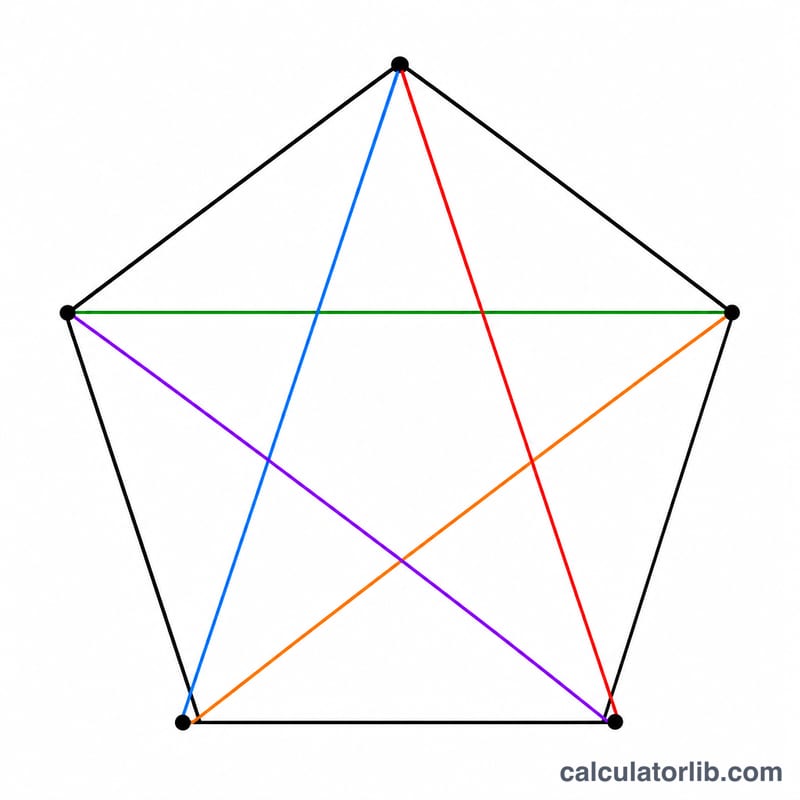
A diagonal is a straight line segment that connects two non-adjacent vertices of a polygon. Sides connect adjacent vertices, so they are not counted as diagonals. This calculator tells you exactly how many diagonals any polygon has, based only on its number of sides (n).
How to Use the Calculator
Enter the number of sides of your polygon — for example, 3 for a triangle, 4 for a quadrilateral, 5 for a pentagon, and so on. The calculator instantly returns the total number of diagonals. The number of sides must be at least 3, since fewer than three sides cannot form a closed polygon.
The Formula Explained
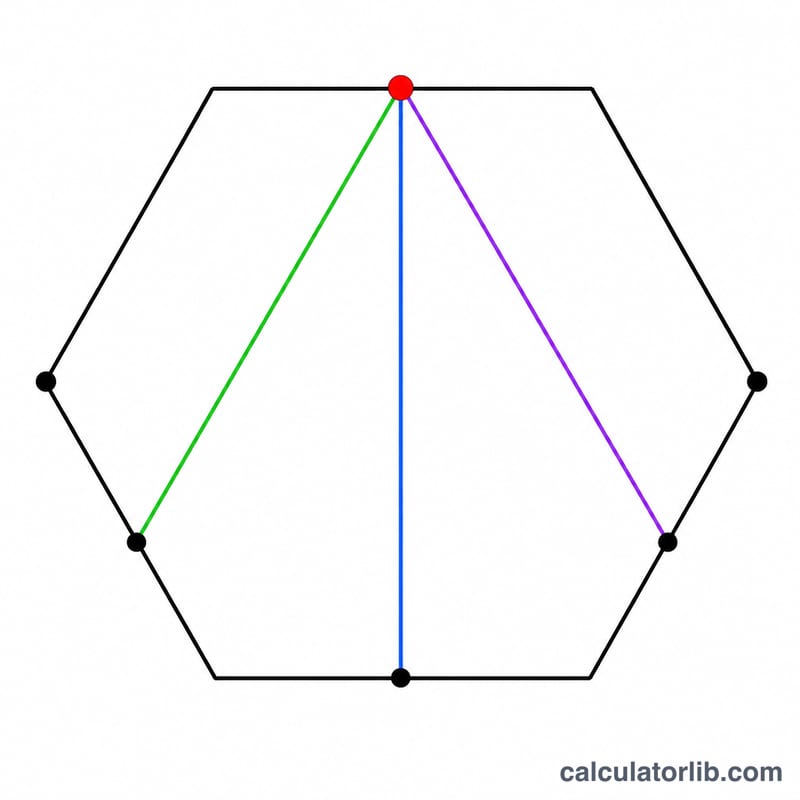
The number of diagonals is given by $$D = \frac{n(n - 3)}{2}$$. Each of the \(n\) vertices can connect to \(n - 3\) others by a diagonal (you exclude itself and its two neighbours). That gives \(n(n - 3)\) connections, but each diagonal is counted twice — once from each endpoint — so we divide by 2.
Worked Example
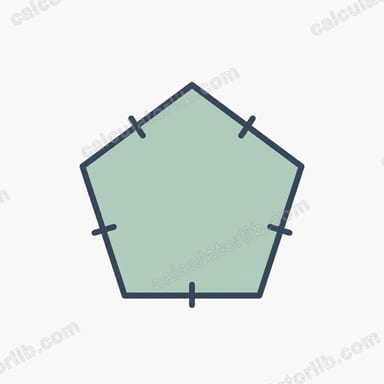
Consider a hexagon, which has \(n = 6\) sides. Plugging into the formula: $$D = \frac{6 \times (6 - 3)}{2} = \frac{6 \times 3}{2} = \frac{18}{2} = 9$$ So a hexagon has 9 diagonals. For a pentagon (\(n = 5\)): \(D = \frac{5 \times 2}{2} = 5\) diagonals.
FAQ
How many diagonals does a triangle have? Zero. With \(n = 3\), \(D = \frac{3 \times 0}{2} = 0\), because every pair of vertices is already connected by a side.
Does the shape have to be regular? No. The formula depends only on the number of sides, so it works for any simple (non-self-intersecting) polygon, regular or irregular.
How many diagonals does a square have? A square (\(n = 4\)) has \(D = \frac{4 \times 1}{2} = 2\) diagonals.