
What is a regular polygon?
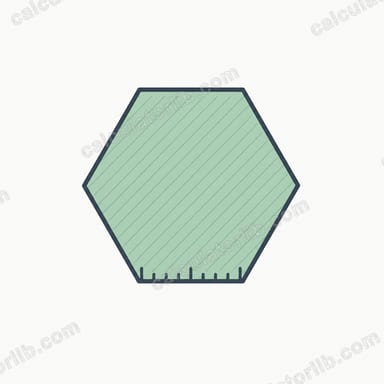
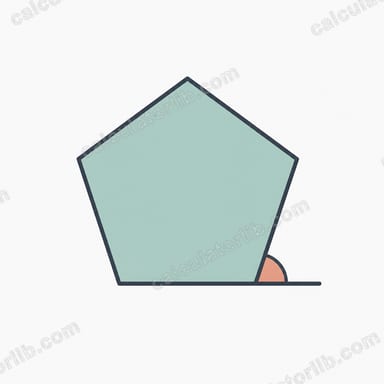
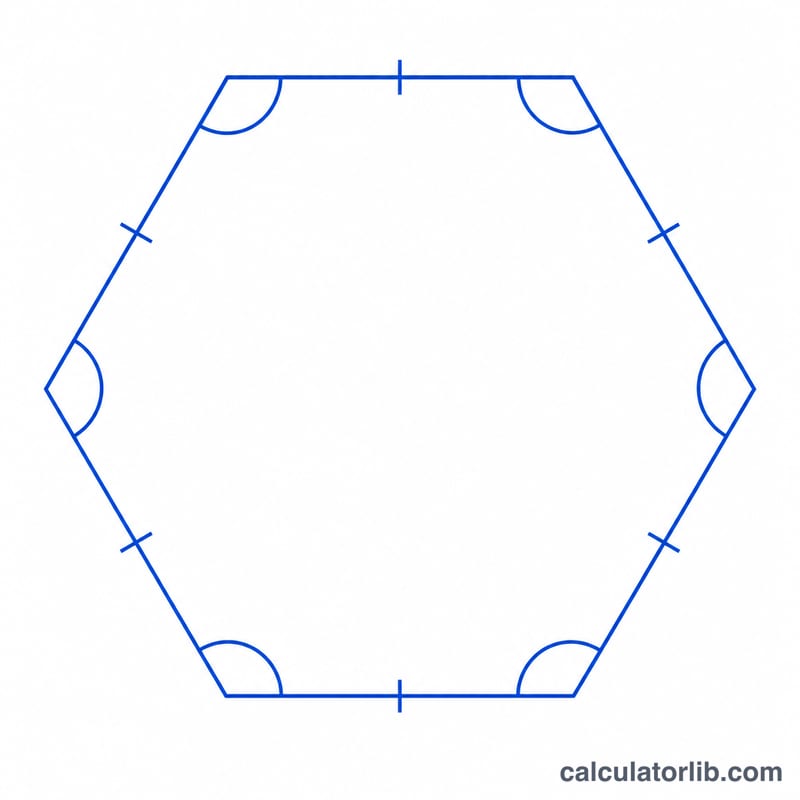
A regular polygon is a closed shape with all sides equal in length and all interior angles equal. Triangles, squares, pentagons, hexagons and octagons are common examples. This calculator works for any regular polygon with three or more sides, returning its area, perimeter, interior and exterior angles, apothem (inradius) and circumradius.
How to use it
Enter the number of sides n (3 or more) and the length of one side s in any unit you like. The results use the same units: lengths share your input unit and area is in those units squared. Angles are always in degrees.
The formulas explained
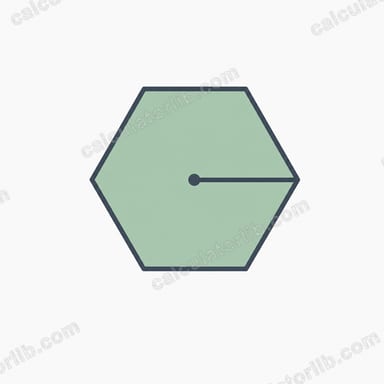
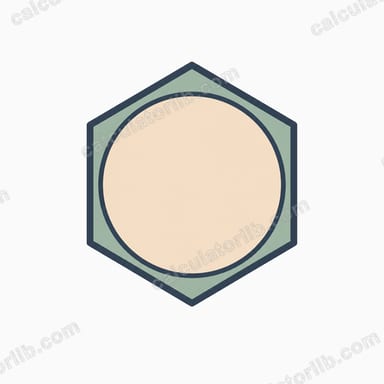
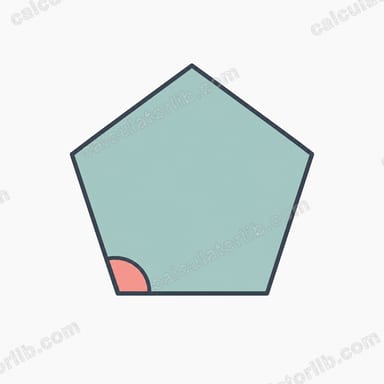
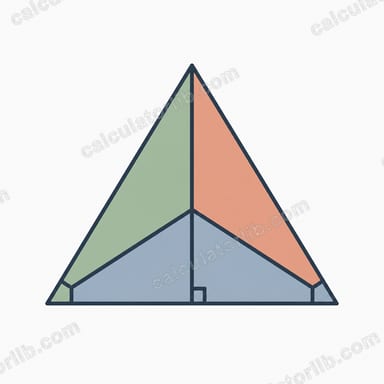
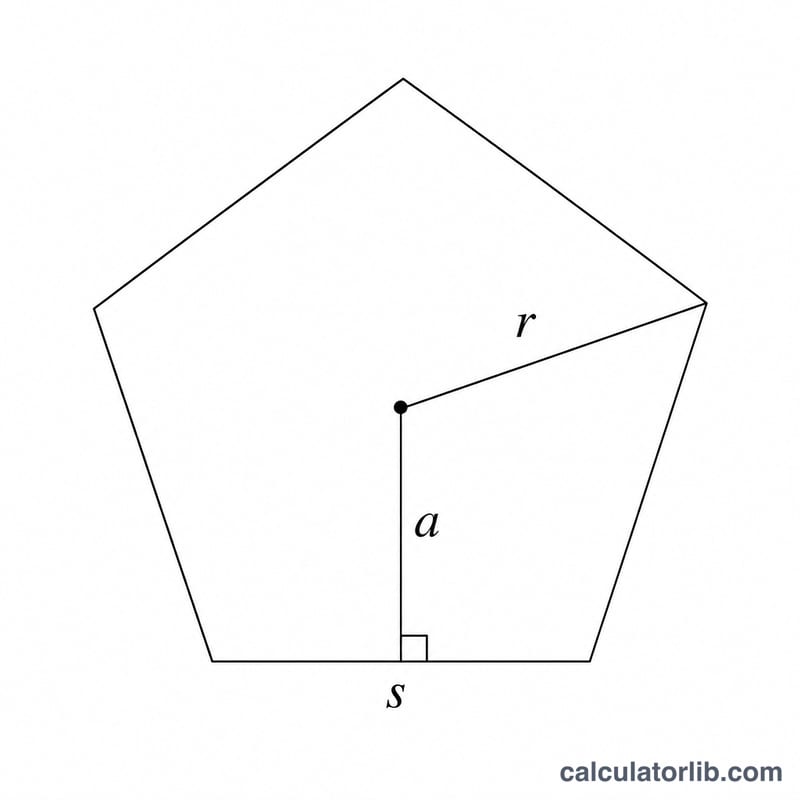
The area is $$A = \tfrac{1}{4}\,n\cdot s^{2}\cdot \cot\!\left(\frac{\pi}{n}\right)$$ where cot is the cotangent and \(\pi/n\) is half the central angle of one of the \(n\) identical triangles that make up the polygon. The perimeter is simply $$P = n\cdot s$$ Each interior angle equals $$\theta_{\text{int}} = \frac{\left(n-2\right)\cdot 180^{\circ}}{n}$$ and each exterior angle equals $$\theta_{\text{ext}} = \frac{360^{\circ}}{n}$$ The apothem (distance from center to the midpoint of a side) is $$a = \frac{s}{2\,\tan\!\left(\frac{\pi}{n}\right)}$$ and the circumradius (center to a vertex) is $$R = \frac{s}{2\,\sin\!\left(\frac{\pi}{n}\right)}$$
Worked example
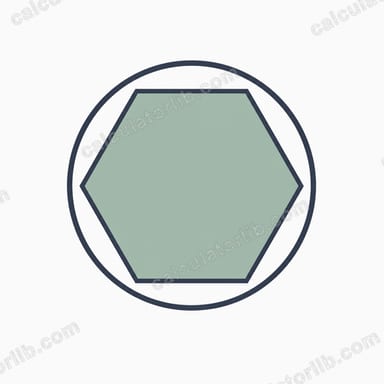
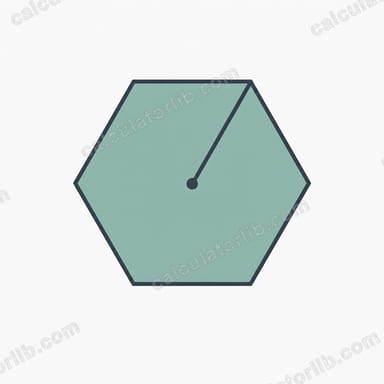
For a regular hexagon (\(n = 6\)) with side length \(s = 10\): the perimeter is $$6 \times 10 = 60$$ The area is $$\tfrac{1}{4} \times 6 \times 100 \times \cot(30^{\circ}) = 150 \times \sqrt{3} \approx 259.81$$ square units. Each interior angle is $$\frac{(6-2)\cdot 180^{\circ}}{6} = 120^{\circ}$$ and each exterior angle is \(60^{\circ}\). The apothem is $$\frac{10}{2\,\tan 30^{\circ}} \approx 8.66$$ and the circumradius is exactly \(10\).
FAQ
Does it work for a triangle or square? Yes. With \(n = 3\) you get an equilateral triangle; with \(n = 4\), a square.
What units does the area use? Whatever unit you enter the side length in, squared (e.g. cm → cm²).
Why must n be at least 3? A polygon needs at least three sides to enclose an area; fewer sides do not form a closed shape.