
What this calculator does
This tool takes the side length of a regular polygon and computes its inscribed circle (the incircle), returning the inradius, the incircle area and the polygon area. Instead of a single result, it builds a table sweeping the number of sides n from a starting value to an ending value, so you can compare a triangle, square, pentagon, hexagon and beyond side by side. The math is pure geometry and is valid everywhere, in any consistent length unit.
How to use it
Enter the side length \(a\) (any positive number), then set the range of side counts: "Regular polygon n (from)" and "Regular polygon n (to)". Because a polygon needs at least three sides, \(n\) starts at 3. The table produces one row per integer \(n\), up to a maximum of 200 rows. To get a single answer, set the "from" and "to" values to the same number.
The formula explained
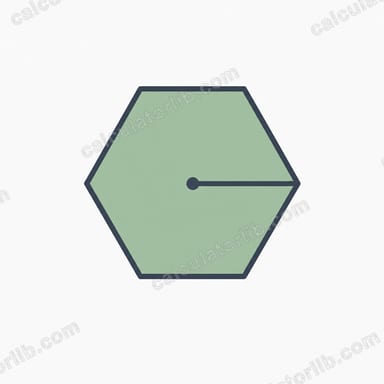
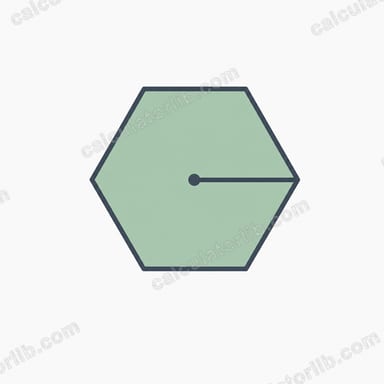
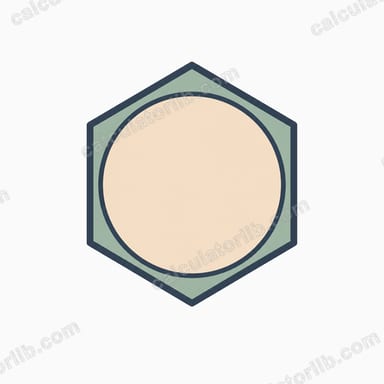
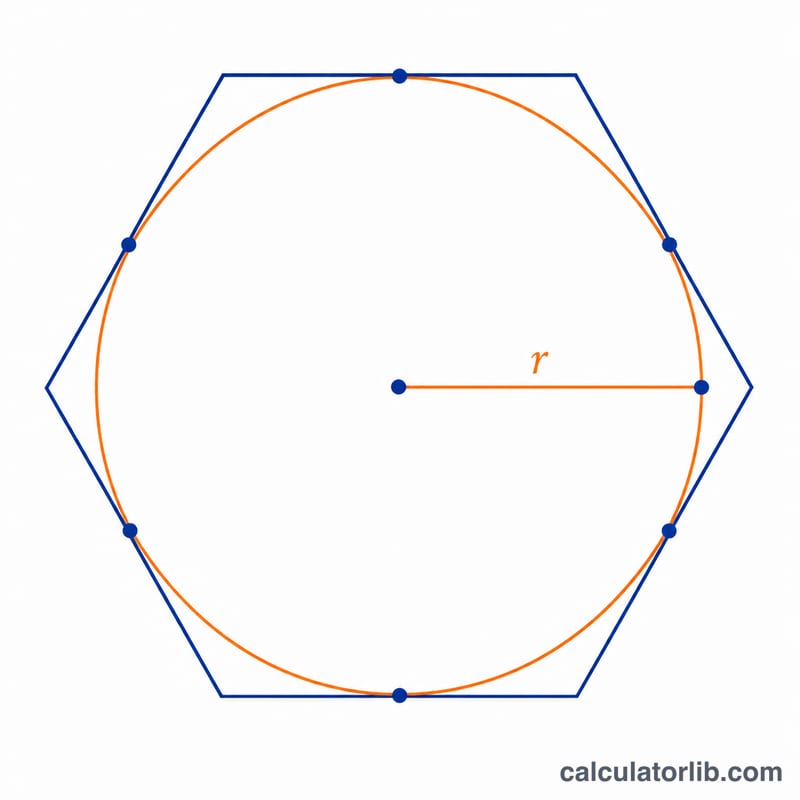
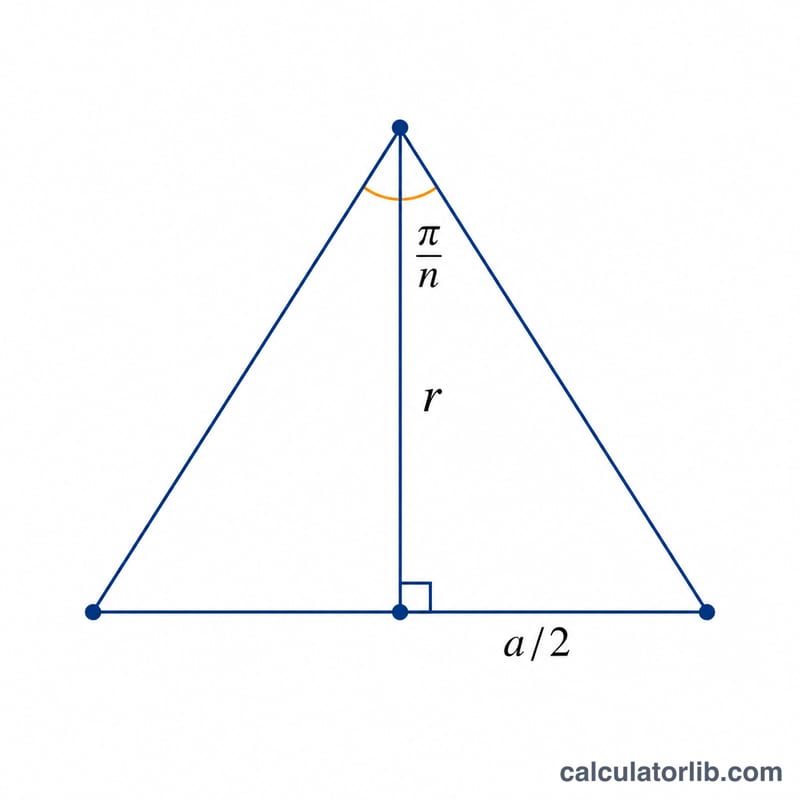
The incircle (also called the inscribed circle) touches the midpoint of every side, and its radius is the polygon's apothem. With angles measured in radians and \(n\) sides of length \(a\), the inradius is $$r = \frac{a}{2\tan(\pi/n)}$$ The incircle area follows from the standard circle formula $$S_c = \pi r^2$$ The polygon area equals half the perimeter times the apothem, which simplifies to $$S_p = \frac{n\,a^2}{4\tan(\pi/n)}$$ Since \(0 < \pi/n < \pi/2\) for \(n \ge 3\), \(\tan(\pi/n)\) is always positive, so there is never a division by zero.
Worked example
For a unit hexagon, \(a = 1\) and \(n = 6\). Here \(\pi/6 = 0.5235988\) rad and \(\tan(\pi/6) = 0.5773503\). The inradius is $$r = \frac{1}{2 \times 0.5773503} = 0.8660254$$ The incircle area is $$S_c = \pi \times 0.8660254^2 = \pi \times 0.75 = 2.3561945$$ The polygon area is $$S_p = \frac{6}{4 \times 0.5773503} = 2.5980762$$ which matches the known hexagon area \(\frac{3\sqrt{3}}{2}\).
FAQ
What is the incircle versus the circumcircle? The incircle sits inside and touches each side at its midpoint; the circumcircle passes through the vertices. This tool computes the incircle.
Why does the polygon area grow as n increases? Because the side length \(a\) is held fixed, larger \(n\) means a physically larger shape, so both areas increase; the polygon area approaches the incircle area in shape but they keep growing.
What units are used? Whatever length unit you supply for \(a\). Lengths come out in that unit and areas in its square.