
What is a Regular Polygon?
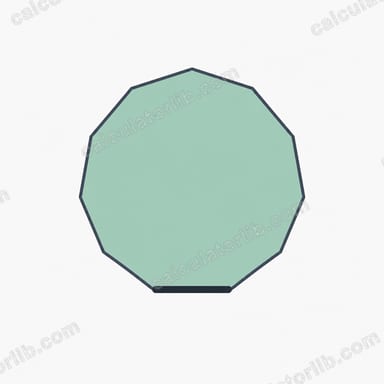
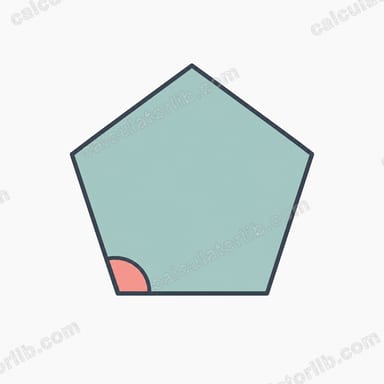
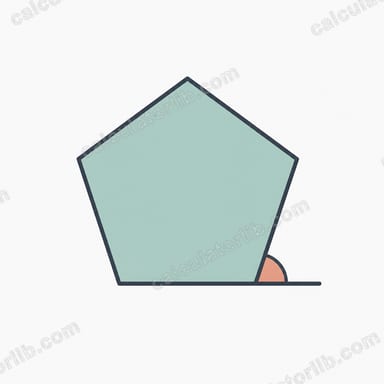
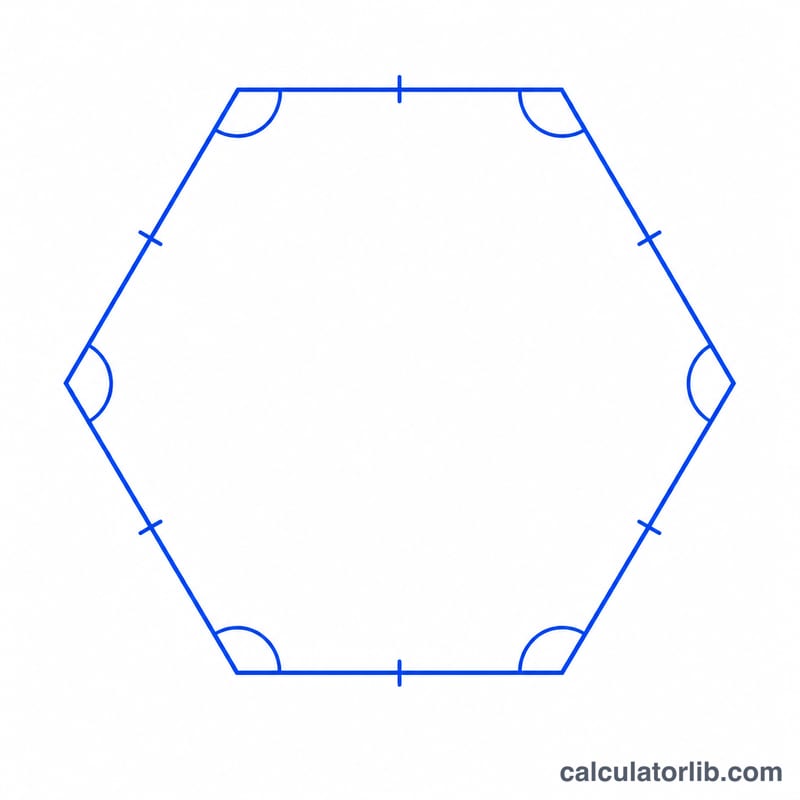
A regular polygon is a closed shape whose sides are all equal in length and whose interior angles are all equal. Common examples include the equilateral triangle (3 sides), square (4 sides), pentagon (5), hexagon (6) and so on. Because every side and angle is identical, all of its key measurements can be derived from just two values: the number of sides n and the side length s.
How to Use This Calculator
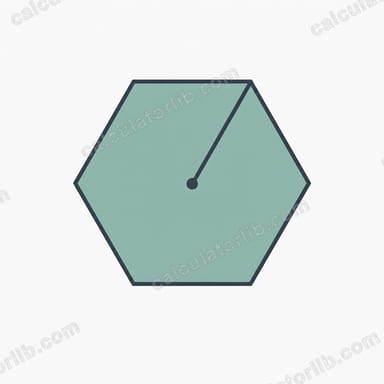
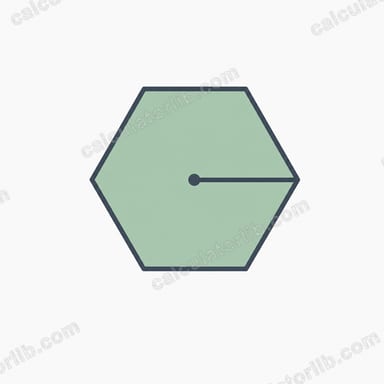
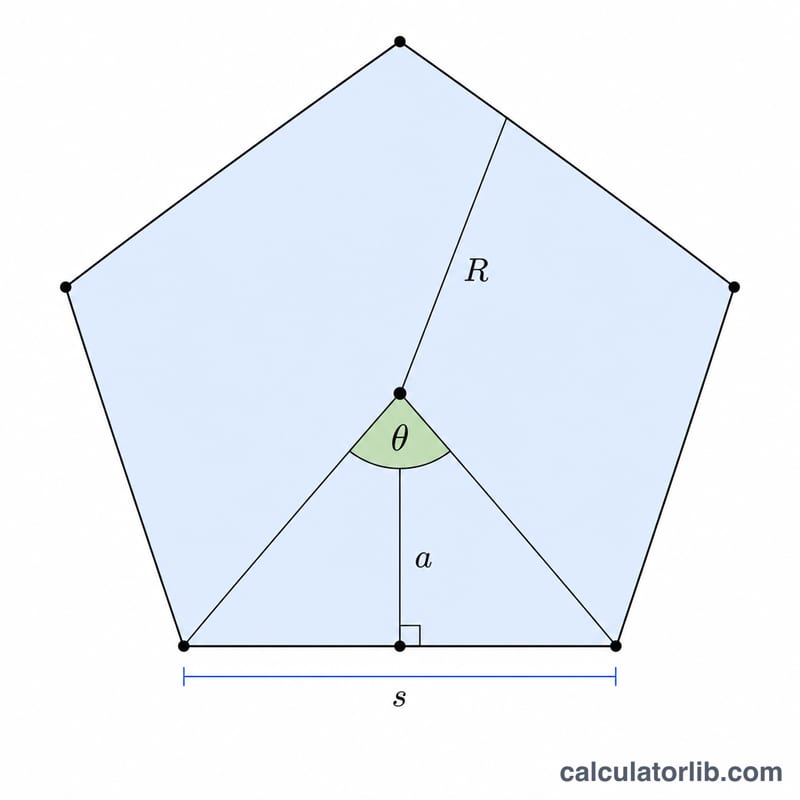
Enter the number of sides (any whole number from 3 upward) and the length of one side. The calculator instantly returns the area, perimeter, apothem (the inradius, or distance from the center to the middle of a side), circumradius (distance from center to a vertex), and both the interior and exterior angles.
The Formula Explained
The area uses the cotangent function: $$A = \frac{1}{4}\,n\,s^2\,\cot\!\left(\frac{\pi}{n}\right)$$ As the number of sides grows, the polygon approaches a circle, and the cotangent term reflects that geometry. The perimeter is simply $$P = n \times s$$ The apothem is \(a = \frac{s}{2\tan(\pi/n)}\) and the circumradius is \(R = \frac{s}{2\sin(\pi/n)}\). Each interior angle equals \(\frac{(n-2)\cdot 180}{n}\) degrees.
Worked Example
For a regular hexagon (\(n = 6\)) with side length \(s = 10\): the perimeter is \(6 \times 10 = 60\) units. The area is $$\frac{1}{4} \times 6 \times 10^2 \times \cot\!\left(\frac{\pi}{6}\right) = 150 \times 1.7320508 \approx 259.81$$ square units. The interior angle is \(\frac{(6-2)\cdot 180}{6} = 120^\circ\).
FAQ
What is the minimum number of sides? A polygon needs at least 3 sides, so the calculator requires \(n \geq 3\).
What units does it use? The tool is unit-agnostic — output is in the same units you enter. If side length is in cm, area is in cm².
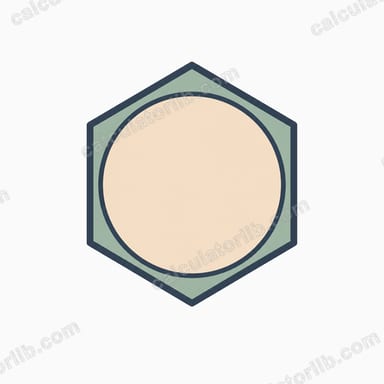
Does it work for very high-sided polygons? Yes. As \(n\) increases, the area and perimeter converge to those of a circle with the corresponding circumradius.