
What is a rhombus?
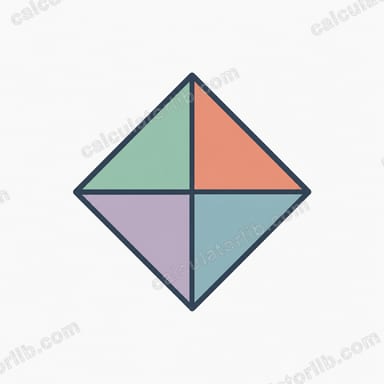
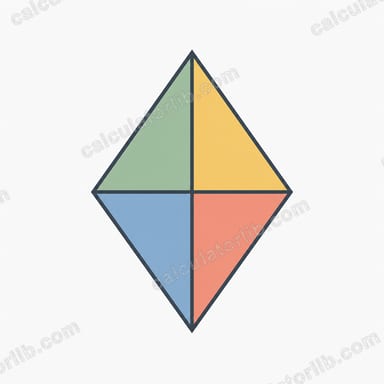
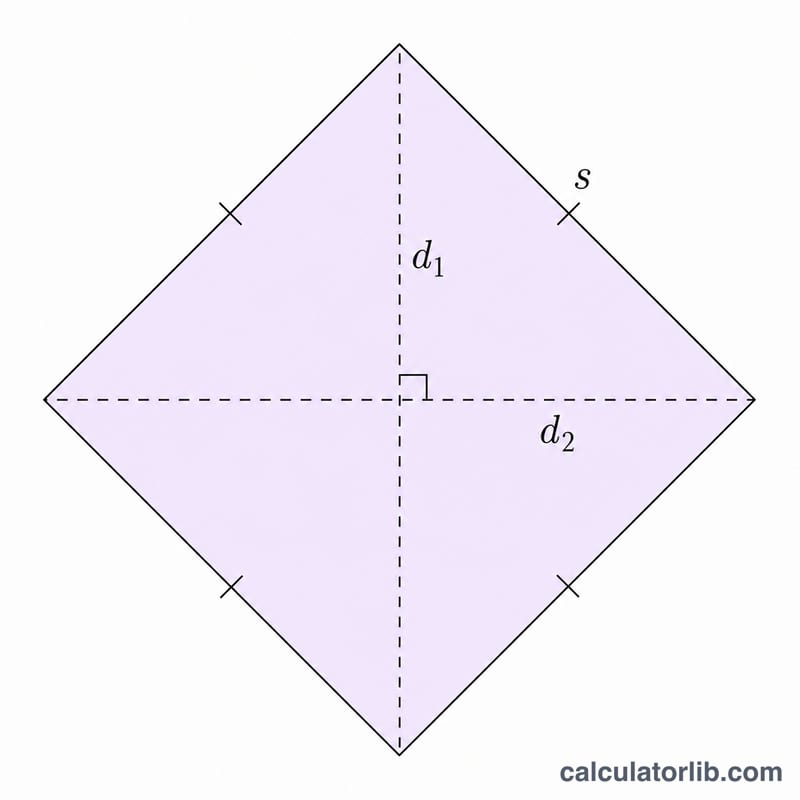
A rhombus is a quadrilateral with four equal-length sides. Its two diagonals cross at right angles and bisect each other, which makes it easy to calculate the area and perimeter once you know the diagonals. A rhombus is sometimes called a diamond or lozenge, and a square is simply a special rhombus where all angles are 90°.
How to use this calculator
Enter the lengths of the two diagonals, \(d_1\) and \(d_2\). The calculator immediately returns the area. If you leave the side field blank, the side is computed automatically from the diagonals using the Pythagorean relationship, and the perimeter follows. If you already know the side length, type it in and the perimeter uses that value directly.
The formulas explained
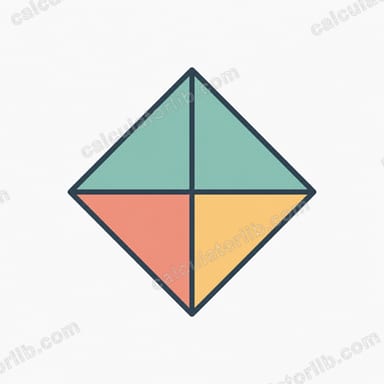
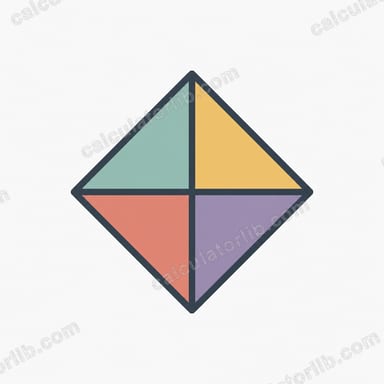
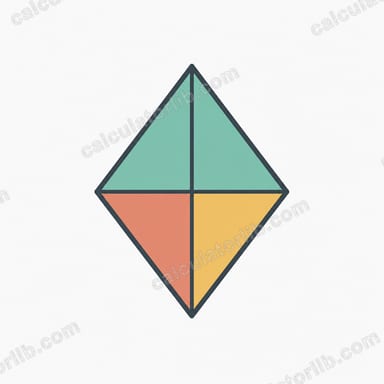
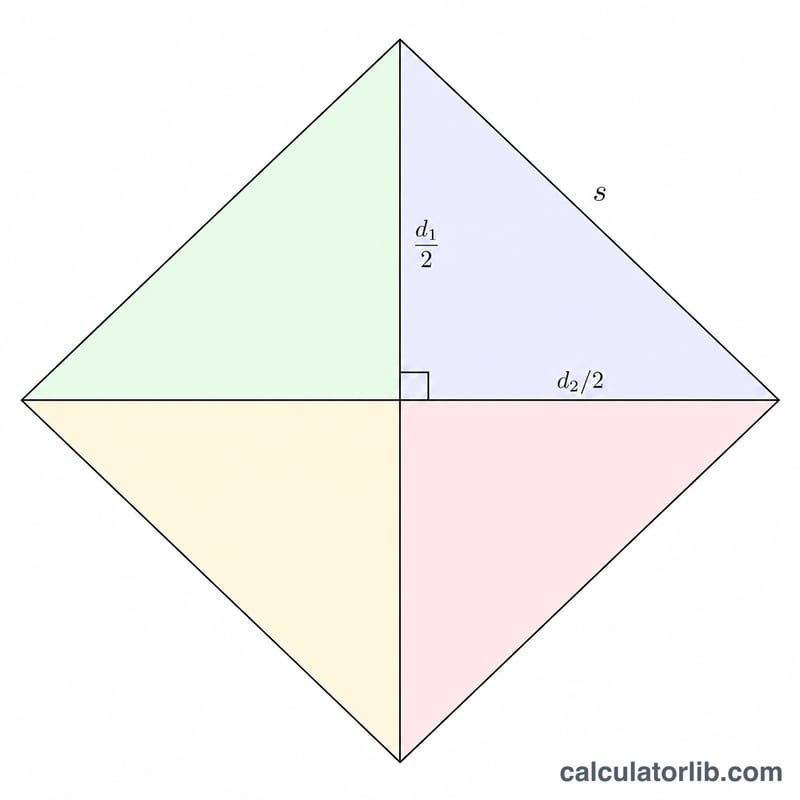
Because the diagonals of a rhombus are perpendicular, they split it into four right triangles. The total area is half the product of the diagonals: $$A = \dfrac{d_1 \times d_2}{2}$$ Each half-diagonal forms the legs of a right triangle whose hypotenuse is a side, so the side is $$s = \tfrac{1}{2}\sqrt{d_1^2 + d_2^2}$$ and the perimeter is $$P = 4s$$
Worked example
Suppose a rhombus has diagonals of 6 and 8 units. The area is $$\frac{6 \times 8}{2} = 24 \text{ square units}$$ The side is $$\tfrac{1}{2}\sqrt{6^2 + 8^2} = \tfrac{1}{2}\sqrt{36 + 64} = \tfrac{1}{2}\sqrt{100} = \tfrac{1}{2} \times 10 = 5 \text{ units}$$ The perimeter is $$4 \times 5 = 20 \text{ units}$$
FAQ
Do I need both diagonals for the area? Yes — the area formula uses both diagonals. If you only know the side and an angle, a different formula (\(A = s^2 \cdot \sin \theta\)) is required.
Why are all four sides equal? By definition, a rhombus has four congruent sides; that is its defining property.
Is every square a rhombus? Yes. A square meets the rhombus definition (four equal sides) and additionally has four right angles.