
What this calculator does
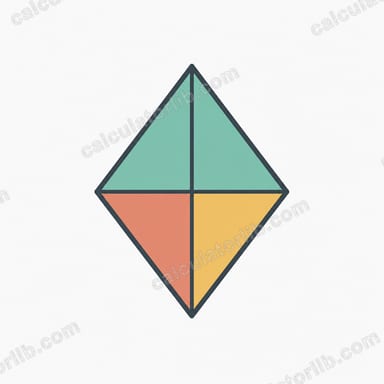
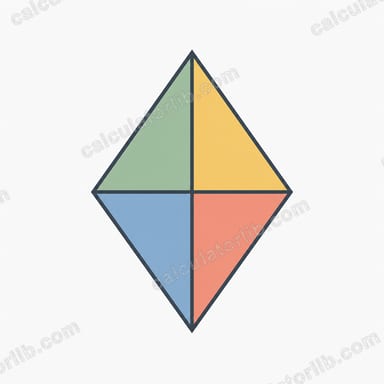
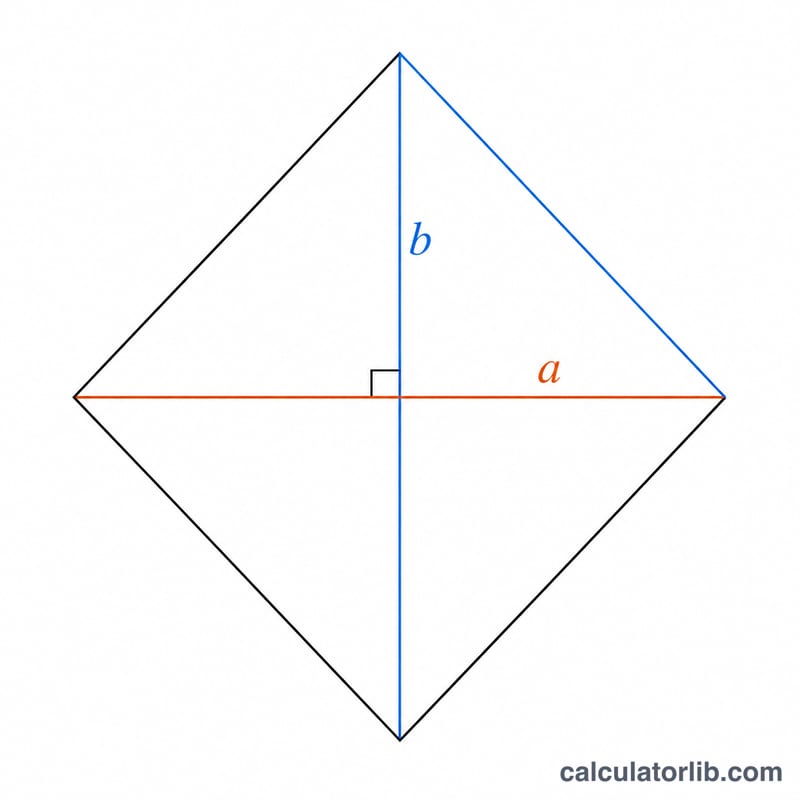
A rhombus is a quadrilateral with four equal sides. Its two diagonals are perpendicular and bisect each other, which means knowing just the two diagonal lengths is enough to fully describe the shape. This tool takes the diagonals a and b (in any consistent length unit) and returns the area, the perimeter, and both interior vertex angles. This is pure geometry, so it applies identically anywhere with no country-specific rules.
How to use it
Enter the length of diagonal a and diagonal b using the same unit for both (for example centimetres, metres, or inches). Both must be greater than zero. The area is reported in the square of that unit, the perimeter in the same unit, and the two angles in degrees.
The formulas explained
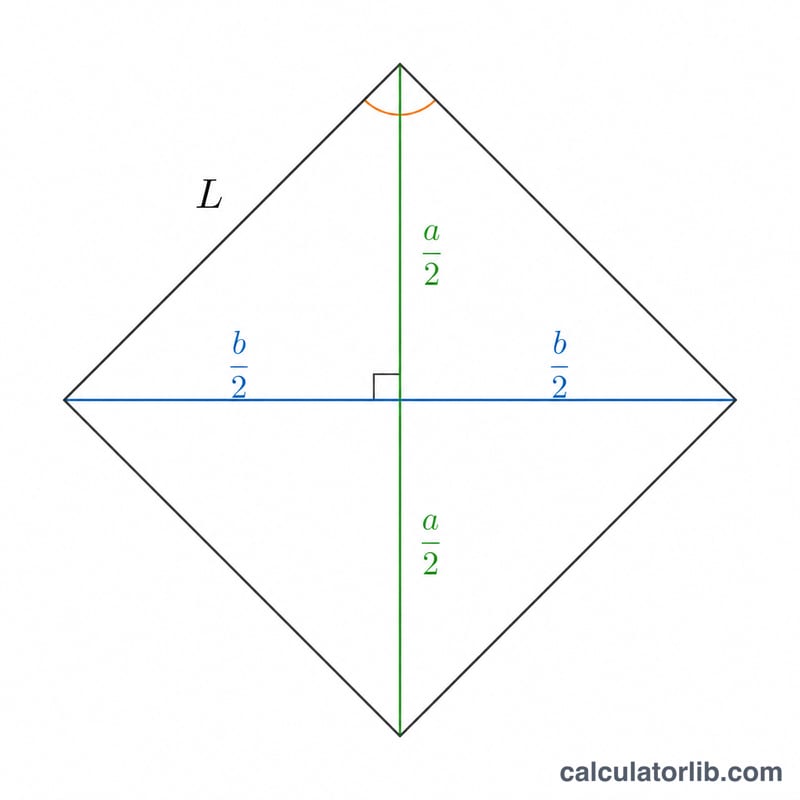
Because the diagonals cross at right angles and bisect one another, each half-diagonal is \(a/2\) and \(b/2\), so the side length is $$s = \sqrt{\left(\frac{a}{2}\right)^{2} + \left(\frac{b}{2}\right)^{2}} = \frac{1}{2}\cdot\sqrt{a^{2}+b^{2}}.$$
- Area: $$S = \frac{a \cdot b}{2}$$
- Perimeter: $$L = 4s = 2\cdot\sqrt{a^{2} + b^{2}}$$
- Vertex angle on diagonal a: $$\theta_a = 2\cdot\arctan\!\left(\frac{b}{a}\right)$$
- Vertex angle on diagonal b: $$\theta_b = 2\cdot\arctan\!\left(\frac{a}{b}\right)$$
The two angles are supplementary, so \(\theta_a + \theta_b\) always equals \(180\degree\).
Worked example
For \(a = 2\) and \(b = 3\): $$S = \frac{2\cdot 3}{2} = 3 \text{ square units}.$$ $$L = 2\cdot\sqrt{4 + 9} = 2\cdot\sqrt{13} \approx 7.2111 \text{ units}.$$ $$\theta_a = 2\cdot\arctan\!\left(\frac{3}{2}\right) \approx 112.6199\degree$$ and $$\theta_b = 2\cdot\arctan\!\left(\frac{2}{3}\right) \approx 67.3801\degree.$$ Their sum is exactly \(180\degree\).
FAQ
What if the two diagonals are equal? The rhombus becomes a square: the area is \(a^{2}/2\) and both vertex angles are \(90\degree\).
What units should I use? Any unit, as long as both diagonals share it. The output area is in that unit squared and the perimeter in the same unit.
Why are there two angles? A rhombus has two pairs of equal opposite angles. The pair at the vertices lying on diagonal a equals \(\theta_a\), and the other pair equals \(\theta_b = 180\degree - \theta_a\).