
What is the Permutation and Combination Calculator?
This tool computes the number of ways to arrange or select r items from a set of n distinct items. A permutation counts ordered arrangements, while a combination counts selections where order does not matter. Both are core ideas in probability, statistics, and combinatorics.
How to use it
Enter the total number of items n and the number you wish to choose r (with \(r \le n\)). The calculator instantly returns both \(P(n, r)\) and \(C(n, r)\). For example, picking a 3-person committee from 5 people is a combination, while assigning 3 ranked prizes among 5 contestants is a permutation.
The formula explained
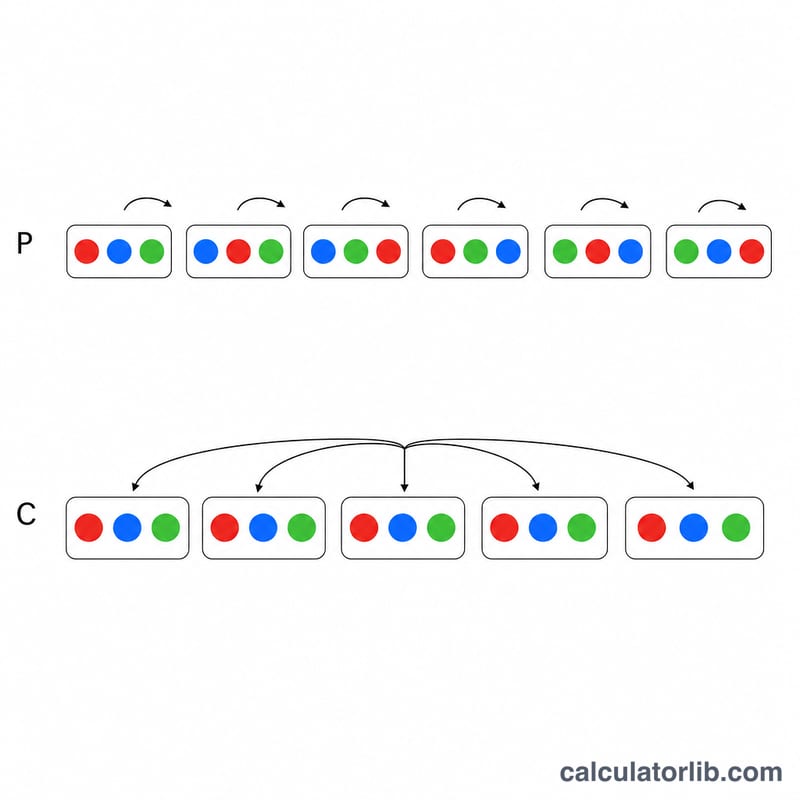
The permutation formula is $$P(n, r) = \frac{n!}{(n - r)!}$$ which counts arrangements where order matters. The combination formula is $$C(n, r) = \frac{n!}{r!\,(n - r)!}$$ dividing out the \(r!\) ways to reorder a chosen group. Because order is ignored, \(C(n, r)\) is always less than or equal to \(P(n, r)\).
Worked example
Let \(n = 5\) and \(r = 3\). Then $$P(5, 3) = 5 \times 4 \times 3 = 60$$ ordered arrangements. Dividing by \(3! = 6\) gives $$C(5, 3) = \frac{60}{6} = 10$$ unordered selections. So there are 60 ways to award gold, silver and bronze among 5 runners, but only 10 ways to pick 3 of them for a team.
FAQ
What if r is greater than n? You cannot choose more items than exist, so both results are 0.
What does 0! equal? By definition \(0! = 1\), so \(C(n, 0) = 1\) and \(P(n, 0) = 1\).
Why do large inputs lose precision? Factorials grow extremely fast, so results beyond about 15 significant digits are approximate floating-point values.