
What Is a Permutation?
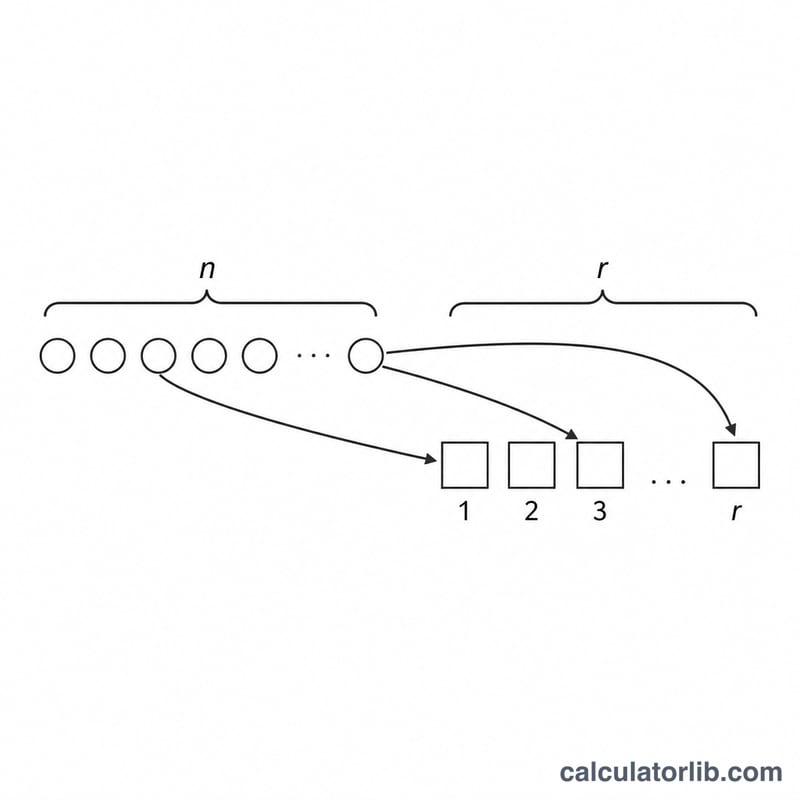
A permutation is an arrangement of items where order matters. The permutation formula \(P(n,r)\) tells you how many different ordered ways you can select r items from a set of n distinct items. Unlike combinations, swapping the position of two chosen items produces a new, distinct permutation.
How to Use This Calculator
Enter the total number of distinct items (n) and the number of items you want to choose and arrange (r). The calculator instantly returns the number of permutations. Note that r must be less than or equal to n; if r exceeds n the result is 0, since you cannot pick more items than are available.
The Formula Explained
The permutation formula is
$$P(n,r) = \frac{\text{n}!}{\left(\text{n} - \text{r}\right)!}$$where "!" denotes a factorial (the product of all positive integers up to that number). In practice it simplifies to multiplying r consecutive descending integers starting at n: \(n \times (n-1) \times \ldots \times (n-r+1)\). This avoids computing huge factorials directly.
Worked Example
Suppose a club has 5 members and needs to elect a President and a Vice-President — that is, choose and order 2 people from 5. Then
$$P(5,2) = \frac{5!}{(5-2)!} = \frac{5!}{3!} = \frac{5 \times 4 \times 3 \times 2 \times 1}{3 \times 2 \times 1} = \frac{120}{6} = 20$$So there are 20 possible ordered outcomes.
FAQ
How is a permutation different from a combination? In permutations order matters; in combinations it does not. \(P(n,r)\) is always greater than or equal to \(C(n,r)\).
What is \(P(n,0)\)? It equals 1 — there is exactly one way to arrange zero items (the empty arrangement).
What is \(P(n,n)\)? It equals \(n!\), the number of ways to arrange all n items in order.