
What Is Relative Risk?
Relative risk (RR), also called the risk ratio, compares the probability of an outcome occurring in an exposed group to the probability in an unexposed group. It is a core measure in epidemiology, clinical trials, and cohort studies. An RR of 1 means no difference between groups, an RR greater than 1 means the exposure is associated with increased risk, and an RR below 1 suggests a protective effect.
How to Use This Calculator
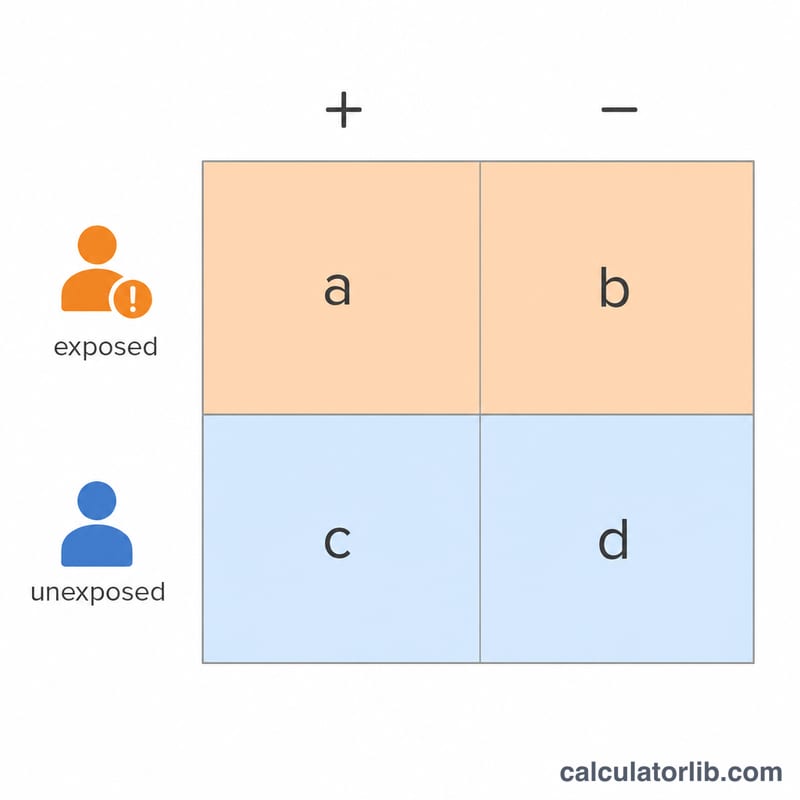
Fill in the four cells of your 2×2 table: (a) exposed subjects who had the outcome, (b) exposed subjects without the outcome, (c) unexposed subjects who had the outcome, and (d) unexposed subjects without the outcome. The calculator returns the relative risk along with the absolute risk percentage in each group.
The Formula Explained
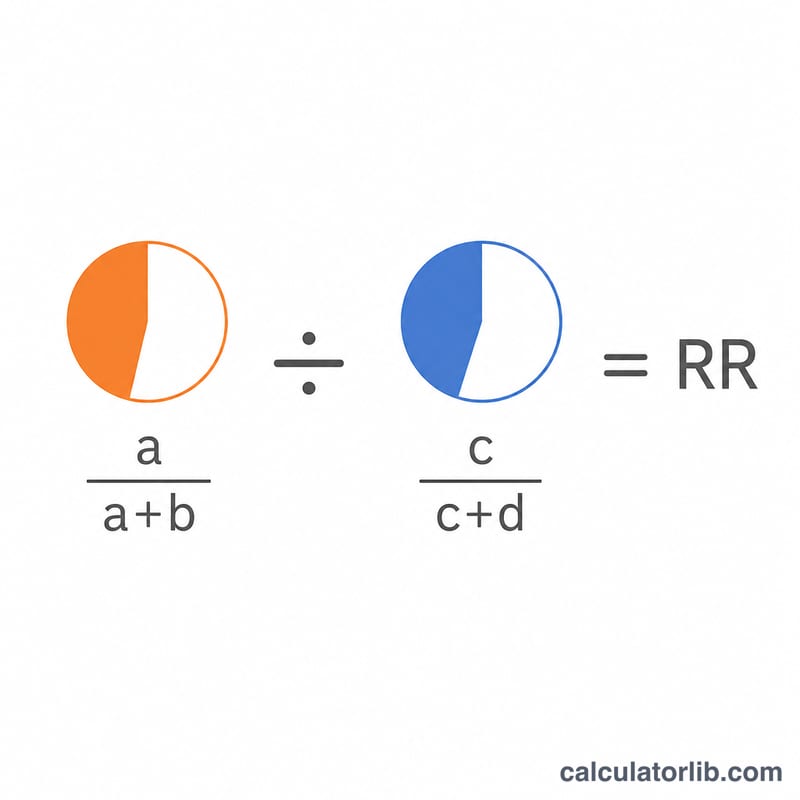
Risk in the exposed group is \(\frac{a}{a+b}\). Risk in the unexposed group is \(\frac{c}{c+d}\). Relative risk divides the exposed risk by the unexposed risk:
$$\text{RR} = \frac{\;\dfrac{\text{a}}{\text{a} + \text{b}}\;}{\;\dfrac{\text{c}}{\text{c} + \text{d}}\;}$$
The result is a unitless ratio.
Worked Example
Suppose 30 of 100 exposed people develop a disease (a=30, b=70) and 10 of 100 unexposed people develop it (c=10, d=90). Risk in exposed = \(\frac{30}{100} = 0.30\) (30%). Risk in unexposed = \(\frac{10}{100} = 0.10\) (10%).
$$\text{RR} = \frac{0.30}{0.10} = 3.0$$
meaning exposed individuals are three times as likely to develop the disease.
FAQ
How is relative risk different from odds ratio? Relative risk compares probabilities (risks), while the odds ratio compares odds. They are similar when the outcome is rare but diverge as it becomes common.
What does an RR of 0.5 mean? It means the exposed group has half the risk of the unexposed group — a protective association.
Can I use RR for case-control studies? No. Relative risk requires cohort or trial data where incidence can be measured; case-control studies should use the odds ratio instead.