
What is the Lottery Odds Calculator?
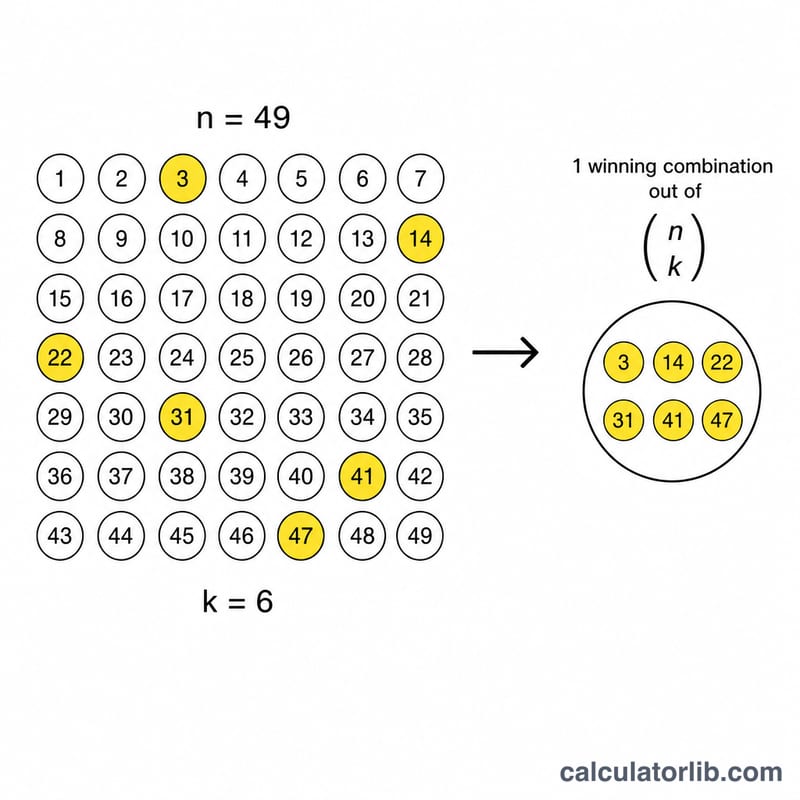
This tool tells you exactly how unlikely a lottery jackpot is. Lotteries work by drawing k numbers from a pool of n, where order does not matter. The number of possible draws is the combination C(n,k), and your single ticket matches just one of them — so your odds are 1 in C(n,k). Many games add a separate bonus ball drawn from its own pool, which multiplies the total combinations and makes the jackpot far harder to hit.
How to use it
Enter the total numbers in the main pool (\(n\)), how many you must pick (\(k\)), and the size of the bonus pool (set 0 if there is no bonus ball). The calculator returns the jackpot odds as "1 in X", the raw probability, and the underlying combination count.
The formula explained
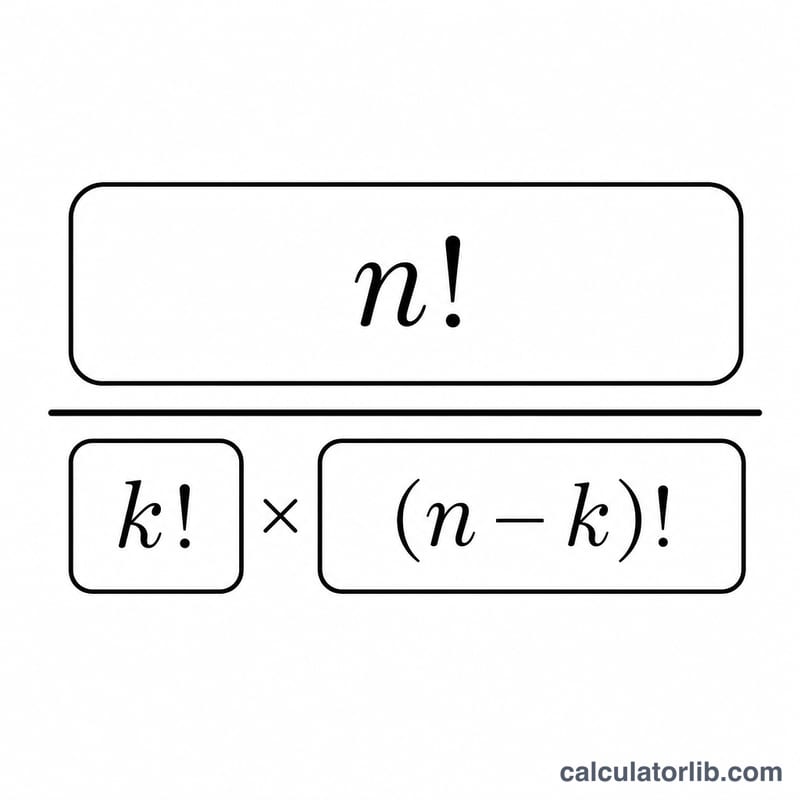
The combination formula is $$C(n,k) = \frac{n!}{k!\,(n-k)!}.$$ Because factorials grow huge, this calculator multiplies the terms iteratively, dividing as it goes, to stay accurate without overflow. With a bonus ball pool of size \(b\), the total combinations become \(C(n,k) \times b\).
Worked example
For a classic 6-from-49 lottery: $$C(49,6) = 13{,}983{,}816.$$ So your odds are 1 in 13,983,816 — about a 0.00000715% chance per ticket. Add a Powerball-style bonus drawn from 26 numbers and you would multiply by 26.
FAQ
Does buying more tickets help? Yes, linearly: two distinct tickets double your chance to 2 in C(n,k), but it is still tiny.
Does order matter? No — lottery numbers are unordered, which is why we use combinations, not permutations.
How is the bonus ball handled? We assume the bonus comes from a separate pool, so we multiply the main combinations by the bonus pool size. If your game draws the bonus from the same remaining numbers, the math differs slightly.