
What Is a Parlay Odds Calculator?
A parlay (also called an accumulator or combo bet) combines multiple individual bets, or "legs," into one wager. To win the parlay, every single leg must win. The reward is higher because the odds of each leg multiply together — but so does the risk. This calculator converts your stake and the decimal odds of each leg into the combined odds, total payout, and profit.
How to Use It
Enter your stake (the amount you wager) and the decimal odds for each leg of the parlay. Leave any unused leg fields blank — you can combine anywhere from 2 to 6 legs. The calculator multiplies the odds, then shows your total payout (stake plus winnings) and your profit.
The Formula Explained
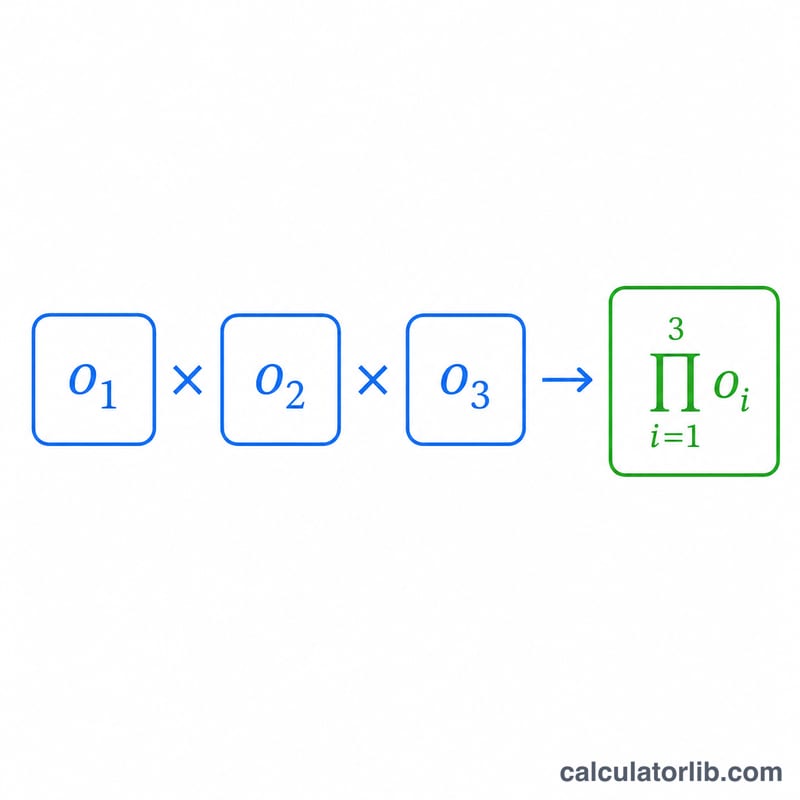
In decimal odds, a value of 2.00 means you double your money (even odds). The combined odds of a parlay equal the product of every leg: $$O = o_1 \times o_2 \times \dots \times o_n.$$ Your total payout is simply \(\text{stake} \times O\), and your profit is payout minus the original stake. Because the odds multiply, even modest legs can produce large payouts when chained together.
Worked Example
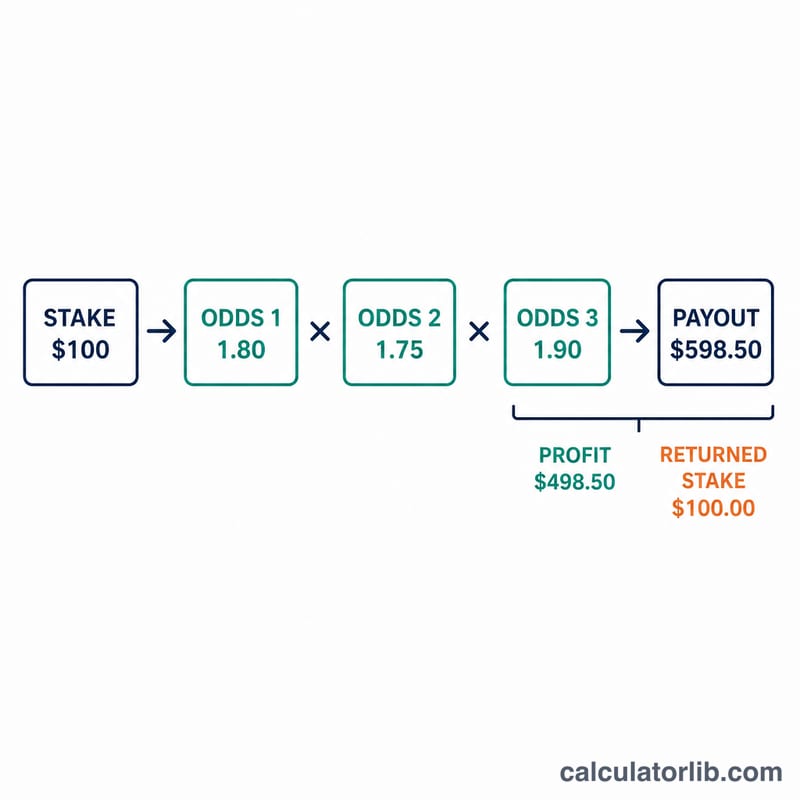
Suppose you stake $100 on a two-leg parlay with decimal odds of 1.91 and 2.50. The combined odds are $$1.91 \times 2.50 = 4.775.$$ Your payout is $$100 \times 4.775 = \$477.50,$$ and your profit is $$\$477.50 - \$100 = \$377.50.$$
FAQ
What are decimal odds? Decimal odds show the total return per unit staked, including your stake. Odds of 3.00 return $3 for every $1 bet.
How do I convert American odds to decimal? For positive American odds: \(\text{decimal} = (\text{odds}/100) + 1\). For negative: \(\text{decimal} = (100/|\text{odds}|) + 1\). For example \(+150 = 2.50\) and \(-110 \approx 1.91\).
Why is one losing leg so costly? A parlay only pays if all legs win. A single loss makes the entire bet a loss, which is why parlays carry more risk than single bets despite higher payouts.