
What this calculator does
This tool converts odds stated as "A to B" (written A:B) into a probability (decimal), a percent chance, and the equivalent fractional odds — for both winning and losing. You can state the odds either for winning or against winning, and the calculator normalizes the direction for you.
How to use it
Enter the first number of the ratio as A and the second as B. Choose whether the ratio is for winning or against winning. Pick how many decimal digits to round to (or "auto" for natural precision). The result shows probability, chance percent, and odds in a side-by-side table for winning vs losing.
The formula explained
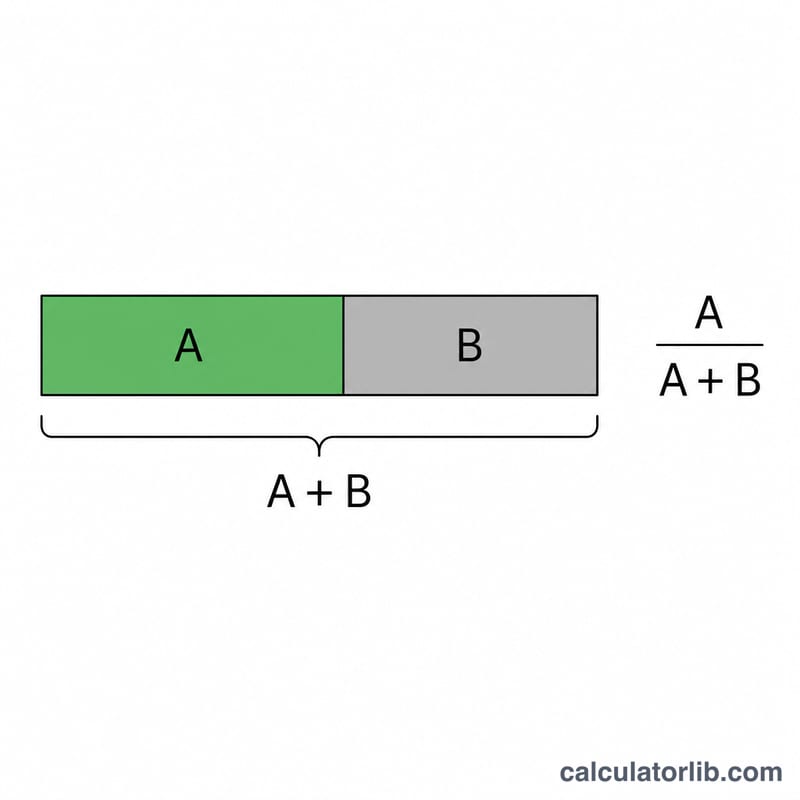
When odds A:B are stated for winning, the favorable count is A and the unfavorable count is B, so:
$$P(\text{Win}) = \dfrac{A}{A + B}$$ and $$P(\text{Lose}) = \dfrac{B}{A + B}.$$ The chance is just the probability times 100. The fractional odds of winning are \(A / B\), and of losing \(B / A\).
When odds are stated against winning, A becomes the unfavorable part, so we swap A and B before applying the formulas — A:B against winning equals B:A for winning.
Worked example
Take \(A = 5\), \(B = 7\), odds for winning, rounded to 4 digits. Total = 12. $$P(\text{Win}) = \frac{5}{12} = 0.4167 \ (41.67\%).$$ $$P(\text{Lose}) = \frac{7}{12} = 0.5833 \ (58.33\%).$$ Odds of winning = \(5/7\); odds of losing = \(7/5\).
Common Odds-to-Probability Conversions
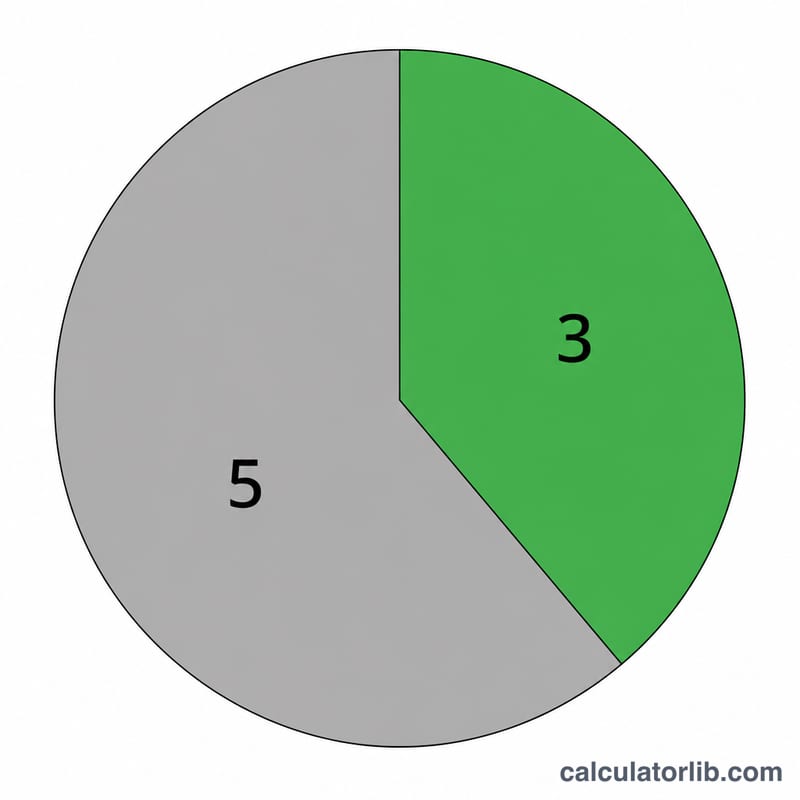
The table below converts common odds expressed as A:B into the probability of winning and the probability of losing. When the odds are stated for winning (the format A:B used here), the winning probability is calculated as:
$$P_{\text{Win}} = \frac{A}{A + B}$$For example, odds of 3:1 for winning give \(P_{\text{Win}} = \frac{3}{3+1} = \frac{3}{4} = 0.75\), a 75% chance. The losing probability is simply \(P_{\text{Lose}} = 1 - P_{\text{Win}} = \frac{B}{A+B}\).
| Odds (A:B) | Win probability (decimal) | Win percent | Lose probability | Lose percent |
|---|---|---|---|---|
| 1:1 | 0.5000 | 50.00% | 0.5000 | 50.00% |
| 2:1 | 0.6667 | 66.67% | 0.3333 | 33.33% |
| 3:1 | 0.7500 | 75.00% | 0.2500 | 25.00% |
| 5:1 | 0.8333 | 83.33% | 0.1667 | 16.67% |
| 10:1 | 0.9091 | 90.91% | 0.0909 | 9.09% |
| 9:2 | 0.8182 | 81.82% | 0.1818 | 18.18% |
| 1:2 | 0.3333 | 33.33% | 0.6667 | 66.67% |
| 1:3 | 0.2500 | 25.00% | 0.7500 | 75.00% |
| 1:5 | 0.1667 | 16.67% | 0.8333 | 83.33% |
| 2:5 | 0.2857 | 28.57% | 0.7143 | 71.43% |
| 1:10 | 0.0909 | 9.09% | 0.9091 | 90.91% |
Note: if your odds are quoted against winning (the more common sports-betting convention, e.g. "3 to 1 against"), swap A and B — odds of 3:1 against winning give a win probability of \(\frac{1}{3+1}=\) 25%.
Key Terms Explained
- Odds (A:B)
- A ratio comparing two outcomes rather than a part of the whole. "A:B" (read "A to B") compares the number of favorable cases (A) to the number of unfavorable cases (B). It is a ratio of counts, not a fraction of the total.
- Probability
- A number between 0 and 1 expressing how likely an event is. It is the favorable outcomes divided by all outcomes: \(P = \frac{A}{A+B}\). A probability of 0 means impossible and 1 means certain.
- Percent chance
- The probability written as a value out of 100, found by multiplying the probability by 100 (for example, \(0.75 \times 100 = 75\%\)). It is the same information as the decimal probability, in a more intuitive form.
- Fractional odds
- Odds written as a fraction such as 3/1 or 9/2, common in UK betting. They state profit relative to stake: 9/2 means you win 9 units of profit for every 2 units staked. Fractional odds are equivalent to odds against the outcome.
- Odds for winning
- Odds where A counts the ways the event happens and B counts the ways it does not, so the win probability is \(\frac{A}{A+B}\). Odds of 3:1 for winning describe a strong favorite (75% chance).
- Odds against winning
- The reversed convention, where the first number counts the ways the event fails. Odds of 3:1 against winning mean three unfavorable cases to one favorable, giving a win probability of \(\frac{1}{1+3}=25\%\). Most posted betting odds are quoted this way.
- "X in Y" versus "X to Y"
- These are not the same. "X in Y" is a direct probability — "1 in 4" means \(\frac{1}{4}=25\%\), where Y is the total. "X to Y" is a ratio of one group against the other — "1 to 4" (1:4) means \(\frac{1}{1+4}=20\%\), because Y is only the remaining cases, not the total. Confusing the two is a common source of error.
FAQ
Is "1 in 500" the same as "1 to 500" odds? No. "1 in 500" is a probability of \(1/500\). As odds for winning that is 1 to 499, not 1 to 500.
Can I enter decimals? Yes — any positive real numbers work, for example 1.5 to 2.5.
What about betting odds like 9/2? Sports odds are usually quoted against winning. Select "against winning" and the calculator interprets the ratio accordingly. Note these are implied odds and may include a bookmaker margin.