
What this tool does
The 5-Card Draw Poker Dealer shuffles a single standard 52-card deck and deals each player a random five-card hand without replacement. It then evaluates every hand using standard poker hand rankings and, when more than one player is dealt, names the winner. There is no betting — it is a pure dealing and ranking demonstrator, useful for learning hand values, settling "what beats what" questions, or generating practice hands.
How to use it
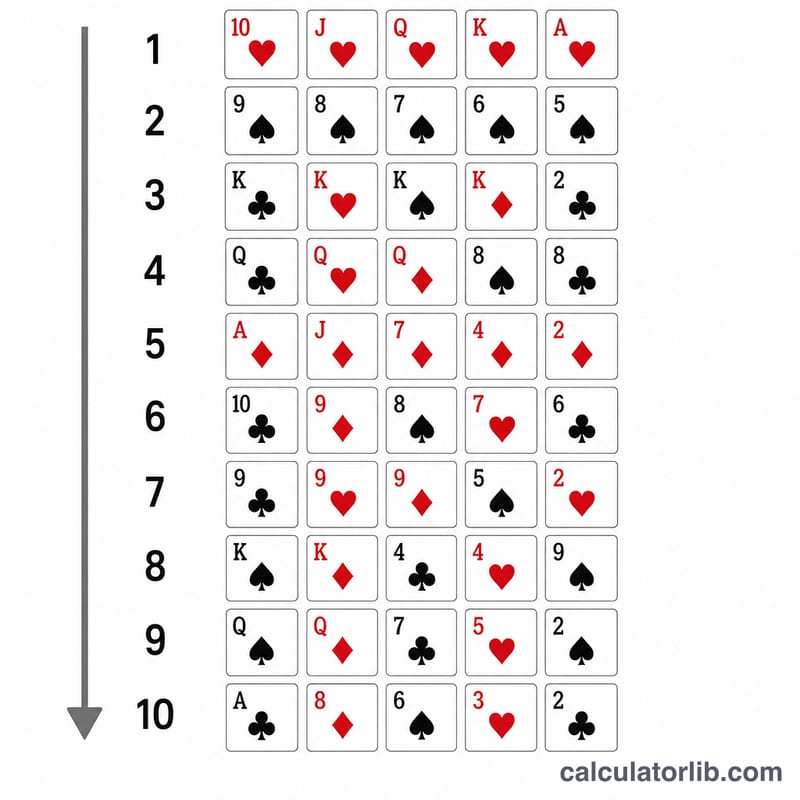
Choose the number of players (1 to 5) and press Deal. Each press reshuffles the full deck fresh and deals new hands one card at a time clockwise (order does not affect ranking). Each player's five cards are shown with their best category label such as Flush or Two Pair, and the category index from 1 (best, Royal Straight Flush) to 10 (worst, High Card).
The ranking formula
For each hand the tool counts how many cards share each rank, checks whether all five suits match (flush), and whether the five distinct ranks are consecutive (straight).
$$\text{rank} = f(\text{counts}, \text{isFlush}, \text{isStraight}) \in \{1,\dots,10\}$$
$$\text{isStraight} = (\max-\min=4) \;\lor\; \{14,2,3,4,5\}$$
The wheel A-2-3-4-5 is treated as a straight with the Ace low (high card 5). Classification order: Royal Straight Flush, Straight Flush, Four of a Kind, Full House, Flush, Straight, Three of a Kind, Two Pair, One Pair, High Card. Ties within a category are broken by comparing the significant ranks — grouped by frequency, then kickers — in descending order.
Worked example
Player 1 receives 10, J, Q, K, A all of spades. All five suits are spades so it is a flush; the ranks \(10\text{-}11\text{-}12\text{-}13\text{-}14\) are five consecutive distinct values so it is also a straight; the top card is the Ace in a 10-J-Q-K-A sequence, giving a Royal Straight Flush — category index \(1\), the best possible hand.
Poker Terms & Definitions
- Category index
- An integer from 1 to 10 that labels the hand's category, where 10 is a Royal Flush and 1 is High Card. The ranker computes it from the card counts, flush status and straight status, then compares indices to find the winner.
- Kicker
- An unpaired side card used to break ties when two hands share the same category. For example, between two hands each holding a pair of Kings, the highest remaining card (kicker) decides the winner.
- The wheel (A-2-3-4-5)
- The lowest possible straight, in which the Ace plays as a 1 below the 2 rather than above the King. It is a valid straight but ranks below 2-3-4-5-6.
- Flush
- Five cards all of the same suit (for example all hearts) that do not form a sequence. A flush is category index 6.
- Straight
- Five cards of consecutive rank in mixed suits, such as 6-7-8-9-10. A straight that is also a flush becomes a Straight Flush (index 9) or Royal Flush (index 10).
- Full house
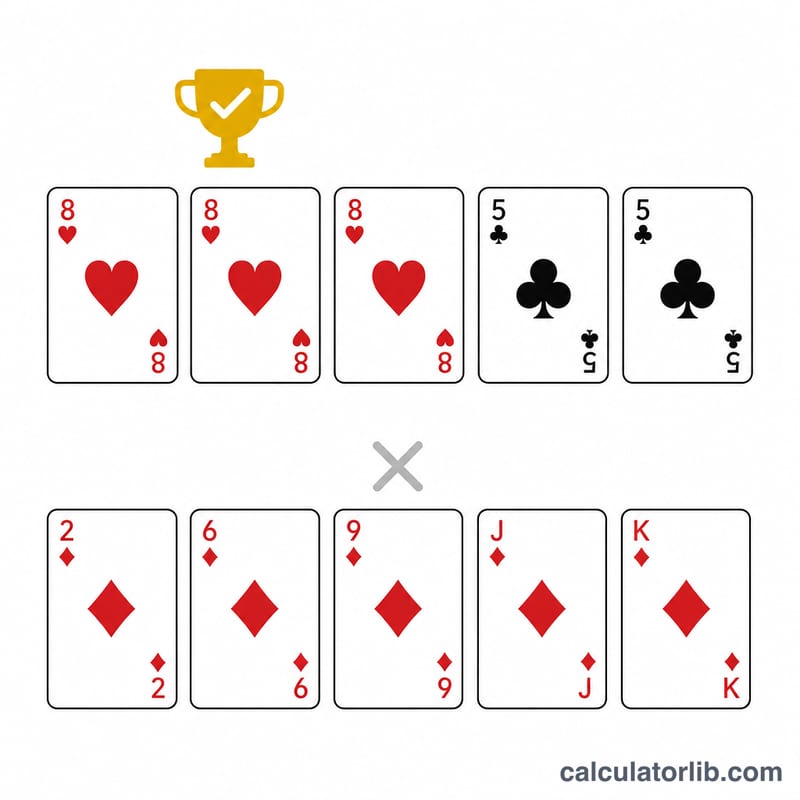
- Three cards of one rank plus two cards of another rank (for example three Kings and two Fours). It is category index 7 and is described as "threes full of fours."
- Two pair
- Two cards of one rank, two cards of a second rank, and one unrelated card. It is category index 3, ranked above One Pair but below Three of a Kind.
- Frequency-grouped significant ranks
- The ordered list of card ranks sorted first by how many times each appears, then by rank value. For example, the hand K-K-K-4-4 groups as (three Kings, two Fours), which lets the ranker quickly distinguish quads, full houses, trips and pairs.
- Deal without replacement
- Each card removed from the 52-card deck cannot be dealt again in the same round. This is why the 5-card hand count is \(\binom{52}{5}\) rather than \(52^5\), and why later cards have shifting probabilities as the deck shrinks.
FAQ
Can a card appear twice? No. All hands come from one deck dealt without replacement, so up to 25 cards (5 players x 5) are always distinct.
Does Ace count high or low? Ace is high (value 14) everywhere except the wheel straight A-2-3-4-5, where it counts as 1.
How is the winner chosen? The lowest category index wins; equal categories are resolved by comparing significant ranks and kickers from highest to lowest.