What Is Poker EV?
Expected value (EV) is the average amount you can expect to win or lose on a given decision if you made it many times over. A positive EV (+EV) means the play is profitable in the long run, while a negative EV (-EV) means it loses money. Strong poker players make decisions based on EV rather than the outcome of any single hand.
How to Use This Calculator
Enter three numbers: your estimated probability of winning the hand (as a percentage), the amount of money you stand to win if you win, and the amount you stand to lose if you lose. The calculator multiplies each outcome by its probability and combines them into a single EV figure. The amount won is usually the current pot plus opponents' future bets; the amount lost is the chips you have to put in to continue.
The Formula Explained
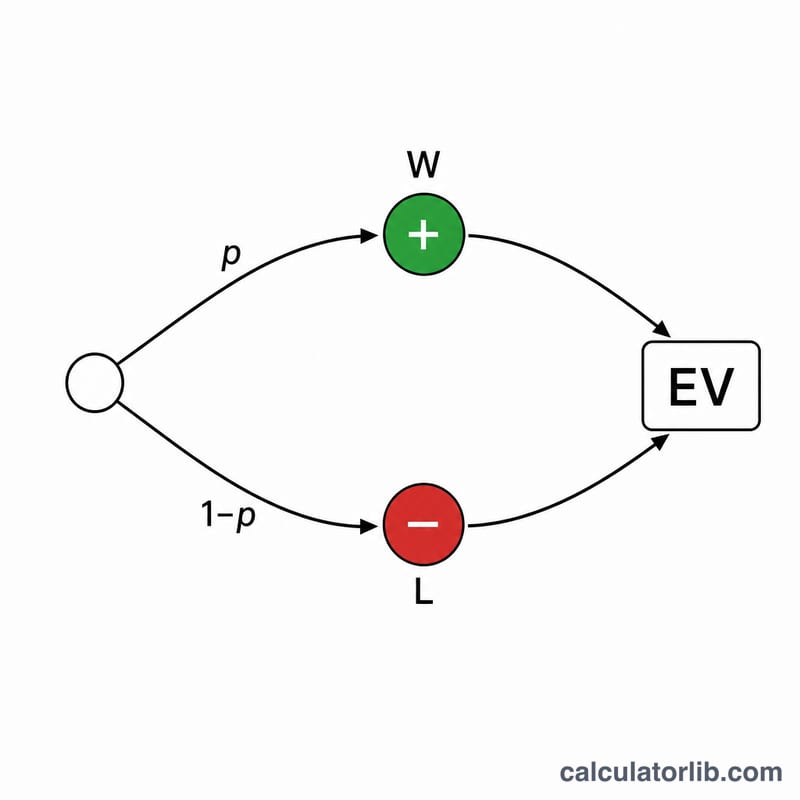
The model uses $$\text{EV} = p_{\text{win}} \times W - (1 - p_{\text{win}}) \times L$$ Here \(p_{\text{win}}\) is your win probability, \(W\) is the amount won and \(L\) is the amount lost. The term \((1 - p_{\text{win}})\) is simply the lose probability. Because exactly one of the two outcomes happens, the probabilities sum to one, so this is a complete two-outcome expectation.
Worked Example
Suppose you have a flush draw and estimate a 35% chance to win. The pot already offers you $120 if you win, and a call costs you $40 if you lose. $$\text{EV} = 0.35 \times 120 - 0.65 \times 40 = 42 - 26 = \textbf{+\$16}$$ Since the EV is positive, calling is the profitable play over the long run.
Common Draw Outs and Win Probabilities
An out is an unseen card that improves your hand to (you hope) the best hand. After the flop you see 5 cards (2 hole + 3 board), so 47 are unseen. After the turn you see 6, so 46 are unseen. Exact equity with two cards to come is \(1 - \frac{(47-n)(46-n)}{47 \times 46}\); with one card to come it is \(\frac{n}{46}\). The rule of 4 (flop) and rule of 2 (turn) multiply outs by 4 or 2 as a quick estimate. These figures assume every out is clean (not shared with an opponent's better hand) and ignore opponent ranges.
| Draw | Outs | Flop exact (2 cards) | Rule of 4 | Turn exact (1 card) | Rule of 2 |
|---|---|---|---|---|---|
| Flush draw | 9 | 35.0% | 36% | 19.6% | 18% |
| Open-ended straight draw | 8 | 31.5% | 32% | 17.4% | 16% |
| Gutshot straight draw | 4 | 16.5% | 16% | 8.7% | 8% |
| Two overcards | 6 | 24.1% | 24% | 13.0% | 12% |
| Set to full house or better | 7 | 27.8% | 28% | 15.2% | 14% |
The rule of 4 is accurate for small out counts but overestimates as outs grow (for example, 9 outs: 36% estimated vs 35.0% exact). The rule of 2 slightly underestimates the one-card equity.
Break-Even Equity by Bet Size
If you face a bet \(b\) into a pot \(P\) (before the bet), calling must win at least \(\frac{b}{P + 2b}\) of the time to break even, which is the same as \(\frac{L}{W+L}\) with \(L = b\) and \(W = P + b\).
| Bet size (into pot P) | Break-even equity |
|---|---|
| 1/3 pot | 20% |
| 1/2 pot | 25% |
| 2/3 pot | 28.6% |
| Pot | 33.3% |
Example: a flush draw on the turn has about 19.6% equity, so it is slightly short of the 20% needed against a 1/3-pot bet on direct odds alone; implied odds may make up the difference.
EV Across Different Scenarios
Here the amount won is fixed at W = $120 and the amount lost at L = $40, using \(\text{EV} = p \times W - (1-p) \times L\). The break-even probability is \(\frac{L}{W+L} = \frac{40}{160} = 25\%\): above it the call is +EV, below it -EV.
| Win probability | Calculation | EV | Verdict |
|---|---|---|---|
| 15% | 0.15 × 120 − 0.85 × 40 = 18 − 34 | −$16 | −EV |
| 25% | 0.25 × 120 − 0.75 × 40 = 30 − 30 | $0 | Break-even |
| 35% | 0.35 × 120 − 0.65 × 40 = 42 − 26 | +$16 | +EV |
| 50% | 0.50 × 120 − 0.50 × 40 = 60 − 20 | +$40 | +EV |
| 65% | 0.65 × 120 − 0.35 × 40 = 78 − 14 | +$64 | +EV |
Varying the Call Size (p = 35%, W = $120)
| Amount lost (L) | Break-even probability | EV | Verdict |
|---|---|---|---|
| $40 | 25.0% | +$16 | +EV |
| $60 | 33.3% | +$3 (42 − 39) | +EV (marginal) |
| $80 | 40.0% | −$10 (42 − 52) | −EV |
The same 35% equity moves from clearly profitable to unprofitable purely because the price of the call rises.
Poker EV Glossary
- EV (expected value)
- The average result per decision if it were repeated many times: \(\text{EV} = p_{win} \times W - (1 - p_{win}) \times L\). It combines all three inputs.
- +EV / −EV
- A decision is +EV if its EV is above zero (profitable on average) and −EV if below zero. A +EV play can still lose in any single hand.
- Equity
- Your share of the pot based on your chance of winning at showdown. It is the source of \(p_{win}\), the win probability you enter.
- Outs
- Unseen cards that improve your hand to a winner. Outs drive equity (roughly outs × 4 on the flop, outs × 2 on the turn) and therefore \(p_{win}\).
- Pot odds
- The ratio of what you must pay to call to the pot you can win. It sets the break-even point and is built from L (the call) and W (the pot plus the opponent's bet).
- Break-even probability
- The win probability at which EV = 0: \(p = \frac{L}{W+L}\). If your \(p_{win}\) is higher, the play is +EV.
- Implied odds
- Extra money you expect to win on later streets when you hit your draw. It effectively increases W, lowering the break-even probability. It is an estimate, not a guarantee.
- Range
- The full set of hands an opponent could hold given their actions. Your \(p_{win}\) should be your equity against their range, not against one specific hand.
- Variance
- The short-term swings of actual results around EV. EV measures the long-run average; variance explains why +EV decisions still lose often over small samples.
This is general educational information about probability, not financial or gambling advice.
FAQ
What does a positive EV mean? It means the decision earns money on average if repeated many times — it is the mathematically correct play.
How do I estimate win probability? Use your equity against your opponent's likely range; pot odds and equity calculators can help. Outs \(\times\) ~2 per remaining card is a quick shortcut.
Does EV guarantee I win this hand? No. EV describes long-run averages. You can make a +EV decision and still lose a specific hand due to variance.