
What is the Dating Theory (Optimal Stopping) Calculator?
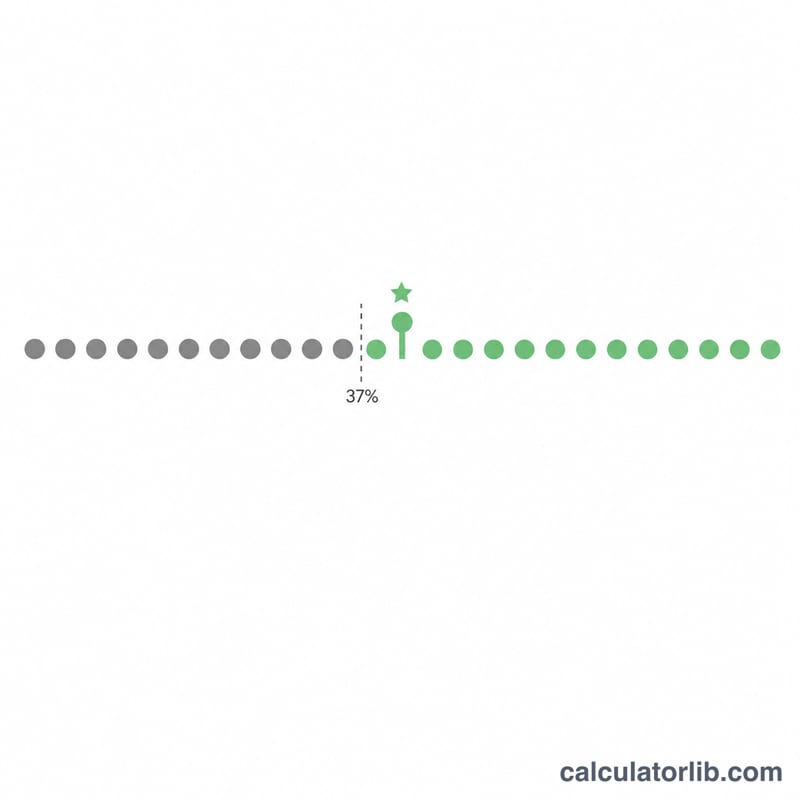
This tool applies the famous "secretary problem" — also called optimal stopping or the 37% rule — to dating. If you expect to meet a fixed number of potential partners and you must decide on each one before moving on, math gives you the strategy that maximizes your chance of choosing the very best person: spend the first portion of the pool just observing, then commit to the first candidate who beats everyone you've seen so far.
How to use it
Enter the number of people you realistically expect to date (your pool size, \(n\)). The calculator returns how many to reject up front. Use that early group purely to calibrate your standards — do not commit to anyone in it, no matter how promising. After the cutoff, say yes to the first person who is better than everyone in your observation phase.
The formula explained
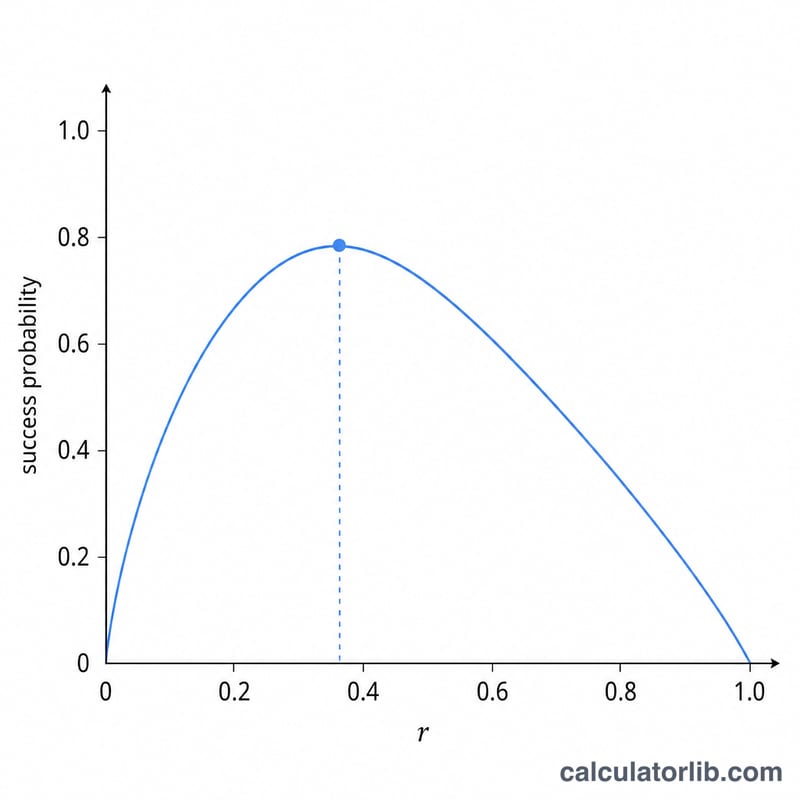
The optimal cutoff is $$\text{Reject Count} = \operatorname{round}\!\left(\frac{\text{Pool Size}}{e}\right)$$ where \(e \approx 2.71828\) is Euler's number. Since \(1/e \approx 0.3679\), you observe about the first 37% of candidates and then start choosing. This rule gives roughly a 37% probability of landing the single best option — far better than random guessing as the pool grows.
Worked example
Suppose you plan to date 10 people. The cutoff is $$\frac{10}{2.71828} \approx 3.68$$ which rounds to 4. So you date and politely pass on the first 4 people, remembering the best of them. From person 5 onward, you commit to the first one who outshines those first 4.
FAQ
Does this guarantee I find "the one"? No. It maximizes the probability of picking the best available candidate, but that probability is about 37% — it's a strategy, not a certainty.
What if a great person appears during the observation phase? The strict model says reject them; they only serve to set your benchmark. In real life, treat the rule as guidance rather than a hard law.
Is 37% always the answer? The sampling fraction (\(1/e \approx 37\%\)) is constant, but the actual reject count depends on your pool size \(n\).