What Is the Sandbox Sand Calculator?
This tool estimates how much play sand you need to fill a sandbox or sand pit. It computes the cubic volume of sand from the box dimensions and the desired sand depth, then converts that volume to weight using the density of sand so you know exactly how many pounds, tons, or 50 lb bags to buy.
How to Use It
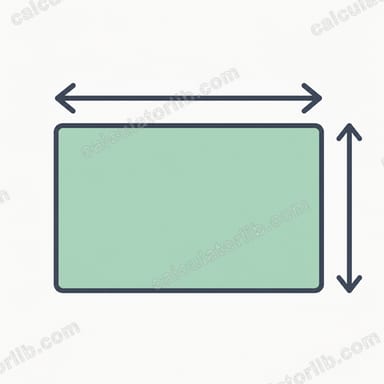
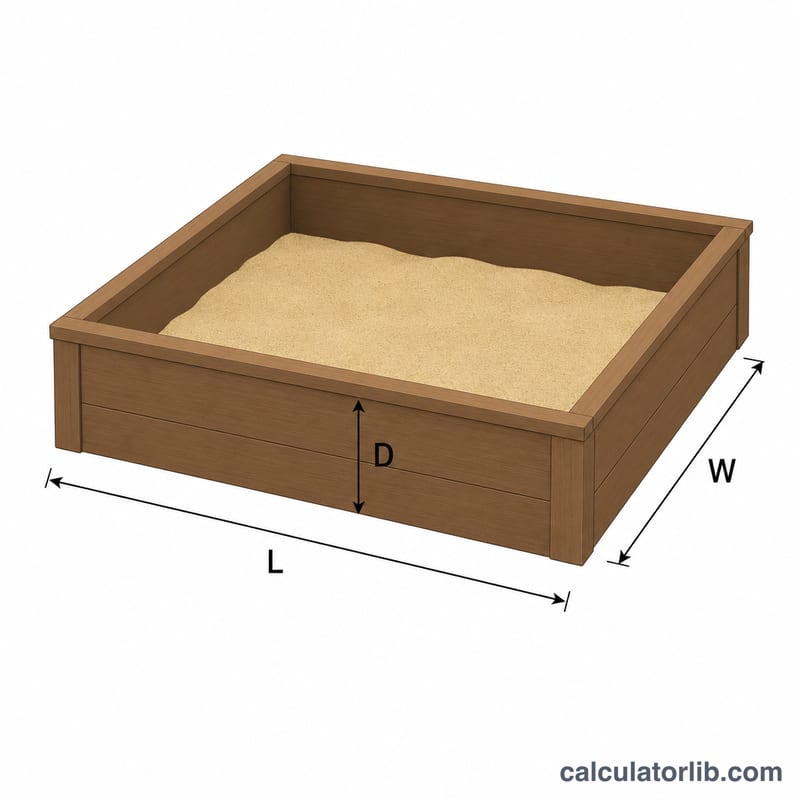
Enter the inside length and width of your sandbox in feet, and the depth of sand you want in inches. The default density of 100 lb/ft³ is typical for dry play sand, but you can adjust it for your specific material. Click calculate to see total volume, weight, and the number of bags required.
The Formula Explained
First the depth is converted from inches to feet by dividing by 12. Volume is then length × width × depth (in feet), giving cubic feet. Weight equals volume × density. For example, a sandbox 6 ft long, 6 ft wide, filled 6 in deep contains
$$6 \times 6 \times 0.5 = 18 \text{ ft}^3.$$At 100 lb/ft³ that is 1,800 lb of sand — about 0.9 US tons, or 36 fifty-pound bags.
Sand Needed for Common Sandbox Sizes and Depths
The table uses the calculator's formula, with volume in cubic feet \(V = L \times W \times \frac{D}{12}\) (L and W in feet, D in inches) and weight \(W = V \times 100\) lb/ft³. Bags assume 50 lb each, rounded up to whole bags. Play sand is often about 100 lb/ft³ when dry, but this varies by product and moisture.
| Sandbox size (ft) | Depth (in) | Volume (ft³) | Weight (lb) | 50 lb bags |
|---|---|---|---|---|
| 4 × 4 | 3 | 4.00 | 400 | 8 |
| 4 | 5.33 | 533 | 11 | |
| 6 | 8.00 | 800 | 16 | |
| 5 × 5 | 3 | 6.25 | 625 | 13 |
| 4 | 8.33 | 833 | 17 | |
| 6 | 12.50 | 1,250 | 25 | |
| 6 × 6 | 3 | 9.00 | 900 | 18 |
| 4 | 12.00 | 1,200 | 24 | |
| 6 | 18.00 | 1,800 | 36 | |
| 8 × 8 | 3 | 16.00 | 1,600 | 32 |
| 4 | 21.33 | 2,133 | 43 | |
| 6 | 32.00 | 3,200 | 64 |
Example: a 6 × 6 ft box filled 6 inches deep needs \(6 \times 6 \times \frac{6}{12} = 18\) ft³, and \(18 \times 100 = 1{,}800\) lb, or \(1{,}800 \div 50 = 36\) bags.
Sand Volume and Weight Conversions
| Quantity | Equivalent |
|---|---|
| 1 cubic yard (yd³) | 27 ft³ |
| 1 US short ton | 2,000 lb |
| 1 ft³ | ≈ 0.0283 m³ |
| 1 lb | ≈ 0.4536 kg |
| 100 ft³ of sand at 100 lb/ft³ | ≈ 3.70 yd³ and 10,000 lb = 5 US short tons |
| 1 yd³ of sand at 100 lb/ft³ | 27 × 100 = 2,700 lb ≈ 1.35 US short tons |
Bags of play sand are often 0.5 ft³ and about 50 lb, which matches 100 lb/ft³. Sizes and weights vary by brand, so check the label and adjust the bag count if yours differ.
Practical Buying Tips
- Round the bag count up. Partial bags are not sold, and running short mid-project is more annoying than having a bag left over.
- Add 5–10% extra to allow for settling, compaction and sand lost over time.
- Consider bulk delivery for large volumes, roughly over 1 yd³ (27 ft³, about 2,700 lb). Bulk sand is sold by the cubic yard and is usually cheaper per pound than bags, but check delivery fees and where it will be dropped.
- Choose play-grade sand. Look for washed, fine, play sand labeled non-toxic and, if available, silica-free. Avoid construction or masonry sand unless the label says it is suitable for play.
- Adjust density for damp sand. Wet or damp sand is heavier than dry sand, so raise the density value in the calculator if your sand is moist. This matters for hauling and for the weight a platform or lid must support.
- Keep a cover on the sandbox. A lid or tarp keeps out animals, leaves and moisture and keeps the sand clean.
FAQ
How deep should sand be in a sandbox? Most playboxes use 3–6 inches; deeper sand allows more digging and shaping.
What density should I use? Dry play sand is roughly 90–110 lb/ft³; use 100 lb/ft³ as a safe estimate, or the figure on your supplier's bag.
Why buy a little extra? Sand settles and compacts over time, so adding 5–10% beyond the estimate keeps the box topped up.