
What Is the Rounds Per Minute Calculator?
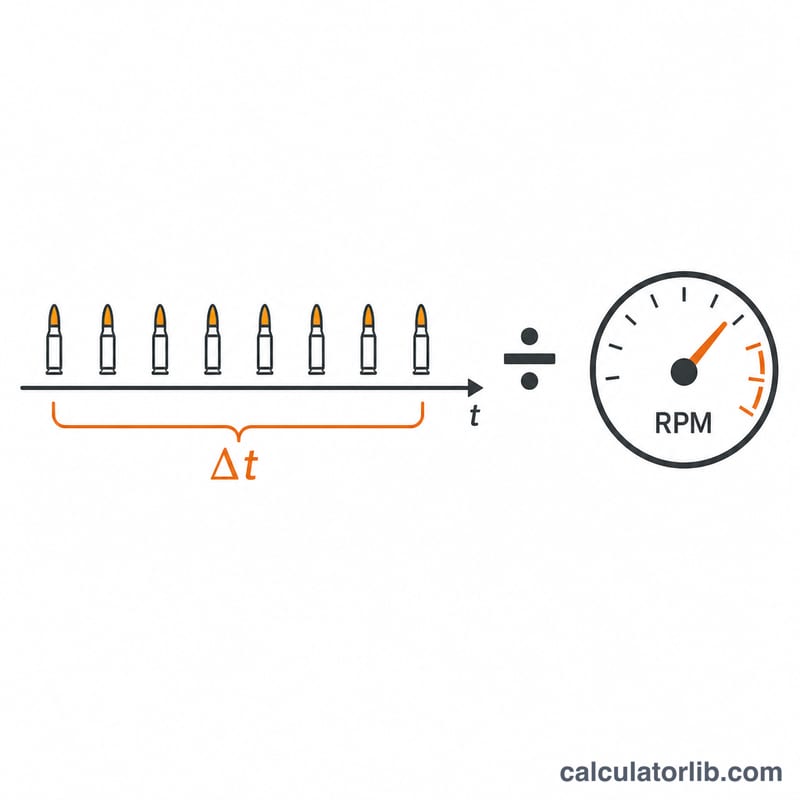
This calculator converts a measured burst — a number of rounds fired over an elapsed time — into a standardized rounds per minute (RPM) rate of fire. RPM is the universal way to compare the cyclic or sustained cadence of firearms, airsoft and paintball markers, nail guns, and any cyclic mechanical system, regardless of how long the test interval actually lasted.
How to Use It
Enter the total number of rounds (or cycles) fired, then enter the time it took in seconds. The tool divides rounds by seconds to get rounds per second, then multiplies by 60 to express the cadence over a full minute. It also reports the rounds-per-second figure for short bursts.
The Formula Explained
The math is a simple rate conversion:
$$\text{RPM} = \frac{\text{Rounds Fired}}{\text{Time (s)}} \times 60$$
Because there are 60 seconds in a minute, multiplying the per-second rate by 60 projects the observed cadence onto a one-minute window. You do not have to fire for a full minute — a 5-second burst is enough to estimate the rate.
Worked Example
Suppose a system fires 30 rounds in 5 seconds. Rounds per second = \(30 \div 5 = 6\). Rounds per minute = \(6 \times 60 = 360\) 360 RPM. So that burst corresponds to a 360 rounds-per-minute cadence.
FAQ
Does the interval need to be a full minute? No. Any time interval works because the formula scales the rate to one minute mathematically.
What is the difference between cyclic and sustained rate? Cyclic rate is the theoretical maximum measured over a very short burst, while sustained rate accounts for reloading and cooling. This calculator returns whatever rate your measured interval implies.
Can I use this for non-firearms? Yes — it works for any repeating event count over time, such as machine cycles or shots from a tool.