
What Is the Drops Per Minute Calculator?
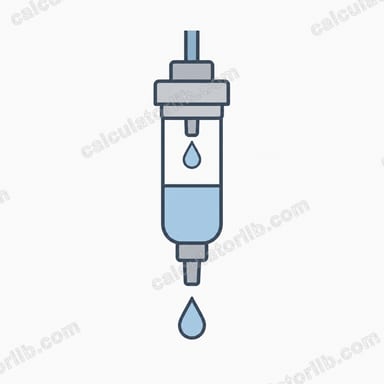
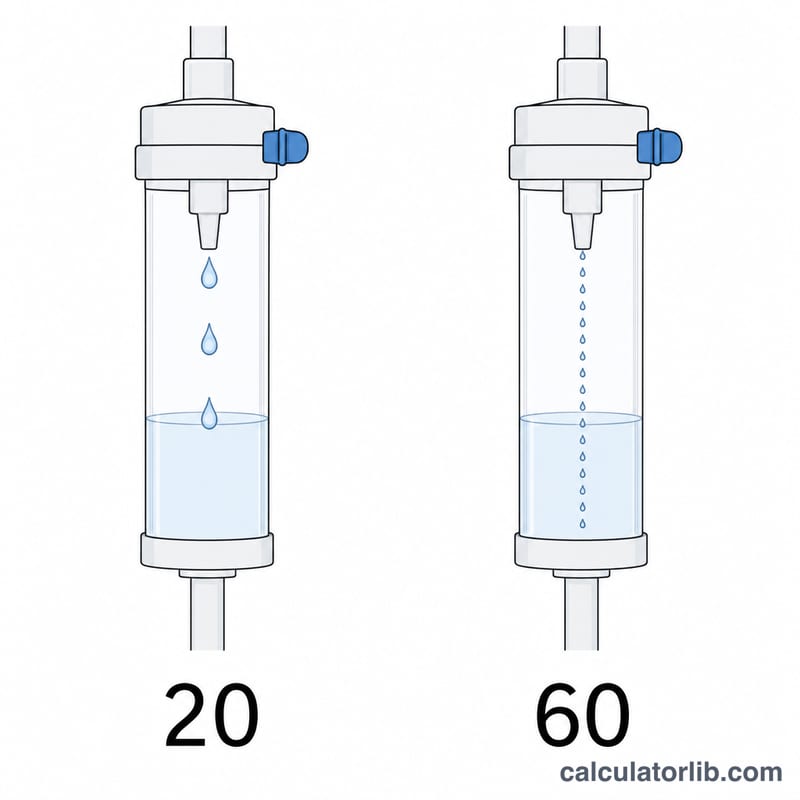
This calculator finds the IV drip rate in drops per minute (gtt/min) when fluids are delivered by gravity infusion. Nurses and clinicians use it to set the manual roller clamp so a prescribed volume infuses over the correct time. It works for both macrodrip tubing (10, 15, or 20 gtt/mL) and microdrip tubing (60 gtt/mL).
How to Use It
Enter the total volume to be infused in millilitres, the infusion time in minutes, and select the drop factor printed on your IV tubing package. The calculator returns the rounded drip rate you would count, plus the exact unrounded value.
The Formula Explained
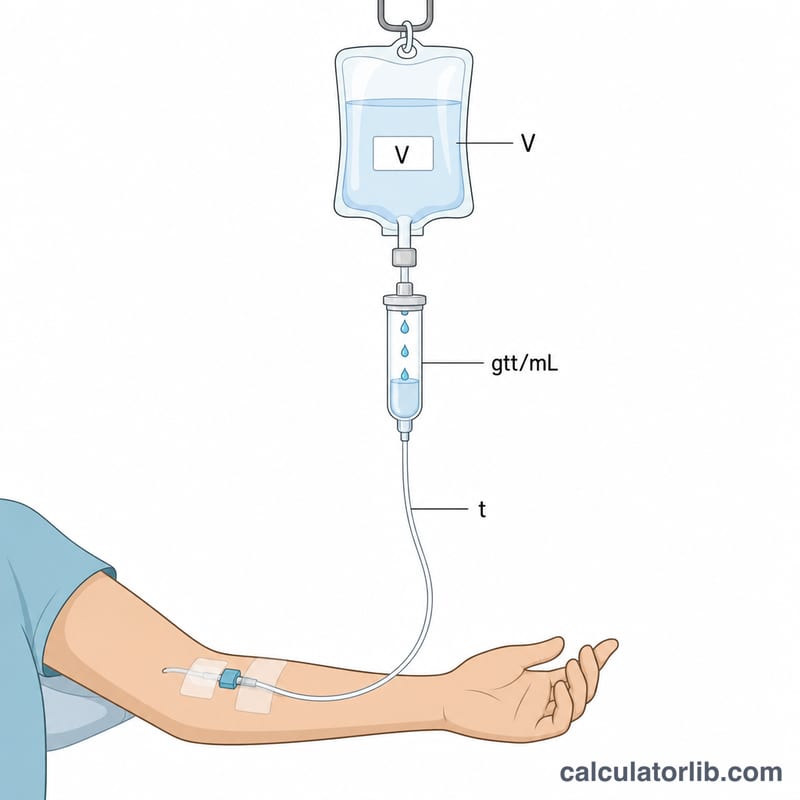
The drip rate equals volume multiplied by the drop factor, divided by time in minutes:
$$\text{Drops/min} = \frac{\text{Volume (mL)} \times \text{Drop Factor (gtt/mL)}}{\text{Time (min)}}$$
The drop factor describes how many drops make up one millilitre for that tubing set. Multiplying volume by drop factor converts millilitres into total drops; dividing by time spreads those drops evenly across the infusion period.
Worked Example
You need to infuse 1000 mL over 480 minutes (8 hours) using tubing with a drop factor of 20 gtt/mL. The drip rate is \((1000 \times 20) \div 480 = 20000 \div 480 = 41.67\), which rounds to 42 drops per minute.
FAQ
What is a drop factor? It is the number of drops per millilitre for a specific IV tubing set, printed on the packaging. Macrodrip sets are 10–20 gtt/mL; microdrip sets are 60 gtt/mL.
Why round the result? You cannot count fractions of a drop, so the rate is rounded to the nearest whole drop for practical bedside counting.
Can I enter time in hours? No — convert hours to minutes first (multiply by 60). For example, 8 hours = 480 minutes.