
What this calculator does
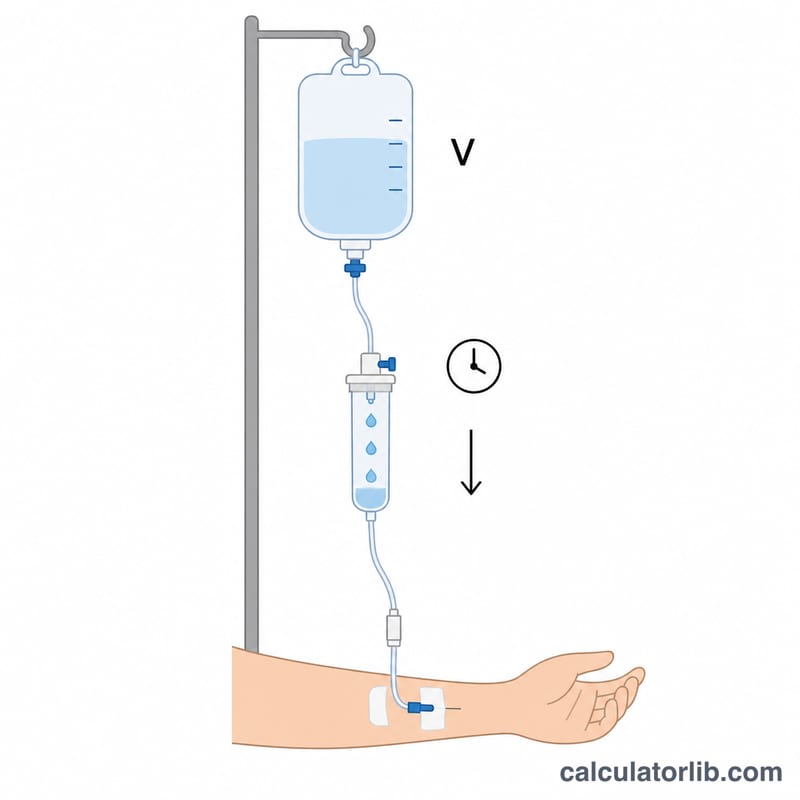
The IV Drip Rate Calculator works out how fast an intravenous infusion should run, expressed in drops per minute (gtt/min) and the matching seconds per drop. It is a standard nursing and clinical calculation used identically worldwide; only the drop-set factors (20 and 60 drops per mL) are equipment conventions. Enter the fluid volume, choose whether you know the total infusion time or the hourly volume, and select your IV set.
How to use it
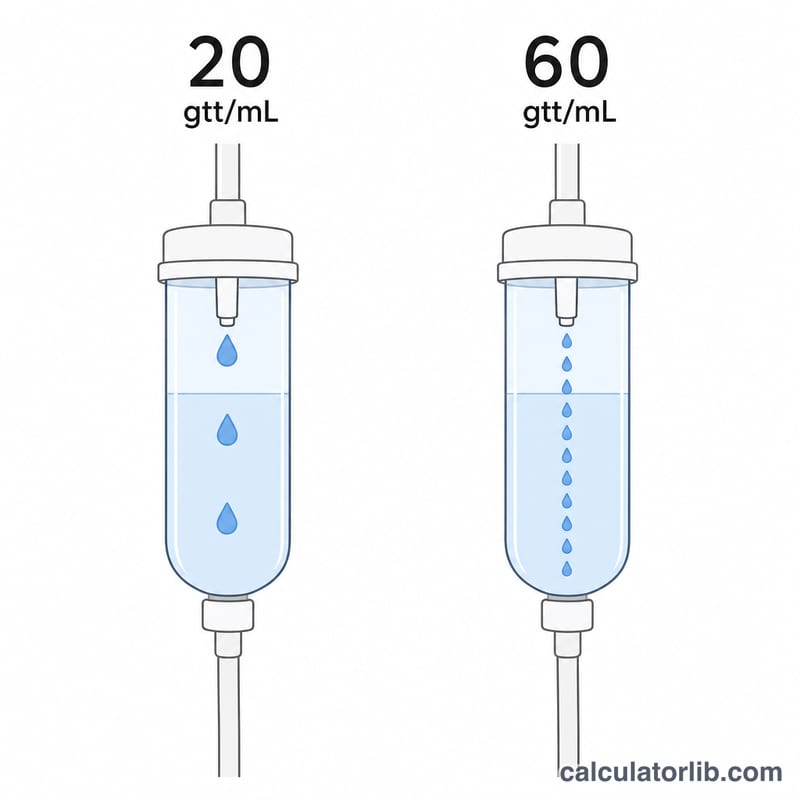
1) Enter the fluid volume in mL. 2) Pick a time condition: either specify the total infusion time (hours) for that volume, or specify the volume to deliver per hour (mL/hour). 3) Choose the drop factor of your administration set: 20 drops/mL is the adult macro-drip set, 60 drops/mL is the micro / pediatric set. The calculator returns the exact drip rate plus a practical rounded value you can set on the roller clamp.
The formula explained
First the infusion duration is converted to minutes. With total time: \(t_{min} = \text{hours} \times 60\). With an hourly rate: \(t_{min} = (\text{volume} / \text{rate}) \times 60\). Then the drip rate is the total number of drops divided by the minutes:
$$\text{drops/min} = \frac{\text{volume}_{mL} \times \text{drop\_factor}}{\text{total\_minutes}}$$
When you specify an hourly rate the volume cancels, so it simplifies to $$\text{drops/min} = \frac{\text{hourly\_rate} \times \text{drop\_factor}}{60}$$ The interval between drops is $$\text{seconds/drop} = \frac{60}{\text{drops\_per\_minute}}$$
Worked example
Infuse 500 mL over 4 hours with a 20 drops/mL set. Total minutes = \(4 \times 60 = 240\). Total drops = \(500 \times 20 = 10{,}000\). Drip rate = \(10{,}000 / 240 = 41.7\) drops/min (set to about 42). Seconds per drop = \(60 / 41.7 = 1.44\) s. So you should see roughly one drop every 1.4 seconds.
FAQ
What is a drop factor? It is how many drops the IV set produces per millilitre of fluid; it is printed on the tubing package. Macro sets are typically 20 gtt/mL and micro sets 60 gtt/mL, though some manufacturers use 10 or 15.
Why round the drops per minute? You cannot set a fraction of a drop on a manual roller clamp, so the exact figure is rounded to the nearest whole drop for practical counting.
Is this safe to rely on? It is a clinical aid only. Always verify against the prescription, the pump or set specification, and your local protocol. No responsibility is accepted for results from this tool.