
What is the Evaporation Rate Calculator?
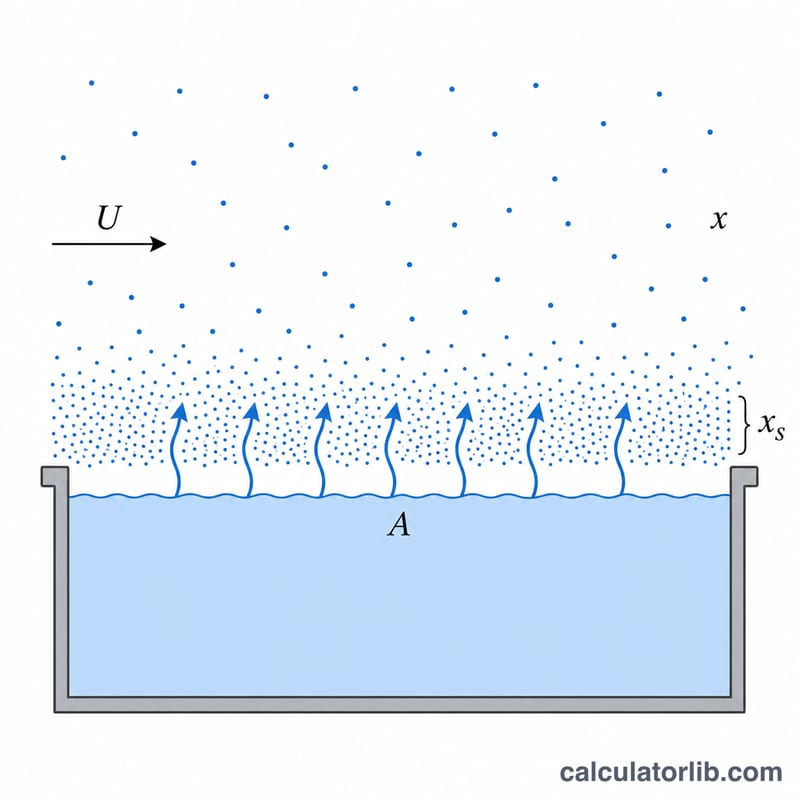
This tool estimates how fast water evaporates from an open surface — such as a swimming pool, pond, tank, or wet floor — using the classic mass-transfer relationship $$g_h = \Theta \cdot A \cdot \left( x_s - x \right)$$ The result tells you how many kilograms of water leave the surface each hour, which is essential for sizing pool dehumidifiers, ventilation systems, and HVAC loads.
How to use it
Enter four values: the evaporation coefficient \(\Theta\) (kg/m²·h), the wetted surface area \(A\) (m²), the saturated humidity ratio \(x_s\) of air directly at the water surface, and the humidity ratio \(x\) of the surrounding room air (both in kg water per kg dry air). The calculator multiplies them to give the hourly evaporation rate and also reports the daily total.
The formula explained
The evaporation coefficient \(\Theta\) captures air velocity over the surface; for a still indoor pool it is often around 25 kg/m²·h, rising with air movement. The driving force \((x_s - x)\) is the difference in humidity ratio — evaporation only occurs while the air can still absorb moisture. When the room air is saturated (\(x = x_s\)) the difference is zero and evaporation stops.
Worked example
For a 1 m² wet surface with \(\Theta = 25\), \(x_s = 0.025\) kg/kg and \(x = 0.010\) kg/kg: the difference is 0.015 kg/kg, so $$g_h = 25 \times 1 \times 0.015 = 0.375 \text{ kg/h}$$ or about 9 kg per day.
FAQ
What value should I use for \(\Theta\)? Use roughly 25 kg/m²·h for still air, and higher (40–60+) for surfaces with significant airflow or activity such as occupied pools.
How do I find the humidity ratios? Read them from a psychrometric chart: \(x_s\) from the water-surface temperature (assumed saturated) and \(x\) from the room's temperature and relative humidity.
Can evaporation be negative? If \(x\) exceeds \(x_s\) the formula gives a negative value, meaning condensation onto the surface rather than evaporation.